Paul Dale Bush - Böcker
Visar alla böcker från författaren Paul Dale Bush. Handla med fri frakt och snabb leverans.
2 produkter
2 produkter
1 640 kr
Skickas inom 10-15 vardagar
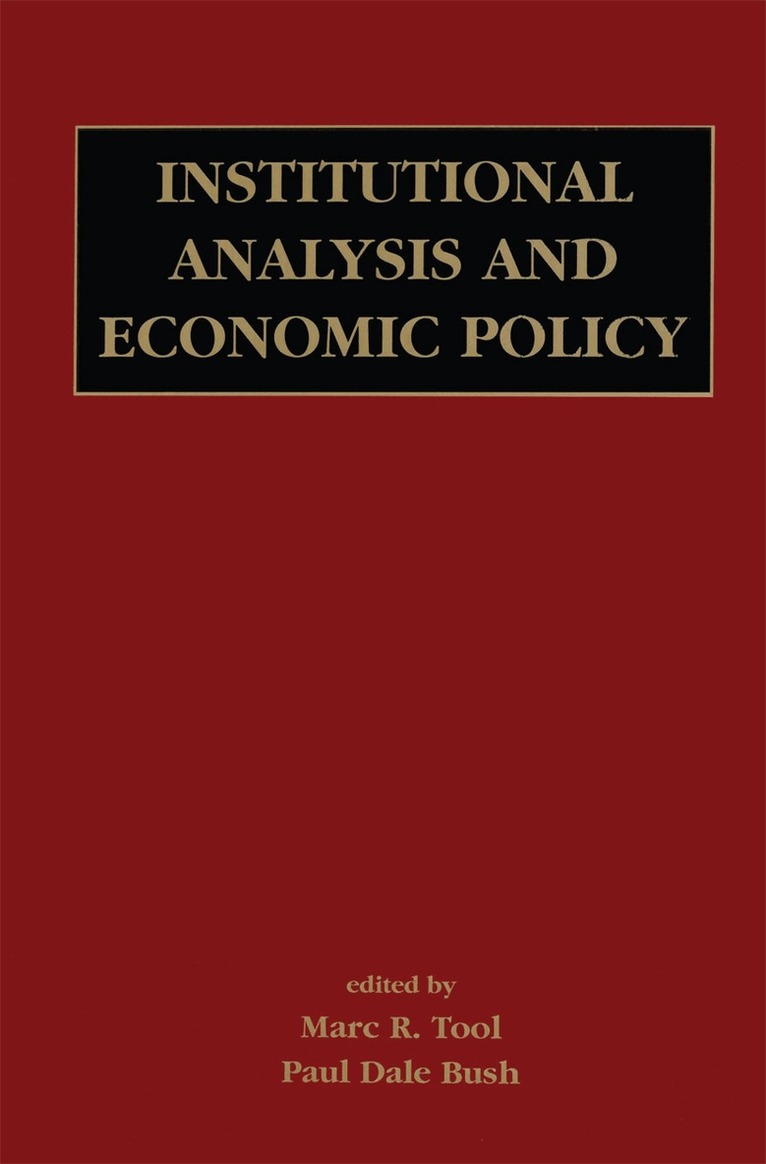
This is a book on economic policy that takes the role of democracy seriously. It challenges the conventional wisdom espoused by leaders of both major political parties in the US, and increasingly by leaders of other nations, that markets and not democratic policy formation should determine the legitimate role of private interests in the conduct of the economy. The authors of the essays in this book reject the mainstream neoclassical view that the market should rule "uber alles." Examining the problems existing in a number of crucial areas of economic policy, they demonstrate the inadequacy of orthodox view that markets can generate economic welfare without the guidance of democratically formulated economic policies. Using the principles of the original institutional economics (OIE), they fashion long-term strategies for the formation of economic policies that can accommodate institutional changes necessary to meet the ever-changing circumstances faced by nations in a global economy. The editors have assembled a group of scholars with special expertise in the problems they address.In each instance they offer original insights into issues that many in the mainstream had thought were settled. The analysis and policy proposals of the essays in this book do not defer to the dominant vested interests in industry, academe, or government. The views expressed are fresh, candid, and break out of the ideological boxes that have for so long encapsulated public debates on economic policies.
1 593 kr
Skickas inom 10-15 vardagar
The purpose of this volume is to demonstrate how contemporary institutional economic analysis can be applied to the resolution of economic problems. All of the essays in this book challenge the conventional wisdom in the problem areas addressed. They advocate policy positions that often run contrary to views widely held by academic economists and policy makers alike. The general literature of institutional economics is unorthodox, beginning with its methodological foundations and continuing through the kind of policy analysis found in these pages. The orthodox tradition in economics is commonly characterized as "neoclassical economics." Neoclassical economics fosters the myth that only "the market" can efficiently allocate a society's economic resources and equitably distribute its income. It provides the intellectual defense for in which "free markets" are championed over democratic capitalist ideology policy formation, which it contends is neither efficient nor equitable. For both professional economists and policy makers of a conservative political persuasion, neoclassical economics writes the script for a morality play in which the market is the "good guy" and the government is the "bad guy." As such, it undermines the belief that free societies can enhance economic welfare through the use of democratic processes in the formulation of economic policies.