Paul Edward Gottfried - Böcker
Visar alla böcker från författaren Paul Edward Gottfried. Handla med fri frakt och snabb leverans.
13 produkter
13 produkter
1 343 kr
Skickas inom 10-15 vardagar
Gottfried looks at Carl Schmitt as a critic of modern liberalism and as a defender of the national state who examined carefully Western historical and political traditions. Challenging the view that Schmitt was a mere polemicist who set out to subvert German democracy, Gottfried's work argues instead, that Schmitt criticized liberalism and democracy from a highly reflective position that combined analytical depth with staggering erudition. The book shows that almost all of Schmitt's critics try to deflect the thrust of his observations by stressing his unpleasant political associations and allegedly hidden motives. This new source also provides a useful bibliography on secondary literature dealing with Carl Schmitt's work.Gottfried's book is the most comprehensive study to date that addresses the major criticisms raised against Schmitt's understanding of politics. The book also underscores a point made by George Schwab and other recent biographers: that Schmitt made some of his strongest criticisms of liberal democracy while still a defender of the Weimar Republic. An excellent bibliographic resource, this book should appeal to anyone interested in German politics and to specialists in political theory and international relations.
635 kr
Skickas inom 3-6 vardagar
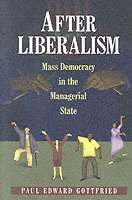
In this trenchant challenge to social engineering, Paul Gottfried analyzes a patricide: the slaying of nineteenth-century liberalism by the managerial state. Many people, of course, realize that liberalism no longer connotes distributed powers and bourgeois moral standards, the need to protect civil society from an encroaching state, or the virtues of vigorous self-government. Many also know that today's "liberals" have far different goals from those of their predecessors, aiming as they do largely to combat prejudice, to provide social services and welfare benefits, and to defend expressive and "lifestyle" freedoms. Paul Gottfried does more than analyze these historical facts, however. He builds on them to show why it matters that the managerial state has replaced traditional liberalism: the new regimes of social engineers, he maintains, are elitists, and their rule is consensual only in the sense that it is unopposed by any widespread organized opposition. Throughout the western world, increasingly uprooted populations unthinkingly accept centralized controls in exchange for a variety of entitlements.In their frightening passivity, Gottfried locates the quandary for traditionalist and populist adversaries of the welfare state. How can opponents of administrative elites show the public that those who provide, however ineptly, for their material needs are the enemies of democratic self-rule and of independent decision making in family life? If we do not wake up, Gottfried warns, the political debate may soon be over, despite sporadic and ideologically confused populist rumblings in both Europe and the United States.
508 kr
Tillfälligt slut
This volume in Religion and Public Life, a series on religion and public affairs, provides a wide-ranging forum for differing views on religious and ethical considerations. The contributions address the decline of social capital-those patterns of behavior which are conducive to self-governance and the spirit of self-reliance-and its relation to the demise of the civic-humanist tradition in American education. The unifying theme, is that classical studies do not merely result in individual mastery over a particular technique or body of knowledge, but also link the individual to the polity and even to the whole of the cosmic order. At the same time, American republicanism, in its exaltation of the common man from the Jeffersonian agrarian soldier to the apotheosis of Lincoln tempers the classical ideal into something less exalted, if more democratic. The effects on the contemporary state of the liberal arts curriculum are demonstrated in articles critical of the market-model university. Two essays explore the historical and philosophical significance of the discipline of rhetoric, that has suffered under the hegemony of rationalistic philosophy. A concluding contribution, invokes Giambattista Vico as an eloquent defender of the humanities. Humanities and Civic Life includes: "Rome, Florence, and Philadelphia: Using the History of the Humanities to Renew Our Civic Life" by Robert E. Proctor; "The Dark Fields of the Republic: The Persistence of Republican Thought in American History" by David Brown; "Unleashing the Humanities" by Robert Weisbuch; "Liberal Arts: Listening to Faculty" by Dennis O'Brien; "Historical Consciousness in Antiquity" by Paul Gottfried; "Taking the Measure of Relativism and the Civic Virtue of Rhetoric" by Gabriel R. Ricci; "The River: A Vichian Dialogue on Humanistic Education" by Randall E. Auxier.
219 kr
Skickas inom 7-10 vardagar
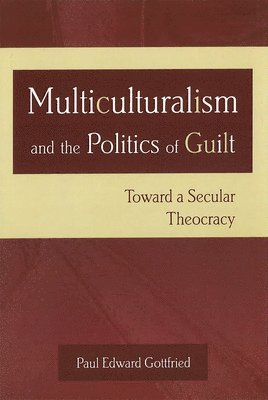
Multiculturalism and the Politics of Guilt extends Paul Gottfried's examination of Western managerial government's growth in the last third of the twentieth century. Linking multiculturalism to a distinctive political and religious context, the book argues that welfare-state democracy, unlike bourgeois liberalism, has rejected the once conventional distinction between government and civil society.
203 kr
Skickas inom 7-10 vardagar
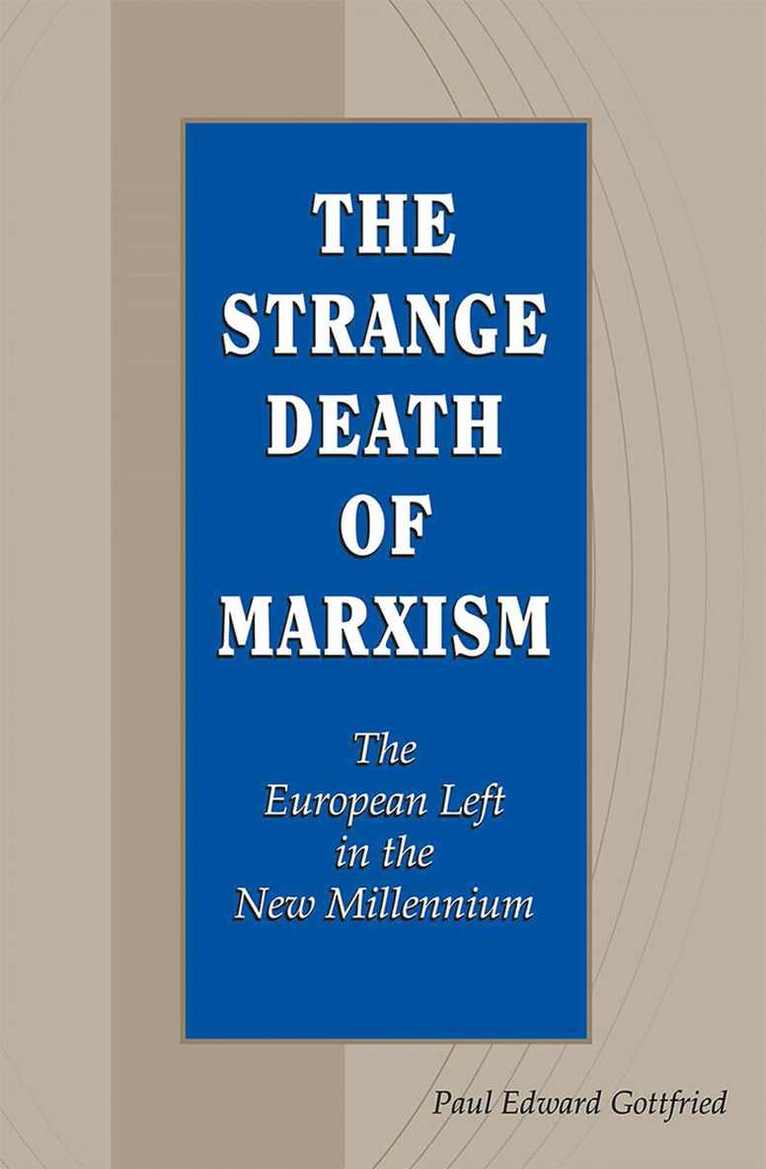
The Strange Death of Marxism seeks to refute certain misconceptions about the current European Left and its relation to Marxist and Marxist-Leninist parties that existed in the recent past. Among the misconceptions that the book treats critically and in detail is that the Post-Marxist Left (a term the book uses to describe this phenomenon) springs from a distinctly Marxist tradition of thought and that it represents an unqualified rejection of American capitalist values and practices.Three distinctive features of the book are the attempts to dissociate the present European Left from Marxism, the presentation of this Left as something that developed independently of the fall of the Soviet empire, and the emphasis on the specifically American roots of the European Left. Gottfried examines the multicultural orientation of this Left and concludes that it has little or nothing to do with Marxism as an economic-historical theory. It does, however, owe a great deal to American social engineering and pluralist ideology and to the spread of American thought and political culture to Europe.American culture and American political reform have foreshadowed related developments in Europe by years or even whole decades. Contrary to the impression that the United States has taken antibourgeois attitudes from Europeans, the author argues exactly the opposite. Since the end of World War II, Europe has lived in the shadow of an American empire that has affected the Old World, including its self-described anti-Americans. Gottfried believes that this influence goes back to who reads or watches whom more than to economic and military disparities. It is the awareness of American cultural as well as material dominance that fuels the anti-Americanism that is particularly strong on the European Left. That part of the European spectrum has, however, reproduced in a more extreme form what began as an American leap into multiculturalism. Hostility toward America, however, can be transformed quickly into extreme affection for the United States, which occurred during the Clinton administration and during the international efforts to bring a multicultural society to the Balkans.Clearly written and well conceived, The Strange Death of Marxism will be of special interest to political scientists, historians of contemporary Europe, and those critical of multicultural trends, particularly among Euro-American conservatives.
409 kr
Tillfälligt slut
607 kr
Tillfälligt slut
2 103 kr
Skickas inom 10-15 vardagar
This volume in Religion and Public Life, a series on religion and public affairs, provides a wide-ranging forum for differing views on religious and ethical considerations. The contributions address the decline of social capital-those patterns of behavior which are conducive to self-governance and the spirit of self-reliance-and its relation to the demise of the civic-humanist tradition in American education. The unifying theme, is that classical studies do not merely result in individual mastery over a particular technique or body of knowledge, but also link the individual to the polity and even to the whole of the cosmic order. At the same time, American republicanism, in its exaltation of the common man from the Jeffersonian agrarian soldier to the apotheosis of Lincoln tempers the classical ideal into something less exalted, if more democratic. The effects on the contemporary state of the liberal arts curriculum are demonstrated in articles critical of the market-model university. Two essays explore the historical and philosophical significance of the discipline of rhetoric, that has suffered under the hegemony of rationalistic philosophy. A concluding contribution, invokes Giambattista Vico as an eloquent defender of the humanities. Humanities and Civic Life includes: "Rome, Florence, and Philadelphia: Using the History of the Humanities to Renew Our Civic Life" by Robert E. Proctor; "The Dark Fields of the Republic: The Persistence of Republican Thought in American History" by David Brown; "Unleashing the Humanities" by Robert Weisbuch; "Liberal Arts: Listening to Faculty" by Dennis O'Brien; "Historical Consciousness in Antiquity" by Paul Gottfried; "Taking the Measure of Relativism and the Civic Virtue of Rhetoric" by Gabriel R. Ricci; "The River: A Vichian Dialogue on Humanistic Education" by Randall E. Auxier.
2 103 kr
Skickas inom 10-15 vardagar
The essays grouped together in this volume look from differing angles at the crisis of condence faced by the contemporary state. What we see is the decline of the authority once associated with the Western nation-state as a source of public order and as a defender of cultural identity. Multiplying and contradictory rights claims, the breakdown of a shared political frame of reference, and attempts by public administration to micromanage society have all contributed to the threat to authority. What remains to be asked is whether the Western paradigm of the state can be restored to the basis of public faith.
2 103 kr
Skickas inom 10-15 vardagar
This is the twenty-ninth volume in This World, a series on religion and public affairs. It focuses on theological and moral questions of deep significance for our time. The lines of division separating secular and religious outlooks, modernity and postmodernism, and romantic and classical styles of thought are some of the topics treated in this volume. Additional features are an exchange of opinions and a position paper intended to generate further discussion. This ongoing series of volumes seeks to provide a wide-ranging forum for differing views on religious and ethical considerations.Theologies and Moral Concern include the following major contributions: "Distinctions of Power: How Church and State Divide America" by Brian Mitchell; "Beyond the Impasses: Making Moral Sense of Abortion" by Anthony Matteo; "Are Religions Ever Traditional" by Jacob Neusner; "Philosophical Issues in Darwinian Theory" by Kenneth T. Gallagher; "Monotheism and Skepticism" by Aryeh Botwinick; "Defining Romantic Theology" by Gerhard Spiegler; and "The YMCA and Suburban America" by Clifford Putney. In addition, the volume features a dialogue between Michael A. Weinstein and Paul Gottfried on what constitutes the proper role for liberal arts education in contemporary American society as well as a position paper titled "The Pitfalls of Political Correctness" by Lawrence Nannery.Theologies and Moral Concern is part of an annual survey of religion and public life which aims to provide relevant information and ideas about significant issues of the day. It is directly pertinent to understanding the connection between religion and the state. This particular volume, coming at a time of intense public scrutiny of fundamentalism, evangelicism, and new religious movements generally, should have special appeal for political scientists, American studies specialists, sociologists, and those involved in the creation of public policy.
683 kr
Skickas inom 10-15 vardagar
This is the twenty-ninth volume in This World, a series on religion and public affairs. It focuses on theological and moral questions of deep significance for our time. The lines of division separating secular and religious outlooks, modernity and postmodernism, and romantic and classical styles of thought are some of the topics treated in this volume. Additional features are an exchange of opinions and a position paper intended to generate further discussion. This ongoing series of volumes seeks to provide a wide-ranging forum for differing views on religious and ethical considerations.Theologies and Moral Concern include the following major contributions: "Distinctions of Power: How Church and State Divide America" by Brian Mitchell; "Beyond the Impasses: Making Moral Sense of Abortion" by Anthony Matteo; "Are Religions Ever Traditional" by Jacob Neusner; "Philosophical Issues in Darwinian Theory" by Kenneth T. Gallagher; "Monotheism and Skepticism" by Aryeh Botwinick; "Defining Romantic Theology" by Gerhard Spiegler; and "The YMCA and Suburban America" by Clifford Putney. In addition, the volume features a dialogue between Michael A. Weinstein and Paul Gottfried on what constitutes the proper role for liberal arts education in contemporary American society as well as a position paper titled "The Pitfalls of Political Correctness" by Lawrence Nannery.Theologies and Moral Concern is part of an annual survey of religion and public life which aims to provide relevant information and ideas about significant issues of the day. It is directly pertinent to understanding the connection between religion and the state. This particular volume, coming at a time of intense public scrutiny of fundamentalism, evangelicism, and new religious movements generally, should have special appeal for political scientists, American studies specialists, sociologists, and those involved in the creation of public policy.
439 kr
Tillfälligt slut
The essays grouped together in this volume look from differing angles at the crisis of condence faced by the contemporary state. What we see is the decline of the authority once associated with the Western nation-state as a source of public order and as a defender of cultural identity. Multiplying and contradictory rights claims, the breakdown of a shared political frame of reference, and attempts by public administration to micromanage society have all contributed to the threat to authority. What remains to be asked is whether the Western paradigm of the state can be restored to the basis of public faith.
84 kr
Skickas inom 3-6 vardagar