Paul Horwich - Böcker
Visar alla böcker från författaren Paul Horwich. Handla med fri frakt och snabb leverans.
17 produkter
17 produkter
1 409 kr
Skickas inom 5-8 vardagar
What is meaning? Paul Horwich presents an original philosophical theory, demonstrates its richness, and defends it against all comers. At the core of his theory is the idea, made famous by Wittgenstein, that the meaning of a word derives from its use; Horwich articulates this idea in a new way that will restore it to the prominence that it deserves. He surveys the diversity of valuable insights into meaning that have been gained in the twentieth century, and seeks to accommodate them within his theory. His aim is not to correct a common-sense view of meaning, but to vindicate it: he seeks to take the mystery out of meaning. Horwich's 1990 book Truth stablished itself both as the definitive exposition and defence of a notable philosophical theory, `minimalism', and as a stimulating, straightforward introduction to philosophical debate about truth. Meaning now gives the broader context in which the theory of truth operates, and is published simultaneously with a revised edition of Truth, in which Horwich refines and develops his treatment of the subject in the light of subsequent discussions, while preserving the distinctive format which made the book so successful. The two books together present a compelling view of the relations between language, thought, and reality. They will be essential reading for all philosophers of language.
537 kr
Skickas inom 5-8 vardagar
What is meaning? Paul Horwich presents an original philosophical theory, demonstrates its richness, and defends it against all comers. At the core of his theory is the idea, made famous by Wittgenstein, that the meaning of a word derives from its use; Horwich articulates this idea in a new way that will restore it to the prominence that it deserves. He surveys the diversity of valuable insights into meaning that have been gained in the twentieth century, and seeks to accommodate them within his theory. His aim is not to correct a common-sense view of meaning, but to vindicate it: he seeks to take the mystery out of meaning. Horwich's 1990 book Truth established itself both as the definitive exposition and defence of a notable philosophical theory, `minimalism', and as a stimulating, straightforward introduction to philosophical debate about truth. Meaning now gives the broader context in which the theory of truth operates, and is published simultaneously with a revised edition of Truth, in which Horwich refines and develops his treatment of the subject in the light of subsequent discussions, while preserving the distinctive format which made the book so successful. The two books together present a compelling view of the relations between language, thought, and reality. They will be essential reading for all philosophers of language.
450 kr
Skickas inom 5-8 vardagar
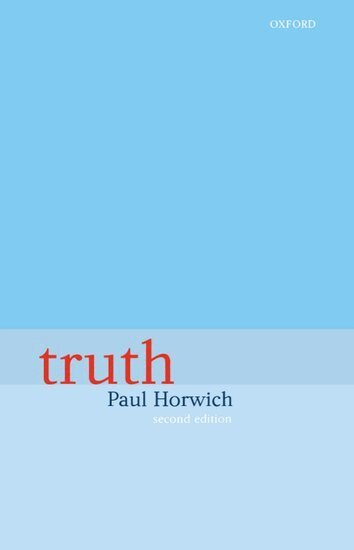
What is truth? Paul Horwich gives the definitive exposition of a notable philosophical theory, `minimalism'. This is the controversial theory that the nature of truth is entirely captured in the trivial fact that each proposition specifies its own condition for being true, and that truth is therefore, despite the philosophical struggles to which it has given rise, an entirely mundane and unpuzzling concept. Horwich makes a powerful case for the minimalist view, and gives a careful systematic explanation of its implications for a cluster of important philosophical issues on which questions about truth have impinged. The first edition of Truth, published in 1990, established itself both as the best account of minimalism and as an excellent introduction to the debate for students. For this new edition Paul Horwich has refined and developed his treatment of the subject in the light of subsequent discussions, while preserving the distinctive format which made the book so successful. It appears simultaneously with his new book Meaning, a companion work which sets out the broader philosophical context for the theory of truth: an account of meaning which seeks to accommodate the diversity of valuable insights that have been gained in the twentieth century within a common-sense view of meaning as deriving from use. The two books together present a compelling view of the relations between language, thought, and reality. Horwich's demystification of meaning and truth will be essential reading for all philosophers of language. Praise for the first edition: 'subtle, penetrating and ingenious . . . everyone interested in philosophy is in his debt' Michael Dummett, University of Oxford 'lucid and compact . . . a forthright presentation of an interesting thesis' Donald Davidson, University of California, Berkeley 'This is an excellent book and deserves to be widely read and used as a text. It states its thesis clearly and argues for it briskly: a style that seems well calculated to start discussions . . . It seems like an admirable starting-point for several weeks' worth of discussions in a philosophy of language course at upper-division undergraduate level.' Australasian Journal of Philosophy 'clearly written and well-structured' British Journal for the Philosophy of Science'clear, informed and provocative ... I thoroughly recommend the book to everyone in the philosophy of language, philosophy of science, and metaphysics' Michael Devitt, Mind and Language
668 kr
Skickas inom 5-8 vardagar
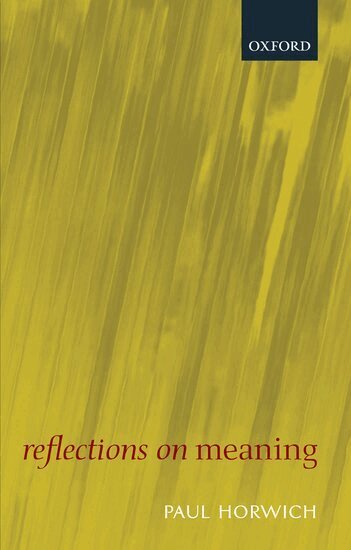
Paul Horwich, one of the world's most distinguished philosophers, develops in this book his highly original deflationary conception of language. His main aim in Reflections on Meaning is to explain how mere noises, marks, gestures, and mental symbols are able to capture the world - that is, how words and sentences (in whatever medium) come to mean what they do, to stand for certain things, to be true or false of reality. His answer is an innovative development of Wittgenstein's idea that the meaning of a term is nothing more than its use.
712 kr
Skickas inom 5-8 vardagar
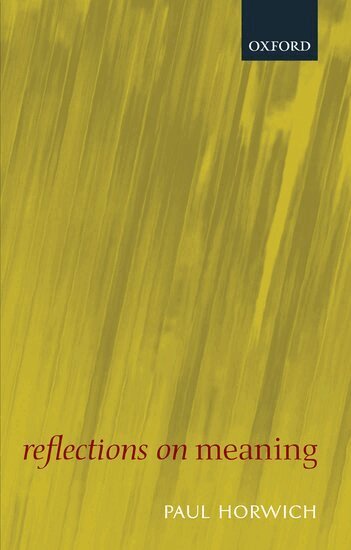
Paul Horwich, one of the world's most distinguished philosophers, develops in this book his highly original deflationary conception of language. His main aim in Reflections on Meaning is to explain how mere noises, marks, gestures, and mental symbols are able to capture the world - that is, how words and sentences (in whatever medium) come to mean what they do, to stand for certain things, to be true or false of reality. His answer is an innovative development of Wittgenstein's idea that the meaning of a term is nothing more than its use.
668 kr
Skickas inom 5-8 vardagar
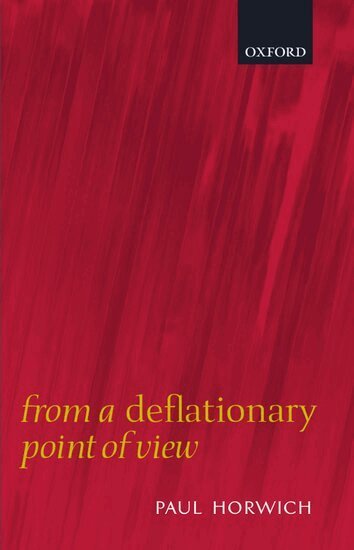
'Deflationism' has emerged as one of the most significant developments in contemporary philosophy. It is best known as a story about truth - roughly, that the traditional search for its underlying nature is misconceived, since there can be no such thing. However, the scope of deflationism extends well beyond that particular topic. For, in the first place, such a view of truth substantially affects what we should say about neighboring concepts such as 'reality', 'meaning', and 'rationality'. And in the second place, the anti-theoretical meta-philosophy that lies behind that view - the idea that philosophical problems are characteristically based on confusion and should therefore be dissolved rather than solved - may fruitfully be applied throughout the subject, in epistemology, ethics, the philosophy of science, metaphysics, and so on. The essays reprinted here were written over the last twenty five years. They represent Paul Horwich's development of the deflationary perspective and demonstrate its considerable power and fertility. They concern a broad array of philosophical problems: the nature of truth, realism vs. anti-realism, the creation of meaning, epistemic rationality, the conceptual role of "ought", probabilistic models of scientific reasoning, the autonomy of art, the passage of time, and the trajectory of Wittgenstein's philosophy. They appear as originally published except for the correction of obvious mistakes, the interpolation of clarifying material, and the inclusion of new footnotes to indicate Horwich's subsequent directions of thought.
803 kr
Skickas inom 3-6 vardagar
"Deflationism" has emerged as one of the most significant developments in contemporary philosophy. It is best known as a story about truth -- roughly, that the traditional search for its underlying nature is misconceived, since there can be no such thing. However, the scope of deflationism extends well beyond that particular topic. For, in the first place, such a view of truth substantially affects what we should say about neighboring concepts such as "reality," "meaning," and "rationality." And in the second place, the anti-theoretical meta-philosophy that lies behind that view -- the idea that philosophical problems are characteristically based on confusion and should therefore be dissolved rather than solved -- may fruitfully be applied throughout the subject, in epistemology, ethics, the philosophy of science, metaphysics, and so on. The essays reprinted here were written over the last twenty five years. They represent Paul Horwich's development of the deflationary perspective and demonstrate its considerable power and fertility. They concern a broad array of philosophical problems: the nature of truth, realism vs. anti-realism, the creation of meaning, epistemic rationality, the conceptual role of "ought," probabilistic models of scientific reasoning, the autonomy of art, the passage of time, and the trajectory of Wittgenstein's philosophy. They appear as originally published except for the correction of obvious mistakes, the interpolation of clarifying material, and the inclusion of new footnotes to indicate Horwich's subsequent directions of thought.
1 178 kr
Skickas inom 3-6 vardagar
Truth -- Meaning -- Reality presents a fresh approach to philosophy: a broad and unified deflationism that encompasses language, thought, knowledge, reality, and the relations between them. Horwich's story begins with a minimalist view of truth according to which this extraordinary concept is far less profound and substantial than has usually been assumed, since it stems entirely from our regarding "It is true that dogs bark" as equivalent to "Dogs bark", and similarly in the case of all other statements. There's nothing more to truth than that! This view turns out to be of fundamental importance throughout the subject. In the first instance it paves the way to an account of meaning as use, whereby the sense of each word-type is given by its basic patterns of deployment rather than by its association with a feature of the non-linguistic world. And the combination of deflated truth and 'meaning as use' then yields a perspective from which the long-standing debates between forms of 'realism' and 'anti-realism' must be reconceived. We are able to see that the positions typically adopted in these debates are all defective -- contrived products of the mistaken assumption that reality, together with our representation of it, must exhibit a rigid uniformity and that deviations from the norm would be intolerably 'weird'. The fourteen essays collected here constitute a coherent and complete expression of this three-pronged philosophy. Each of them is self-standing. But they have been revised and arranged so as to reveal the power and plausibility of Horwich's overall approach.
546 kr
Skickas inom 5-8 vardagar
Truth -- Meaning -- Reality presents a fresh approach to philosophy: a broad and unified deflationism that encompasses language, thought, knowledge, reality, and the relations between them. Horwich's story begins with a minimalist view of truth according to which this extraordinary concept is far less profound and substantial than has usually been assumed, since it stems entirely from our regarding "It is true that dogs bark" as equivalent to "Dogs bark", and similarly in the case of all other statements. There's nothing more to truth than that! This view turns out to be of fundamental importance throughout the subject. In the first instance it paves the way to an account of meaning as use, whereby the sense of each word-type is given by its basic patterns of deployment rather than by its association with a feature of the non-linguistic world. And the combination of deflated truth and 'meaning as use' then yields a perspective from which the long-standing debates between forms of 'realism' and 'anti-realism' must be reconceived. We are able to see that the positions typically adopted in these debates are all defective -- contrived products of the mistaken assumption that reality, together with our representation of it, must exhibit a rigid uniformity and that deviations from the norm would be intolerably 'weird'. The fourteen essays collected here constitute a coherent and complete expression of this three-pronged philosophy. Each of them is self-standing. But they have been revised and arranged so as to reveal the power and plausibility of Horwich's overall approach.
1 886 kr
Skickas inom 3-6 vardagar
Paul Horwich develops an interpretation of Ludwig Wittgenstein's later writings that differs in substantial respects from what can already be found in the literature. He argues that it is Wittgenstein's radically anti-theoretical metaphilosophy--and not (as assumed by most other commentators) his identification of the meaning of a word with its use--that lies at the foundation of his discussions of specific issues concerning language, the mind, mathematics, knowledge, art, and religion. Thus Horwich's first aim is to give a clear account of Wittgenstein's hyper-deflationist view of what philosophy is, how it should be conducted, and what it might achieve. His second aim is to defend this view against a variety of objections: that is, to display its virtues, not merely as an accurate reading of Wittgenstein, but as the correct conception of philosophy itself. And the third aim is to examine the application of this view to a variety of topics--but primarily to language and to experience. A further distinctive feature of this approach is its presupposition that Wittgenstein's ideas may be formulated with precision and that solid arguments may be found on their behalf. This pair of guiding assumptions--the centrality of Wittgenstein's metaphilosophy, and its susceptibility to rigorous articulation and rational support--are admittedly controversial but are vindicated, not just textually, but by the power and plausibility of the philosophy that results from them.
379 kr
Skickas inom 5-8 vardagar
Paul Horwich develops an interpretation of Ludwig Wittgenstein's later writings that differs in substantial respects from what can already be found in the literature. He argues that it is Wittgenstein's radically anti-theoretical metaphilosophy--and not (as assumed by most other commentators) his identification of the meaning of a word with its use--that lies at the foundation of his discussions of specific issues concerning language, the mind, mathematics, knowledge, art, and religion. Thus Horwich's first aim is to give a clear account of Wittgenstein's hyper-deflationist view of what philosophy is, how it should be conducted, and what it might achieve. His second aim is to defend this view against a variety of objections: that is, to display its virtues, not merely as an accurate reading of Wittgenstein, but as the correct conception of philosophy itself. And the third aim is to examine the application of this view to a variety of topics--but primarily to language and to experience. A further distinctive feature of this approach is its presupposition that Wittgenstein's ideas may be formulated with precision and that solid arguments may be found on their behalf. This pair of guiding assumptions--the centrality of Wittgenstein's metaphilosophy, and its susceptibility to rigorous articulation and rational support--are admittedly controversial but are vindicated, not just textually, but by the power and plausibility of the philosophy that results from them.
701 kr
Skickas inom 5-8 vardagar
360 kr
Skickas inom 7-10 vardagar
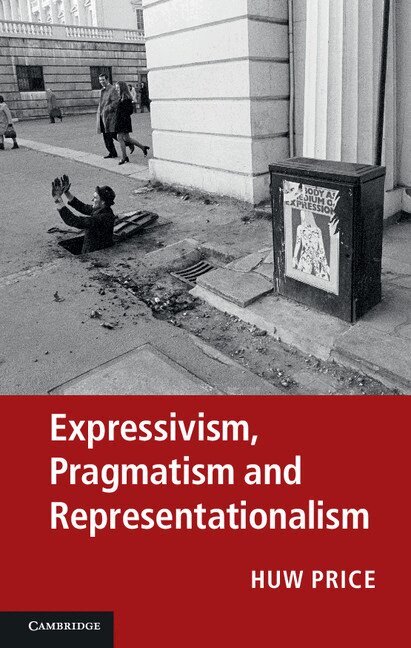
Pragmatists have traditionally been enemies of representationalism but friends of naturalism, when naturalism is understood to pertain to human subjects, in the sense of Hume and Nietzsche. In this volume Huw Price presents his distinctive version of this traditional combination, as delivered in his René Descartes Lectures at Tilburg University in 2008. Price contrasts his view with other contemporary forms of philosophical naturalism, comparing it with other pragmatist and neo-pragmatist views such as those of Robert Brandom and Simon Blackburn. Linking their different 'expressivist' programmes, Price argues for a radical global expressivism that combines key elements from both. With Paul Horwich and Michael Williams, Brandom and Blackburn respond to Price in new essays. Price replies in the closing essay, emphasising links between his views and those of Wilfrid Sellars. The volume will be of great interest to advanced students of philosophy of language and metaphysics.
428 kr
Skickas inom 7-10 vardagar
In this volume, which was originally published in 1982, Paul Horwich presents a clear and unified approach to a number of problems in the philosophy of science. He diagnoses the failure of other attempts to resolve them as stemming from a too-rigid, all-or-nothing conception of belief, and adopts instead a Bayesian strategy, emphasising the degree of confidence to which we are entitled the light of scientific evidence. This probabilistic approach, he argues, yields a more complete understanding of the assumptions and procedures characteristic of scientific reasoning. It also accounts for the merits of simplicity, severe tests and surprising predictions, and provides a way in which the dispute between the realist and instrumentalist views of science might be resolved. The result is a crisp, well-focused contribution to the philosophy of science. The elaboration of an important conception of probability will stimulate anyone with an interest in the field.
1 034 kr
Skickas inom 7-10 vardagar
Pragmatists have traditionally been enemies of representationalism but friends of naturalism, when naturalism is understood to pertain to human subjects, in the sense of Hume and Nietzsche. In this volume Huw Price presents his distinctive version of this traditional combination, as delivered in his René Descartes Lectures at Tilburg University in 2008. Price contrasts his view with other contemporary forms of philosophical naturalism, comparing it with other pragmatist and neo-pragmatist views such as those of Robert Brandom and Simon Blackburn. Linking their different 'expressivist' programmes, Price argues for a radical global expressivism that combines key elements from both. With Paul Horwich and Michael Williams, Brandom and Blackburn respond to Price in new essays. Price replies in the closing essay, emphasising links between his views and those of Wilfrid Sellars. The volume will be of great interest to advanced students of philosophy of language and metaphysics.
705 kr
Skickas inom 7-10 vardagar
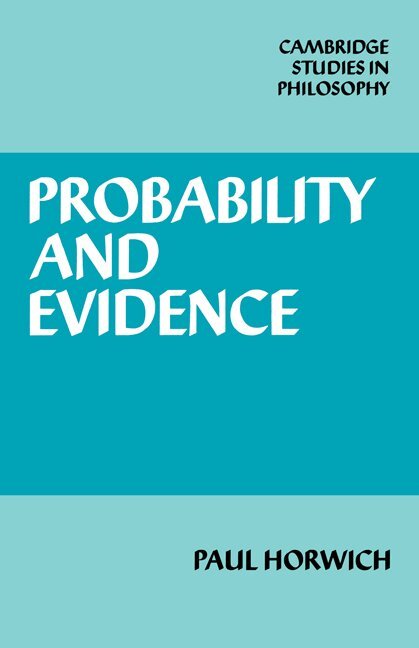
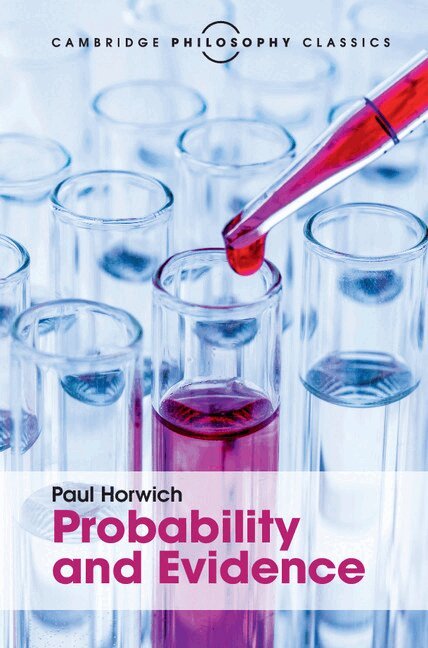
In this influential study of central issues in the philosophy of science, Paul Horwich elaborates on an important conception of probability, diagnosing the failure of previous attempts to resolve these issues as stemming from a too-rigid conception of belief. Adopting a Bayesian strategy, he argues for a probabilistic approach, yielding a more complete understanding of the characteristics of scientific reasoning and methodology. Presented in a fresh twenty-first-century series livery, and including a specially commissioned preface written by Colin Howson, illuminating its enduring importance and relevance to philosophical enquiry, this engaging work has been revived for a new generation of readers.
271 kr
Skickas inom 7-10 vardagar
In this influential study of central issues in the philosophy of science, Paul Horwich elaborates on an important conception of probability, diagnosing the failure of previous attempts to resolve these issues as stemming from a too-rigid conception of belief. Adopting a Bayesian strategy, he argues for a probabilistic approach, yielding a more complete understanding of the characteristics of scientific reasoning and methodology. Presented in a fresh twenty-first-century series livery, and including a specially commissioned preface written by Colin Howson, illuminating its enduring importance and relevance to philosophical enquiry, this engaging work has been revived for a new generation of readers.