• Fri frakt över 249 kr
  • •
  • Snabba leveranser
  • •
  • Billiga böcker
Kundservice

Du är på sajten för privatpersoner.

Företag, bibliotek eller offentlig verksamhet?

Du handlar på classic.bokus.com, där alla dina funktioner finns intakta.
Till classic.bokus.com
Bokus logotyp. Gå till startsidan.
  • Erbjudanden
  • Student
  • Topplistor
  • Barn & ungdom
  • Bokus Play
  • E-böcker
  • Ljudböcker
  • Pocketböcker
  • Spel och pussel

5% studentrabatt – använd koden KURSBOK27 →

Sidfot

Mina sidor

    Hjälp

    • Kundservice
    • Vanliga frågor och svar
    • Frakt och leverans
    • Retur vid ångerrätt
    • Reklamera vara
    • Betalning
    • Köpvillkor
    • Allmänna villkor
    • Information om webbplatsens tillgänglighet

    Om Bokus

    • Om oss
    • Pressrum
    • För studenter
    • För företag
    • För bibliotek och offentlig verksamhet
    • För leverantörer
    • Hållbarhet

    Populärt

    • Aktuella erbjudanden
    • Presentkort
    • Studentlitteratur
    • Nya böcker
    • Topplistor
    • Signerade böcker
    • Engelska böcker

    Inspiration

    • Boktips
    • BookTok
    • Barnbokskaraktärer
    • Populära författare
    Logotyp för Bokus
    Följ oss på Facebook (extern länk)Följ oss på Instagram (extern länk)Följ oss på YouTube (extern länk)Följ oss på TikTok (extern länk)
    bokus @ CookiesAnpassa cookiesIntegritetspolicyKöpvillkor
    Till Citymail hemsida (extern länk)Till Budbee hemsida (extern länk)Till Postnord hemsida (extern länk)Till Schenker hemsida (extern länk)Till Early Bird hemsida (extern länk)Till Walleys hemsida (extern länk)
    1. Naturvetenskap och teknik
    2. Matematik och naturvetenskap
    3. Naturvetenskap:allmänt
    4. Naturvetenskapens filosofi

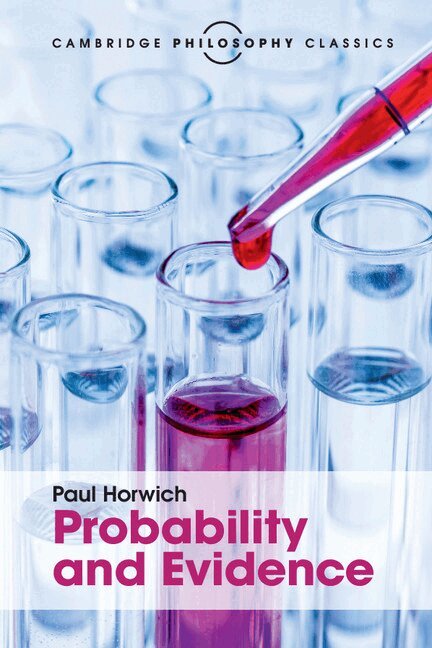
    Probability and Evidence

    AvPaul Horwich

    Häftad, Engelska, 2016

    Del i serien Cambridge Philosophy Classics

    289 kr

    Beställningsvara. Skickas inom 7-10 vardagar. Fri frakt över 249 kr.

    Fler format och utgåvor

    Häftad

    463 kr

    Inbunden

    758 kr

    E-bok

    349 kr

    E-bok

    348 kr

    Beskrivning

    In this influential study of central issues in the philosophy of science, Paul Horwich elaborates on an important conception of probability, diagnosing the failure of previous attempts to resolve these issues as stemming from a too-rigid conception of belief. Adopting a Bayesian strategy, he argues for a probabilistic approach, yielding a more complete understanding of the characteristics of scientific reasoning and methodology. Presented in a fresh twenty-first-century series livery, and including a specially commissioned preface written by Colin Howson, illuminating its enduring importance and relevance to philosophical enquiry, this engaging work has been revived for a new generation of readers.

    Produktinformation

    • Utgivningsdatum:2016-08-26
    • Mått:152 x 227 x 9 mm
    • Vikt:230 g
    • Format:Häftad
    • Språk:Engelska
    • Serie:Cambridge Philosophy Classics
    • Antal sidor:150
    • Förlag:Cambridge University Press
    • ISBN:9781316507018

    Utforska kategorier

    • Naturvetenskapens filosofi inom Naturvetenskap och teknik

    Mer om författaren

    Paul Horwich is Professor of Philosophy at New York University. He is best known for his contributions to the philosophy of science, including a probabilistic account of scientific methodology. His most recent publications include Wittgenstein's Metaphilosophy (2012) and Truth – Meaning – Reality (2010).

    Recensioner i media

    '… the strongest and most influential parts of Probability and Evidence are Horwich's solutions to various puzzles about scientific reasoning … the book might very well still be of considerable interest to those who are looking for an engaging and readable introduction to the topic of scientific reasoning from a Bayesian perspective.' Finnur Dellsén, Metascience

    Innehållsförteckning

    • Preface to this edition Colin Howson; Part I. Methodology: 1. Introduction; 2. Aspects of the scientific method; 3. A taste of Bayesianism; Part II. Probability: 4. The primitive theory; 5. Subjectivism; 6. The rationalist interpretation; 7. The logical interpretation; 8. The evidential state; 9. The empirical interpretation; Part III. Confirmation: 10. Explications; 11. The paradox; 12. A Bayesian pseudo-solution to the problem of induction; 13. Projection; Part IV. Induction: Section 1. The Nature of Inductive Inference; Section 2. Conditions of Rationality: 14. Demonstrable reliability; 15. The demonstrable reliability of c+; 16. Immodesty; 17. Audacity; Section 3. The Justification of Induction: 18. The impossibility of a noncircular rationale; 19. Inductive demonstration of reliability; 20. Semantic justification; Part V. Prediction: 21. Surprise; 22. Severe tests; 23. Ad hoc hypothesis; 24. Prediction versus accommodation; Part VI. Evidence: 25. The evidential value of varied data; 26. The value of further data; Part VII. Realism: 27. Popper; 28. Realism versus instrumentalism; 29. Putnam; 30. Glymour; 31. Conclusion; Bibliography; Index.