Paul Livingston - Böcker
Visar alla böcker från författaren Paul Livingston. Handla med fri frakt och snabb leverans.
6 produkter
6 produkter
2 300 kr
Skickas inom 10-15 vardagar
In this book, Livingston develops the political implications of formal results obtained over the course of the twentieth century in set theory, metalogic, and computational theory. He argues that the results achieved by thinkers such as Cantor, Russell, Godel, Turing, and Cohen, even when they suggest inherent paradoxes and limitations to the structuring capacities of language or symbolic thought, have far-reaching implications for understanding the nature of political communities and their development and transformation. Alain Badiou's analysis of logical-mathematical structures forms the backbone of his comprehensive and provocative theory of ontology, politics, and the possibilities of radical change. Through interpretive readings of Badiou's work as well as the texts of Giorgio Agamben, Jacques Lacan, Jacques Derrida, Gilles Deleuze, and Ludwig Wittgenstein, Livingston develops a formally based taxonomy of critical positions on the nature and structure of political communities. These readings, along with readings of Parmenides and Plato, show how the formal results can transfigure two interrelated and ancient problems of the One and the Many: the problem of the relationship of a Form or Idea to the many of its participants, and the problem of the relationship of a social whole to its many constituents.
719 kr
Skickas inom 7-10 vardagar
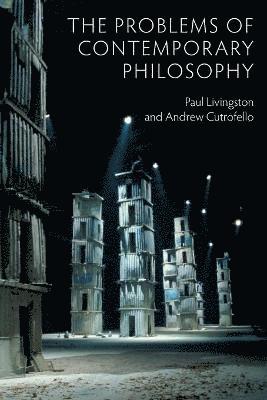
This accessible new book provides a clear and wide-ranging introduction to the defining problems of contemporary philosophy. Its unique feature is to focus on problems that cut across the established divide between �analytic� and �continental� philosophical traditions. Instead of segregating the two traditions, as is usually done, the authors offer a critical orientation and guide for readers who are not exclusively affiliated with either approach and who want to understand the increasingly shared questions philosophers are asking and addressing today.Each chapter starts with a fundamental overarching question: (1) What and how can we know? (2) What is the structure of the world? (3) What goes beyond the physical world? (4) What is to be done? (5) What does it mean to orient oneself philosophically? Under these headings, the authors critically examine the discipline�s most fundamental problems. Their approach reveals deep and unexpected connections across the analytic/continental divide, and opens up new ways of thinking about critique itself. No other book about contemporary philosophy is as comprehensive and cosmopolitan.The Problems of Contemporary Philosophy provides newcomers and seasoned philosophers alike with an entertaining, engaging, and far-reaching portrait of today�s philosophical landscape. It is an exemplary instance of thinking across and beyond the analytic/continental divide.
294 kr
Skickas inom 5-8 vardagar
This accessible new book provides a clear and wide-ranging introduction to the defining problems of contemporary philosophy. Its unique feature is to focus on problems that cut across the established divide between �analytic� and �continental� philosophical traditions. Instead of segregating the two traditions, as is usually done, the authors offer a critical orientation and guide for readers who are not exclusively affiliated with either approach and who want to understand the increasingly shared questions philosophers are asking and addressing today.Each chapter starts with a fundamental overarching question: (1) What and how can we know? (2) What is the structure of the world? (3) What goes beyond the physical world? (4) What is to be done? (5) What does it mean to orient oneself philosophically? Under these headings, the authors critically examine the discipline�s most fundamental problems. Their approach reveals deep and unexpected connections across the analytic/continental divide, and opens up new ways of thinking about critique itself. No other book about contemporary philosophy is as comprehensive and cosmopolitan.The Problems of Contemporary Philosophy provides newcomers and seasoned philosophers alike with an entertaining, engaging, and far-reaching portrait of today�s philosophical landscape. It is an exemplary instance of thinking across and beyond the analytic/continental divide.
372 kr
Skickas inom 11-20 vardagar
In The Logic of Being, Paul Livingston examines the relationship of truth and time from a perspective that draws on Martin Heidegger's inquiry into the question of being, as well as twentieth-century analytic philosophy of language and logic. In his influential earlier work The Politics of Logic, Livingston elaborated an innovative ""formal"" or ""metaformal realism."" In the Logic of Being, he now extends this concept into a ""temporal realism"" that accounts for the reality of temporal change and becoming while also preserving realism about logic and truth.Livingston employs a formal and phenomenological method of analysis to articulate and defend a position of realism about being, time, and their relationship, on which all of these are understood as structured and constituted in a way that does not depend on the human mind, consciousness, or subjectivity. This approach provides a basis for new logically and phenomenologically based accounts of the structure of linguistic truth in relation to the appearance of objects and of the formal structure of time as given.Livingston draws on philosophers from Plato and Aristotle to Davidson and Heidegger in this exploration of truth and time. In it, readers and scholars will discover innovative connections between Continental and analytic philosophy.
1 294 kr
Skickas inom 10-15 vardagar
In The Logic of Being, Paul Livingston examines the relationship of truth and time from a perspective that draws on Martin Heidegger's inquiry into the question of being, as well as twentieth-century analytic philosophy of language and logic. In his influential earlier work The Politics of Logic, Livingston elaborated an innovative ""formal"" or ""metaformal realism."" In the Logic of Being, he now extends this concept into a ""temporal realism"" that accounts for the reality of temporal change and becoming while also preserving realism about logic and truth.Livingston employs a formal and phenomenological method of analysis to articulate and defend a position of realism about being, time, and their relationship, on which all of these are understood as structured and constituted in a way that does not depend on the human mind, consciousness, or subjectivity. This approach provides a basis for new logically and phenomenologically based accounts of the structure of linguistic truth in relation to the appearance of objects and of the formal structure of time as given.Livingston draws on philosophers from Plato and Aristotle to Davidson and Heidegger in this exploration of truth and time. In it, readers and scholars will discover innovative connections between Continental and analytic philosophy.
810 kr
Skickas inom 10-15 vardagar
In this book, Livingston develops the political implications of formal results obtained over the course of the twentieth century in set theory, metalogic, and computational theory. He argues that the results achieved by thinkers such as Cantor, Russell, Godel, Turing, and Cohen, even when they suggest inherent paradoxes and limitations to the structuring capacities of language or symbolic thought, have far-reaching implications for understanding the nature of political communities and their development and transformation. Alain Badiou's analysis of logical-mathematical structures forms the backbone of his comprehensive and provocative theory of ontology, politics, and the possibilities of radical change. Through interpretive readings of Badiou's work as well as the texts of Giorgio Agamben, Jacques Lacan, Jacques Derrida, Gilles Deleuze, and Ludwig Wittgenstein, Livingston develops a formally based taxonomy of critical positions on the nature and structure of political communities. These readings, along with readings of Parmenides and Plato, show how the formal results can transfigure two interrelated and ancient problems of the One and the Many: the problem of the relationship of a Form or Idea to the many of its participants, and the problem of the relationship of a social whole to its many constituents.