Andrew Cutrofello – författare
320 kr
Läs direkt efter köp
Hamlet as performed by philosophers, with supporting roles played by Kant, Nietzsche, and others.
A specter is haunting philosophy—the specter of Hamlet. Why is this? Wherefore? What should we do?
Entering from stage left: the philosopher''s Hamlet. The philosopher''s Hamlet is a conceptual character, played by philosophers rather than actors. He performs not in the theater but within the space of philosophical positions. In All for Nothing, Andrew Cutrofello critically examines the performance history of this unique role.
The philosopher''s Hamlet personifies negativity. In Shakespeare''s play, Hamlet''s speech and action are characteristically negative; he is the melancholy Dane. Most would agree that he has nothing to be cheerful about. Philosophers have taken Hamlet to embody specific forms of negativity that first came into view in modernity. What the figure of the Sophist represented for Plato, Hamlet has represented for modern philosophers. Cutrofello analyzes five aspects of Hamlet''s negativity: his melancholy, negative faith, nihilism, tarrying (which Cutrofello distinguishes from “delaying”), and nonexistence. Along the way, we meet Hamlet in the texts of Kant, Coleridge, Hegel, Marx, Schopenhauer, Kierkegaard, Nietzsche, Freud, Russell, Wittgenstein, Heidegger, Benjamin, Arendt, Schmitt, Lacan, Deleuze, Foucault, Derrida, Badiou, Žižek, and other philosophers. Whirling across a kingdom of infinite space, the philosopher''s Hamlet is nothing if not thought-provoking.
2 648 kr
Skickas inom 10-15 vardagar
611 kr
Skickas inom 10-15 vardagar
757 kr
Skickas inom 5-8 vardagar
299 kr
Skickas inom 5-8 vardagar
698 kr
Skickas inom 5-8 vardagar
665 kr
Läs direkt efter köp
690 kr
Läs direkt efter köp
751 kr
Skickas inom 10-15 vardagar
2 395 kr
Skickas inom 10-15 vardagar
891 kr
Läs direkt efter köp
This forward-thinking collection presents new work that looks beyond the division between the analytic and continental philosophical traditions—one that has long caused dissension, mutual distrust, and institutional barriers to the development of common concerns and problems. Rather than rehearsing the causes of the divide, contributors draw upon the problems, methods, and results of both traditions to show what post-divide philosophical work looks like in practice.
Ranging from metaphysics and philosophy of mind to political philosophy and ethics, the papers gathered here bring into mutual dialogue a wide range of recent and contemporary thinkers, and confront leading problems common to both traditions, including methodology, ontology, meaning, truth, values, and personhood. Collectively, these essays show that it is already possible to foresee a future for philosophical thought and practice no longer determined neither as "analytic" nor as "continental," but, instead, as a pluralistic synthesis of what is best in both traditions. The new work assembled here shows how the problems, projects, and ambitions of twentieth-century philosophy are already being taken up and productively transformed to produce new insights, questions, and methods for philosophy today.
891 kr
Läs direkt efter köp
This forward-thinking collection presents new work that looks beyond the division between the analytic and continental philosophical traditions—one that has long caused dissension, mutual distrust, and institutional barriers to the development of common concerns and problems. Rather than rehearsing the causes of the divide, contributors draw upon the problems, methods, and results of both traditions to show what post-divide philosophical work looks like in practice.
Ranging from metaphysics and philosophy of mind to political philosophy and ethics, the papers gathered here bring into mutual dialogue a wide range of recent and contemporary thinkers, and confront leading problems common to both traditions, including methodology, ontology, meaning, truth, values, and personhood. Collectively, these essays show that it is already possible to foresee a future for philosophical thought and practice no longer determined neither as "analytic" nor as "continental," but, instead, as a pluralistic synthesis of what is best in both traditions. The new work assembled here shows how the problems, projects, and ambitions of twentieth-century philosophy are already being taken up and productively transformed to produce new insights, questions, and methods for philosophy today.
258 kr
Läs direkt efter köp
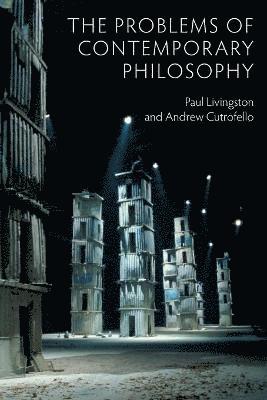
This accessible new book provides a clear and wide-ranging introduction to the defining problems of contemporary philosophy. Its unique feature is to focus on problems that cut across the established divide between �analytic� and �continental� philosophical traditions. Instead of segregating the two traditions, as is usually done, the authors offer a critical orientation and guide for readers who are not exclusively affiliated with either approach and who want to understand the increasingly shared questions philosophers are asking and addressing today.
Each chapter starts with a fundamental overarching question: (1) What and how can we know? (2) What is the structure of the world? (3) What goes beyond the physical world? (4) What is to be done? (5) What does it mean to orient oneself philosophically? Under these headings, the authors critically examine the discipline�s most fundamental problems. Their approach reveals deep and unexpected connections across the analytic/continental divide, and opens up new ways of thinking about critique itself. No other book about contemporary philosophy is as comprehensive and cosmopolitan.
The Problems of Contemporary Philosophy provides newcomers and seasoned philosophers alike with an entertaining, engaging, and far-reaching portrait of today�s philosophical landscape. It is an exemplary instance of thinking across and beyond the analytic/continental divide.
113 kr
Tillfälligt slut
383 kr
Tillfälligt slut
383 kr
Tillfälligt slut