Paul Oh – författare
Visar alla böcker från författaren Paul Oh. Handla med fri frakt och snabb leverans.
11 produkter
Army's Professional Military Ethic in an Era of Persistent Conflict
Av Don M Snider, Paul Oh m. fl.
Häftad, 2012
221 kr
Lägg i varukorg
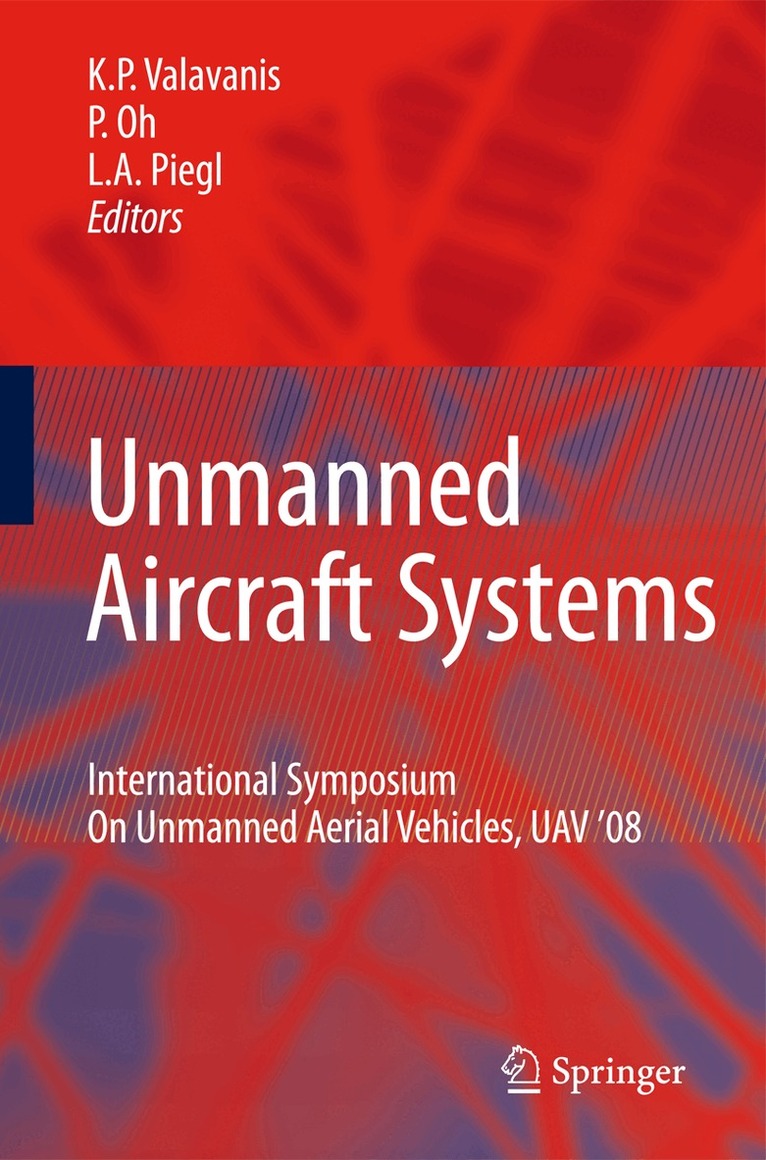
Unmanned Aircraft Systems
International Symposium On Unmanned Aerial Vehicles, UAV’08
Av Kimon P. Valavanis, Paul Oh m. fl.
Inbunden, 2008
552 kr
Lägg i varukorg
Unmanned Aircraft Systems (UAS) have seen unprecedented levels of growth during the last decade in both military and civilian domains. It is anticipated that civilian applications will be dominant in the future, although there are still barriers to be overcome and technical challenges to be met. …
Unmanned Aircraft Systems
International Symposium On Unmanned Aerial Vehicles, UAV’08
Av Les A. Piegl, Paul Oh m. fl.
E-bok, 2008
734 kr
Lägg i varukorg
Unmanned Aircraft Systems (UAS) have seen unprecedented levels of growth during the last decade in both military and civilian domains. It is anticipated that civilian applications will be dominant in the future, although there are still barriers to be overcome and technical challenges to be met. …
Aerial Manipulation
Av Matko Orsag, Christopher Korpela m. fl.
Inbunden, 2017
1313 kr
Lägg i varukorg
This text is a thorough treatment of the rapidly growing area of aerial manipulation. It details all the design steps required for the modeling and control of unmanned aerial vehicles (UAV) equipped with robotic manipulators. Starting with the physical basics of rigid-body kinematics, the book …
Aerial Manipulation
Av Stjepan Bogdan, Paul Oh m. fl.
E-bok, 2017
1622 kr
Lägg i varukorg
This text is a thorough treatment of the rapidly growing area of aerial manipulation. It details all the design steps required for the modeling and control of unmanned aerial vehicles (UAV) equipped with robotic manipulators. Starting with the physical basics of rigid-body kinematics, the book …
Aerial Manipulation
Av Matko Orsag, Christopher Korpela m. fl.
Häftad, 2018
1261 kr
Lägg i varukorg
This text is a thorough treatment of the rapidly growing area of aerial manipulation. It details all the design steps required for the modeling and control of unmanned aerial vehicles (UAV) equipped with robotic manipulators. Starting with the physical basics of rigid-body kinematics, the book …
Unmanned Aircraft Systems
International Symposium On Unmanned Aerial Vehicles, UAV’08
Av Kimon P. Valavanis, Paul Oh m. fl.
Häftad, 2011
552 kr
Lägg i varukorg
Unmanned Aircraft Systems (UAS) have seen unprecedented levels of growth during the last decade in both military and civilian domains. It is anticipated that civilian applications will be dominant in the future, although there are still barriers to be overcome and technical challenges to be met. …
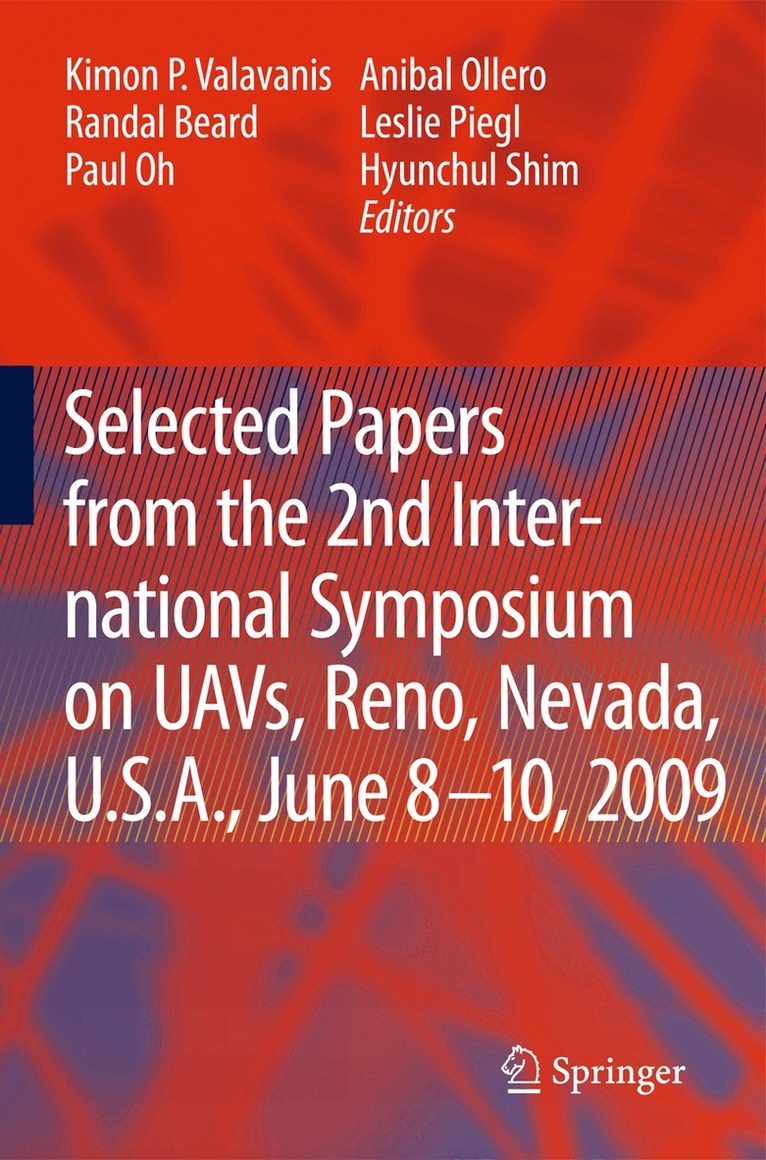
Selected papers from the 2nd International Symposium on UAVs, Reno, U.S.A. June 8-10, 2009
Av Kimon P. Valavanis, Randal Beard m. fl.
Inbunden, 2010
2188 kr
Lägg i varukorg
In the last decade, signi?cant changes have occurred in the ?eld of vehicle motion planning, and for UAVs in particular. UAV motion planning is especially dif?cult due to several complexities not considered by earlier planning strategies: the - creased importance of differential constraints, …
Selected papers from the 2nd International Symposium on UAVs, Reno, U.S.A. June 8-10, 2009
Av Hayong Shin, Leslie A. Piegl m. fl.
E-bok, 2011
2925 kr
Lägg i varukorg
In the last decade, signi?cant changes have occurred in the ?eld of vehicle motion planning, and for UAVs in particular. UAV motion planning is especially dif?cult due to several complexities not considered by earlier planning strategies: the - creased importance of differential constraints, …
Selected papers from the 2nd International Symposium on UAVs, Reno, U.S.A. June 8-10, 2009
Av Kimon P. Valavanis, Randal Beard m. fl.
Häftad, 2014
2188 kr
Lägg i varukorg
In the last decade, signi?cant changes have occurred in the ?eld of vehicle motion planning, and for UAVs in particular. UAV motion planning is especially dif?cult due to several complexities not considered by earlier planning strategies: the - creased importance of differential constraints, …
Army's Professional Military Ethic in an Era of Persistent Conflict [Enlarged Edition]
Av Don M. Snider, Paul Oh m. fl.
Häftad, 2014
97 kr
Tillfälligt slut


![Don M. Snider, Paul Oh, Kevin Toner, Strategic Studies Institute - Army's Professional Military Ethic in an Era of Persistent Conflict [Enlarged Edition], Häftad. Tillgänglighet: Tillfälligt slut](https://image.bokus.com/images2/9781304891983_766)