Peter Herring – författare
Visar alla böcker från författaren Peter Herring. Handla med fri frakt och snabb leverans.
3 produkter
3 produkter
961 kr
Skickas inom 7-10 vardagar
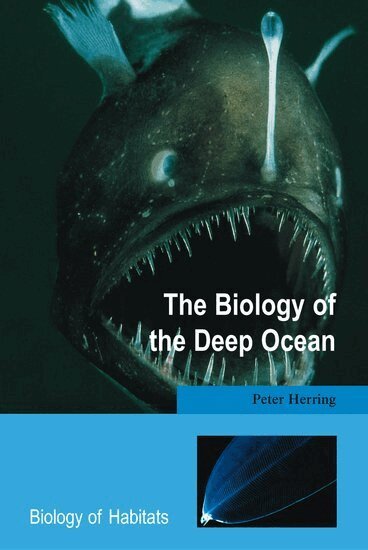
The deep ocean environment is the most extensive on our planet. Its denizens are normally unseen but whenever they are exposed to view they are regarded as bizarre aliens from a different world. The Biology of the Deep Ocean takes a close look at this apparently hostile world and explains how its inhabitants are exquisitely adapted to survive and flourish within it. The book begins with an analysis of how conditions in the oceanic environment differ from those in the familiar terrestrial world and then describes the techniques (and ingenuity) required to reveal the populations inhabiting the colossal volume of the deep oceans. A section on primary production emphasizes how almost all deep-sea life depends ultimately on the phytoplankton at the surface and the export flux to deeper water. The ultimate beneficiaries of this export, the populations on the deep-sea floor, are then discussed, together with the unique features of life fuelled by chemosynthesis at hydrothermal vents and cold seeps. The horizontal and vertical distribution patterns of deep-sea animals, and their changes in time and space, are controlled by physical, biological and historical factors. The rapid reduction of biomass with depth puts a high priority on efficient prey capture and energy conservation. Chapters on energy efficiency, mechanoreception, chemoreception and vision reveal the extraordinary adaptations necessary for success. Accounts of the effector systems involved in colour, camouflage and bioluminescence heighten the concept of a different world. A chapter on animal life styles emphasizes the links between size, sex, and seasonality, visible in the contrasting benefits of gigantism, dwarf males and the ability to respond to a periodic influx of food from the surface. The final chapter and appendix deal with the unique and exciting variety of life in the deep ocean, formalized as biodiversity. Its different expression on the sea floor and in midwater invites both comparisons with the rain forest and concerns about its fragility, taking the reader back to the emphasis in the first chapter on how little we still know about this critical habitat.The Biology of the Deep Ocean complements the two companion volumes on the biology of littoral and estuarine habitats and is designed to be accessible to all marine scientists, student and professional.
Classic British Steam Locomotives: A Comprehensive Guide with Over 200 Photographs
Häftad, Engelska, 2013
100 kr
Skickas
This title features key facts and figures spanning over 150 years of British railway history, from the early 1800s to the end of the golden era of steam in the 20th century. It offers technical specification tables for each class, including builder's name, location and date, weight, driving wheel diameter, boiler pressure, cylinders, valve gear, coal capacity, water capacity and tractive effort. It features all the classic British steam locomotives, including the 'Iron Duke' class, the D class, the 'Royal Scot' class, the Q1 class, and many more. It is divided into sections covering the four main eras: 1800-1885; 1885-1920; 1920-1940; and 1940-1960. It includes a glossary of key railway terms. Britain was the pioneering force behind the birth of the steam locomotive. By 1829, George Stephenson and his son Robert had developed a fast, revolutionary and light-weight steam engine: Rocket. This superbly illustrated book celebrates the British steam locomotive legacy. From the streamlined 'flyers' of the 1930s to freight workhorses and dock tanks, the book profiles the variety of steam locomotives that Britain has produced.With over 200 photographs covering 85 classes, as well as detailed information on each period and a comprehensive glossary, the book covers the story of the first, finest and fastest locomotives ever to run on rails.
369 kr
Skickas inom 3-6 vardagar