Piyush Kumar Sonkar - Böcker
Visar alla böcker från författaren Piyush Kumar Sonkar. Handla med fri frakt och snabb leverans.
5 produkter
5 produkter
1 963 kr
Skickas inom 10-15 vardagar
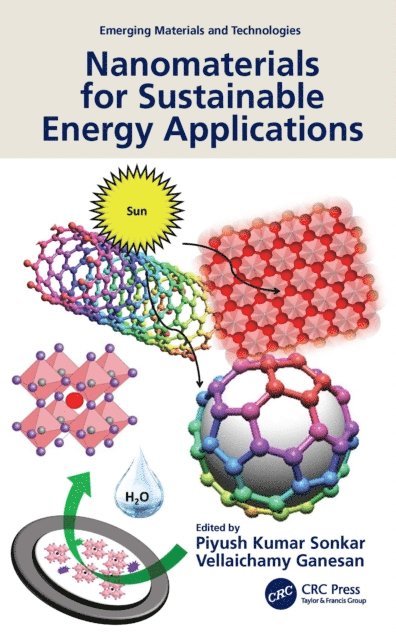
This book provides a detailed overview of different devices and nanomaterials for energy storage applications. The application of each nanomaterial is discussed for fuel cells, metal–air batteries, supercapacitors, solar cells, regenerative fuel cells, hydrogen energy, batteries, and redox flow batteries to understand the reaction process and material performance improvement for energy storage devices. In addition, major challenges, case studies, historical, and future perspective are summarized.Features:Summarizes state-of-the-art nanomaterials for energy storage and conversion applicationsComprehensive coverage of a wide range of nanomaterials, including synthesis and characterizationDetails different energy storage devices, construction, working principles, and major challengesCovers specific reactions, nanomaterials, and nanocomposites via audio–video slides/short filmsIncludes case studies pertaining to development of energy storage devices and major challengesThis book is aimed at researchers and graduate students in chemical engineering, chemical sciences, nanomaterials, and energy engineering/conversion.
729 kr
Skickas inom 10-15 vardagar
This book provides a detailed overview of different devices and nanomaterials for energy storage applications. The application of each nanomaterial is discussed for fuel cells, metal–air batteries, supercapacitors, solar cells, regenerative fuel cells, hydrogen energy, batteries, and redox flow batteries to understand the reaction process and material performance improvement for energy storage devices. In addition, major challenges, case studies, historical, and future perspective are summarized.Features:Summarizes state-of-the-art nanomaterials for energy storage and conversion applicationsComprehensive coverage of a wide range of nanomaterials, including synthesis and characterizationDetails different energy storage devices, construction, working principles, and major challengesCovers specific reactions, nanomaterials, and nanocomposites via audio–video slides/short filmsIncludes case studies pertaining to development of energy storage devices and major challengesThis book is aimed at researchers and graduate students in chemical engineering, chemical sciences, nanomaterials, and energy engineering/conversion.
1 761 kr
Skickas inom 10-15 vardagar
In this book, readers will find an exhaustive examination of the latest advancements in nanomaterials, covering their synthesis, characterization, and utilization in energy storage and conversion. Additionally, the text delves into the diverse applications of these nanomaterials across various fields such as supercapacitors, fuel cells, biofuel cells, solar cells, batteries, and organic electronics. The discussion also encompasses the challenges faced, historical context, and future outlooks within this rapidly evolving domain.Features: Cutting-edge insights: Stays abreast of the latest breakthroughs in nanomaterial science, with a succinct review of advanced materials tailored for energy storage applications.Developmental journey: Traces the evolution of energy storage materials, from their inception to their current state of the art.Versatile applications: Explores the diverse applications of nanomaterials in energy storage, spanning supercapacitors, fuel cells, biofuel cells, solar cells, batteries, and beyond.Visual aids: Enhances readers' understanding, with key figures and tables spotlighting the intricate applications of various nanomaterials.Geared toward researchers and graduate students in chemical engineering, chemical sciences, nanomaterials, and energy engineering/conversion, this book serves as an indispensable resource for those seeking to push the boundaries of nanotechnology in the pursuit of sustainable energy solutions.
1 897 kr
Skickas inom 7-10 vardagar
SMART MATERIALS FOR SCIENCE AND ENGINEERING Smart materials, also known as advanced or creative materials, are described as advanced materials that react intuitively to environmental changes or as materials that can return to their original shape in response to certain stimuli. Smart materials are classified as either active or passive based on their characteristics. There are two types of active materials. The first kind cannot change its characteristics when subjected to outside stimuli, for example photochromatic spectacles that only alter their color when exposed to sunlight. The other, which includes piezoelectric materials, can change one sort of energy (thermal, electrical, chemical, mechanical, or optical) into another. When subjected to external pressure, it can generate an electric charge. As an example, optical fibers can transmit electromagnetic waves. In contrast, passive smart materials can transmit a specific sort of energy. They have some amazing qualities that set them apart from other materials, such as transiency, meaning they can react to different kinds of external stimuli immediately, self-actuation or the capacity to change their appearance and shape, selectivity where the response is divided and expected, directness when the response is limited to the activating event, shape-changing where the material can change its shape to external stimuli, their ability to determine their own health, also known as self-diagnosis, and their ability to self-heal. The ability to synthesize novel materials has substantially progressed thanks to science and technology over the past 20 years. They fall mostly into the following four categories: polymers, ceramics, metals, and smart materials. Among these, smart materials are gaining popularity since they have more uses than conventional materials. Smart materials are unusual substances that have the ability to alter their properties, such as those that can immediately change their phase when placed near a magnet or their shape simply by applying heat. Humanity will be significantly impacted by this new era of smart materials. For instance, some of them can adapt their properties to the environment, some have sensory capabilities, some can repair themselves automatically, and some can degrade themselves. These extraordinary properties of smart materials will have an effect on all facets of civilization. There are many different types of intelligent materials, including magnetorheological materials, electro-rheostat materials, shape memory alloys, piezoelectric materials, and more. This book describes many forms of smart materials and their possible uses in various fields. A literature survey discusses the different types of smart materials, such as based ceramics, polymers, and organic compounds and their needs, advantages, disadvantages, and applications will be comprehensively discussed. A discussion of well-established smart materials including piezoelectric, magnetostrictive, shape memory alloy, electro-rheological fluid, and magnetorheological fluid materials will be discussed with their present prospects.
1 754 kr
Skickas inom 7-10 vardagar
Gain valuable insight into applying carbon-based nanomaterials to the green technologies of the future The green revolution is the most important technological development of the new century. Carbon-based nanomaterials, with their organic origins and immense range of applications, are increasingly central to this revolution as it unfolds. There is an urgent need for an up-to-date overview of the latest research in this ever-expanding field. Carbon-Based Nanomaterials for Green Applications meets this need by providing a brief outline of the synthesis and characterization of different carbon-based nanomaterials, including their historical backgrounds. It proceeds to move through each major category, outlining properties and applications for each. The result is an essential contribution to a huge range of sustainable and renewable industries. With contributions from a global list of distinguished writers, the book includes: Discussion of nanomaterial applications in fields from drug delivery to biomedical technology to opticsAnalysis of nanomaterial categories including graphene, fullerene, mesoporous carbon, and many moreSeparate chapters describing aspects of supercapacitors, solar cells, and fuel cells Carbon-Based Nanomaterials for Green Applications is ideal for scientists and researchers working in nanotechnology, life sciences, biomedical research, bioengineering, and a range of related fields.