R. Glaser – författare
Visar alla böcker från författaren R. Glaser. Handla med fri frakt och snabb leverans.
12 produkter
Epstein-Barr Virus and Human Disease
Av P. H. Levine, D. V. Ablashi m. fl.
Inbunden, 1987
2189 kr
Lägg i varukorg
Since its discovery as the cause of infectious mononucleosis in 1964, the Epstein-Barr virus (EBV) has been etiologically implicated in an increasing number of human diseases. Generally considered the first human oncogenic virus because of a number of studies linking it with Burkitt's lymphoma and …
Thinking and Learning Skills
Volume 1: Relating Instruction To Research
Av J. W Segal, S. F. Chipman m. fl.
Inbunden, 1985
3078 kr
Lägg i varukorg
First Published in 1985. This is Volume 1 on Relating Instruction to Research borne from a conference that took place at the Learning Research and Development Center (LRDC) of the University of Pittsburgh, one of the major research and development centers The chapters are structured into sections …
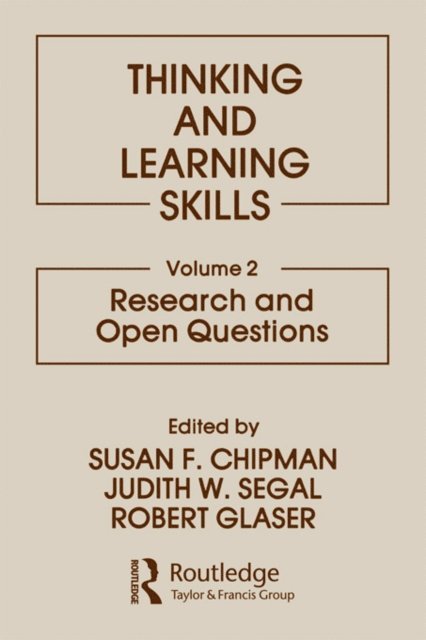
Thinking and Learning Skills
Volume 2: Research and Open Questions
Av S. F. Chipman, J. W. Segal m. fl.
Inbunden, 1985
2448 kr
Lägg i varukorg
First Published in 1985, Currently, two streams of endeavor offer promise for improving school effectiveness in developing students’ higher cognitive capacities. One of these is represented by the increased interest of school districts, colleges, and universities in identifying ways to help their …
Research and Development and School Change
Av R. Glaser
Inbunden, 1983
1483 kr
Lägg i varukorg
First published in 1983. The essays in this book are based on papers presented at a symposium held in March 1976 at the Learning and Development Center (LRDC), University of Pittsburgh. It was planned to serve three purposes: to pay tribute to retiring chairman Ralph W. Tyler, to mark the …
Research and Development and School Change
Av R. Glaser
E-bok, 2020
972 kr
Lägg i varukorg
First published in 1983. The essays in this book are based on papers presented at a symposium held in March 1976 at the Learning and Development Center (LRDC), University of Pittsburgh. It was planned to serve three purposes: to pay tribute to retiring chairman Ralph W. Tyler, to mark the …
Research and Development and School Change
Av R. Glaser
E-bok, 2020
964 kr
Lägg i varukorg
First published in 1983. The essays in this book are based on papers presented at a symposium held in March 1976 at the Learning and Development Center (LRDC), University of Pittsburgh. It was planned to serve three purposes: to pay tribute to retiring chairman Ralph W. Tyler, to mark the …
Thinking and Learning Skills
Volume 1: Relating Instruction To Research
Av R. Glaser, S. F. Chipman m. fl.
E-bok, 2014
993 kr
Lägg i varukorg
First Published in 1985. This is Volume 1 on Relating Instruction to Research borne from a conference that took place at the Learning Research and Development Center (LRDC) of the University of Pittsburgh, one of the major research and development centers The chapters are structured into sections …
Thinking and Learning Skills
Volume 1: Relating Instruction To Research
Av R. Glaser, S. F. Chipman m. fl.
E-bok, 2014
993 kr
Lägg i varukorg
First Published in 1985. This is Volume 1 on Relating Instruction to Research borne from a conference that took place at the Learning Research and Development Center (LRDC) of the University of Pittsburgh, one of the major research and development centers The chapters are structured into sections …
Thinking and Learning Skills
Volume 2: Research and Open Questions
Av R. Glaser, J. W. Segal m. fl.
E-bok, 2013
993 kr
Lägg i varukorg
First Published in 1985, Currently, two streams of endeavor offer promise for improving school effectiveness in developing students’ higher cognitive capacities. One of these is represented by the increased interest of school districts, colleges, and universities in identifying ways to help their …
Thinking and Learning Skills
Volume 2: Research and Open Questions
Av R. Glaser, J. W. Segal m. fl.
E-bok, 2013
993 kr
Lägg i varukorg
First Published in 1985, Currently, two streams of endeavor offer promise for improving school effectiveness in developing students’ higher cognitive capacities. One of these is represented by the increased interest of school districts, colleges, and universities in identifying ways to help their …
Epstein-Barr Virus and Human Disease
Av R. Glaser, G. R. Pearson m. fl.
E-bok, 2012
2925 kr
Lägg i varukorg
Since its discovery as the cause of infectious mononucleosis in 1964, the Epstein-Barr virus (EBV) has been etiologically implicated in an increasing number of human diseases. Generally considered the first human oncogenic virus because of a number of studies linking it with Burkitt''s lymphoma and …
Epstein-Barr Virus and Human Disease
Av P. H. Levine, D. V. Ablashi m. fl.
Häftad, 2011
2254 kr
Lägg i varukorg
Since its discovery as the cause of infectious mononucleosis in 1964, the Epstein-Barr virus (EBV) has been etiologically implicated in an increasing number of human diseases. Generally considered the first human oncogenic virus because of a number of studies linking it with Burkitt's lymphoma and …