R.-M. Bonnet - Böcker
Visar alla böcker från författaren R.-M. Bonnet. Handla med fri frakt och snabb leverans.
6 produkter
6 produkter
1 578 kr
Skickas inom 10-15 vardagar
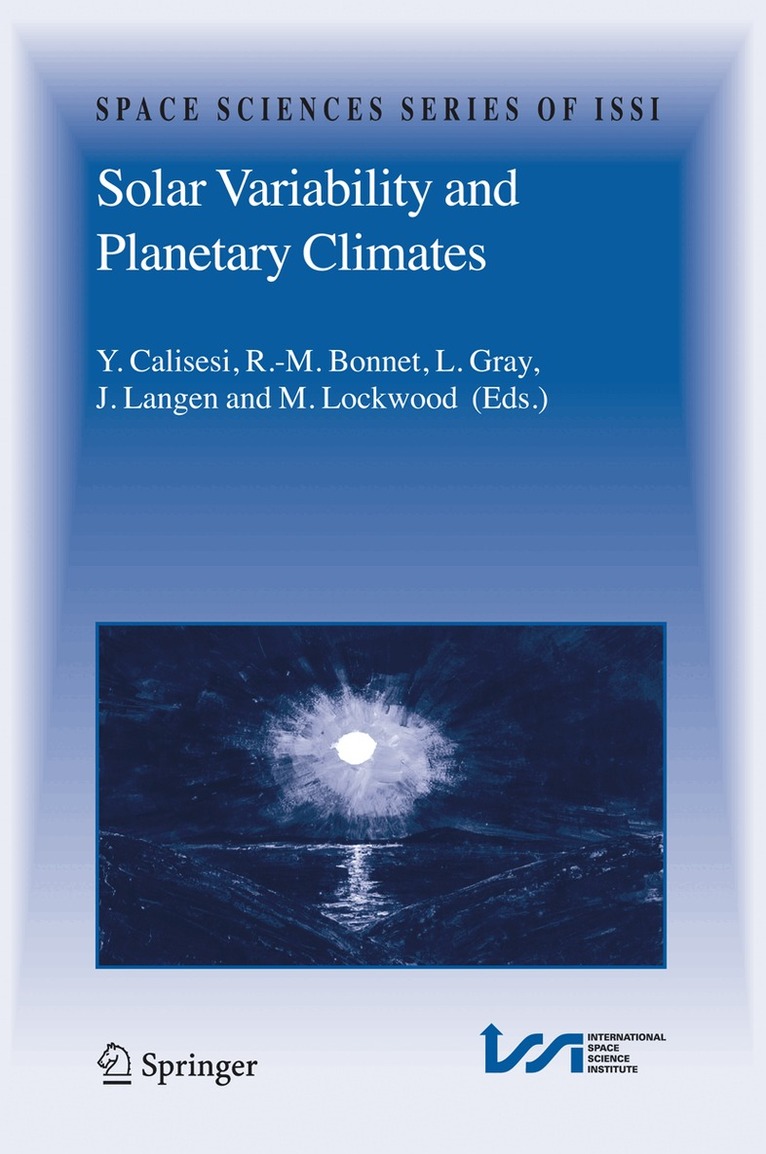
2 With a global average irradiance of 342 W/m , the Sun is by far the largest source of energy for planet Earth. In comparison, the internal energy produced by Earth 2 itself is only about 0. 087 W/m (Pollack et al. , 1993), which in turn is 3. 5 times 2 larger than the 0. 025 W/m of heat produced by the burning of fossil fuels. About 31% (31 units) of the solar energy which arrives at the top of the - mosphere is re?ected back to space by scattering from clouds, aerosols, and the Earth’s surface. Almost 20 units of solar radiation are absorbed in the atmosphere. The remaining 49 units are absorbed at the surface. Evaporation of water at the Earth’s surface consumes 23 units, and 7 units are transferred to the atmosphere by heat conduction. On balance 19 units are lost from the Earth’s surface as infrared radiation, however consisting of 114 going upward and 95 returning from the - mosphere to the Earth’s surface (see also Rosenfeld, 2006). There is thus a sixfold recycling of energy. This is the greenhouse effect, established by the presence of watervaporandofothergreenhousegases,CO ,CH ,N O,andCFCs,intheatmo- 2 4 2 sphere. Due to human activities the latter have been increasing in the atmosphere, 2 causing climate warming through an energy imbalance of 2. 5–3 W/m , more than 100 times larger than the heat released into the atmosphere by the burning of fossil fuels.
1 578 kr
Skickas inom 10-15 vardagar
2 With a global average irradiance of 342 W/m , the Sun is by far the largest source of energy for planet Earth. Due to human activities the latter have been increasing in the atmosphere, 2 causing climate warming through an energy imbalance of 2.
1 064 kr
Skickas inom 10-15 vardagar
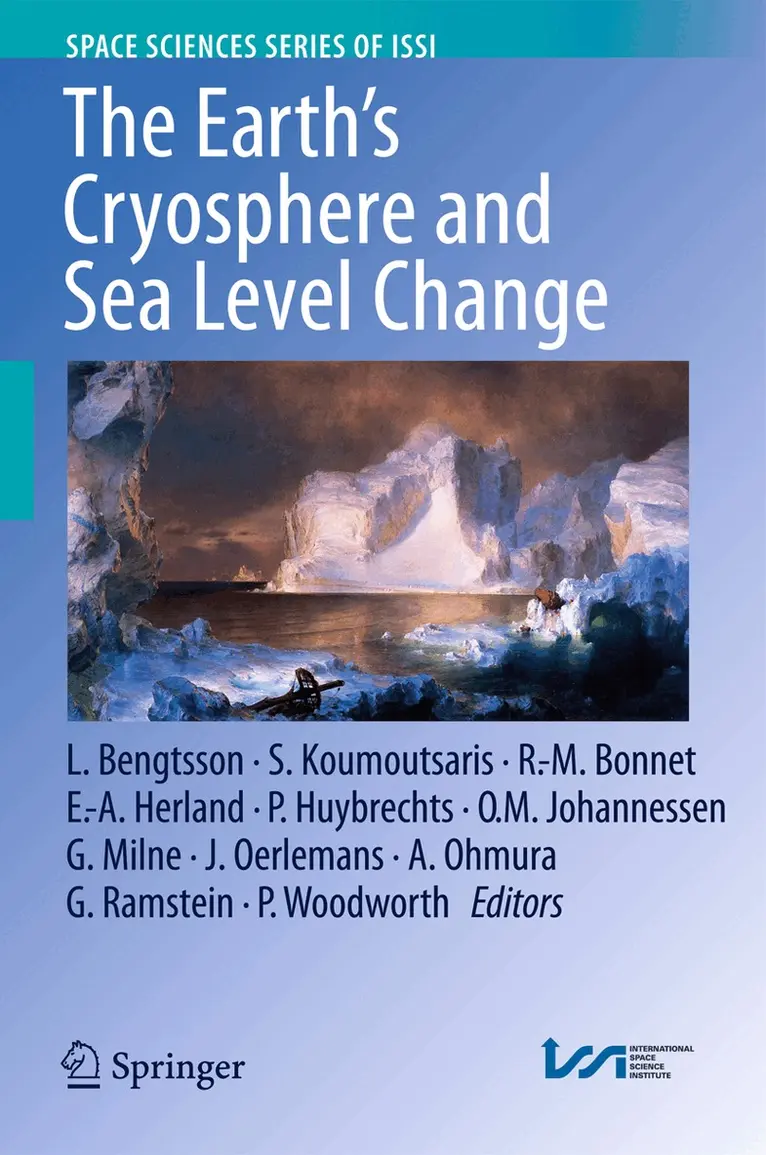
This book gives a comprehensive overview of our present understanding of the Earth's cryosphere, its changes and their consequences for mean sea level changes. Since the middle of the 19th century there has been an increase of sea level height by 20-25 cm. Some 8-10 cm of this is due to net losses from glaciers, the remainder being due to mass losses from land ice and thermal expansion of the oceans. The mean sea level rise is slowly accelerating; at present it is some 3 mm/year. Recent space observations made by the GRACE satellite combined with ocean temperature and volume measurements have enabled the separate contributions to sea level rise from melting ice and from thermal expansion to be better estimated. The estimation of mean sea level change is complicated by changes in land level due to tectonic effects and to ongoing changes following the latest major glaciation. The book gives an up-to-date survey of our present knowledge of this crucial subject.
1 064 kr
Skickas inom 10-15 vardagar
This book gives a comprehensive overview of our present understanding of the Earth's cryosphere, its changes and their consequences for mean sea level changes. Since the middle of the 19th century there has been an increase of sea level height by 20-25 cm. Some 8-10 cm of this is due to net losses from glaciers, the remainder being due to mass losses from land ice and thermal expansion of the oceans. The mean sea level rise is slowly accelerating; at present it is some 3 mm/year. Recent space observations made by the GRACE satellite combined with ocean temperature and volume measurements have enabled the separate contributions to sea level rise from melting ice and from thermal expansion to be better estimated. The estimation of mean sea level change is complicated by changes in land level due to tectonic effects and to ongoing changes following the latest major glaciation. The book gives an up-to-date survey of our present knowledge of this crucial subject.
1 064 kr
Skickas inom 10-15 vardagar
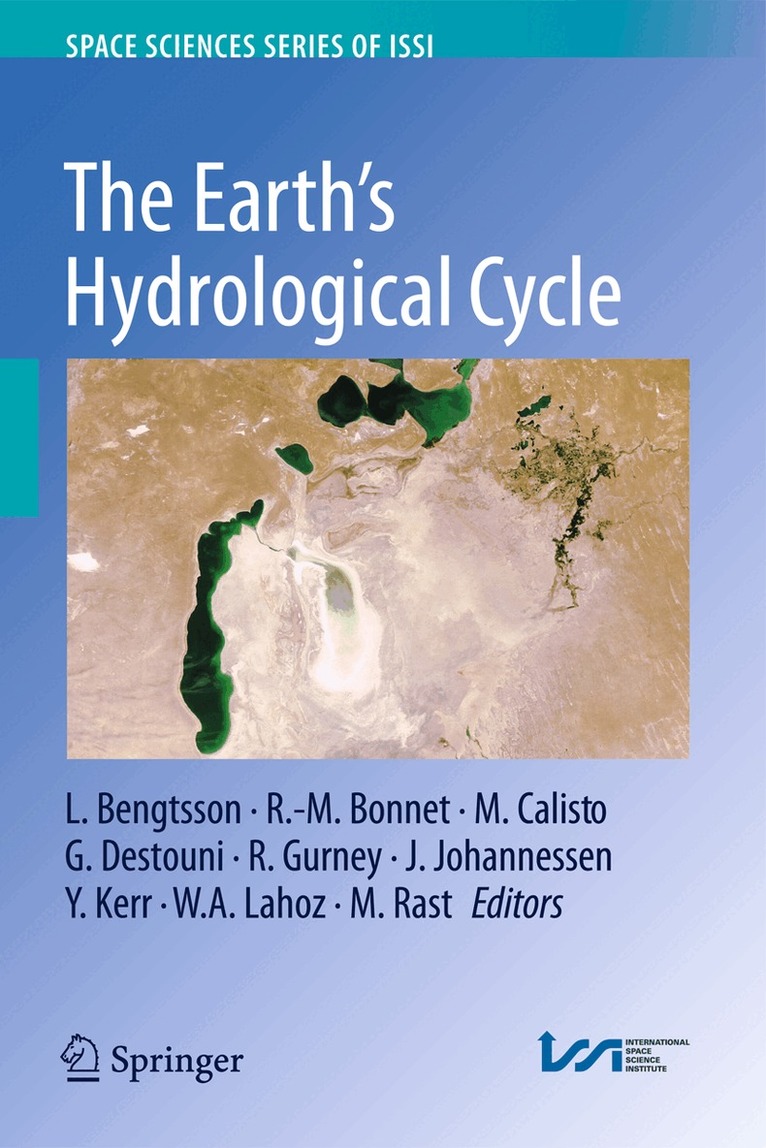
This book gives a comprehensive presentation of our present understanding of the Earth's Hydrological cycle and the problems, consequences and impacts that go with this topic. Water is a central component in the Earth's system. It is indispensable for life on Earth in its present form and influences virtually every aspect of our planet's life support system. On relatively short time scales, atmospheric water vapor interacts with the atmospheric circulation and is crucial in forming the Earth's climate zones. Water vapor is the most powerful of the greenhouse gases and serves to enhance the tropospheric temperature. The dominant part of available water on Earth resides in the oceans. Parts are locked up in the land ice on Greenland and Antarctica and a smaller part is estimated to exist as groundwater. If all the ice over the land and all the glaciers were to melt, the sea level would rise by some 80 m. In comparison, the total amount of water vapor in the atmosphere is small; it amounts to ~ 25 kg/m2, or the equivalent of 25 mm water for each column of air. Yet atmospheric water vapor is crucial for the Earth’s energy balance. The book gives an up to date presentation of the present knowledge.Previously published in Surveys in Geophysics, Volume 35, No. 3, 2014
1 064 kr
Skickas inom 10-15 vardagar
This book gives a comprehensive presentation of our present understanding of the Earth's Hydrological cycle and the problems, consequences and impacts that go with this topic. Water is a central component in the Earth's system. It is indispensable for life on Earth in its present form and influences virtually every aspect of our planet's life support system. On relatively short time scales, atmospheric water vapor interacts with the atmospheric circulation and is crucial in forming the Earth's climate zones. Water vapor is the most powerful of the greenhouse gases and serves to enhance the tropospheric temperature. The dominant part of available water on Earth resides in the oceans. Parts are locked up in the land ice on Greenland and Antarctica and a smaller part is estimated to exist as groundwater. If all the ice over the land and all the glaciers were to melt, the sea level would rise by some 80 m. In comparison, the total amount of water vapor in the atmosphere is small; it amounts to ~ 25 kg/m2, or the equivalent of 25 mm water for each column of air. Yet atmospheric water vapor is crucial for the Earth’s energy balance. The book gives an up to date presentation of the present knowledge.Previously published in Surveys in Geophysics, Volume 35, No. 3, 2014