R. McNeill Alexander – Författare
Visar alla böcker från författaren R. McNeill Alexander. Handla med fri frakt och snabb leverans.
6 produkter
6 produkter
725 kr
Skickas inom 7-10 vardagar
The Oxford Animal Biology Series is an innovative new series of supplementary undergraduate texts in comparative animal biology. Topics within each book are addressed using examples from throughout the animal kingdom, looking for parallels that transcend taxonomy. Further reading sections will guide the student into the literature at greater depth. The series will be international in scope, both in terms of the species used as examples and in references to scientific work. Energy for Animal Life, the first book in the series, is about how animals get energy, and how they use it, a central topic in our understanding of animal biology. Life depends on energy, and much of the activity of animals is devoted to getting the food which is their energy source. It encompasses the food chain, from solar radiation and photosynthesis to food sources for herbiviores and for carnivores, and compares the merits of different designs of digestive system, and of different strategies for finding and choosing food. Of course, animal energy isn't simply a question of feeding, and several chapters in turn look at energy use. The energy costs of motion - of running, swimming, and flight - are discussed in one chapter, and the energetic demands of growth and reproduction in another. A chapter on body temperature shows how the processes of life go faster at higher temperatures, and discusses how animals regulate their temperature. A final chapter draws all of these aspects of energy use together, and considers the energy budgets of several different animals, assessing the different energy gains and costs of their everyday activities in the wild. The book is truly comparative, drawing on examples from a wide range of animal species, and lots of practical information on relevant experiments is included. The style is very accessible, and suitable as supplementary reading for first and second year undergraduates taking a degree course in biological sciences.
434 kr
Skickas inom 11-20 vardagar
How did the larger dinosaurs run? How and why did they fight? The author applies laws of physics, mechanical engineering and aerodynamics to answer these and other questions.
639 kr
Skickas inom 7-10 vardagar
This book is about the major groups of animals, their structure, physiology and ways of life. Each chapter, except the first, deals with a taxonomic group of animals, usually a phylum or class. Brief descriptions of a few examples are followed by more detailed discussion of selected topics. Some of the topics are peculiarities of the groups (for example, the shells of molluscs and the flight of insects). Others are more widespread features or properties of animals which can be illustrated particularly well by reference to the group. Many experiments are described, on the grounds that it is as important and interesting to know how information is obtained, as to know the information itself. The text demonstrates the extraordinary diversity of animals, without becoming encumbered with excessive morphological and taxonomic information.
626 kr
Skickas inom 7-10 vardagar
Originally published in 1988, this book is about the uses and implications of elastic properties in various aspects of animal biology. After a brief study of the properties of elastic materials, the book considers the functions of springs in the bodies of animals. Drawing on specific examples, the uses of elastic structures as, amongst other things, muscle antagonists, energy stores, catapults and suspension springs are described. This book will be of value to anyone with an interest in animal mechanics.
830 kr
Skickas inom 7-10 vardagar
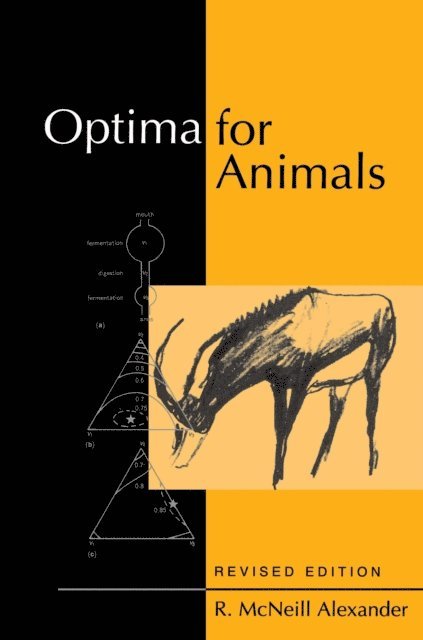
Optimization theory is designed to find the best ways of doing things. The structures of animals, their movements, their behavior, and their life histories have all been shaped by the optimizing processes of evolution or of learning by trial and error. In this revised edition of R. McNeill Alexander's widely acclaimed Optima for Animals, we see how extraordinarily diverse branches of biology are illuminated by the powerful methods of optimization theory. What is the best strength for a bone? Too weak a bone will probably break but an excessively stout one will be cumbersome. At what speed should humans change from walking to running? Should a bird take only big juicy worms or should it eat every worm it finds, and do birds make the best choices? Why do the males of some species of fishes and the females of others look after the young, while the young of others are looked after by both parents or neither? Is it possible that all these policies can be optimal, in different circumstances? This book shows how these and many other questions can be answered. The mathematics involved is explained very simply, with biology students in mind, but the book is not just for them.It is also for professionals, ranging from teachers to researchers.
790 kr
Skickas inom 7-10 vardagar
How can geckoes walk on the ceiling and basilisk lizards run over water? What are the aerodynamic effects that enable small insects to fly? What are the relative merits of squids' jet-propelled swimming and fishes' tail-powered swimming? Why do horses change gait as they increase speed? What determines our own vertical leap? Recent technical advances have greatly increased researchers' ability to answer these questions with certainty and in detail. This text provides an up-to-date overview of how animals run, walk, jump, crawl, swim, soar, hover, and fly. Excluding only the tiny creatures that use cilia, it covers all animals that power their movements with muscle--from roundworms to whales, clams to elephants, and gnats to albatrosses. The introduction sets out the general rules governing all modes of animal locomotion and considers the performance criteria--such as speed, endurance, and economy--that have shaped their selection. It introduces energetics and optimality as basic principles. The text then tackles each of the major modes by which animals move on land, in water, and through air.It explains the mechanisms involved and the physical and biological forces shaping those mechanisms, paying particular attention to energy costs. Focusing on general principles but extensively discussing a wide variety of individual cases, this is a superb synthesis of current knowledge about animal locomotion. It will be enormously useful to advanced undergraduates, graduate students, and a range of professional biologists, physicists, and engineers.