Ralph Ross – Författare
Visar alla böcker från författaren Ralph Ross. Handla med fri frakt och snabb leverans.
3 produkter
3 produkter
686 kr
Skickas inom 10-15 vardagar
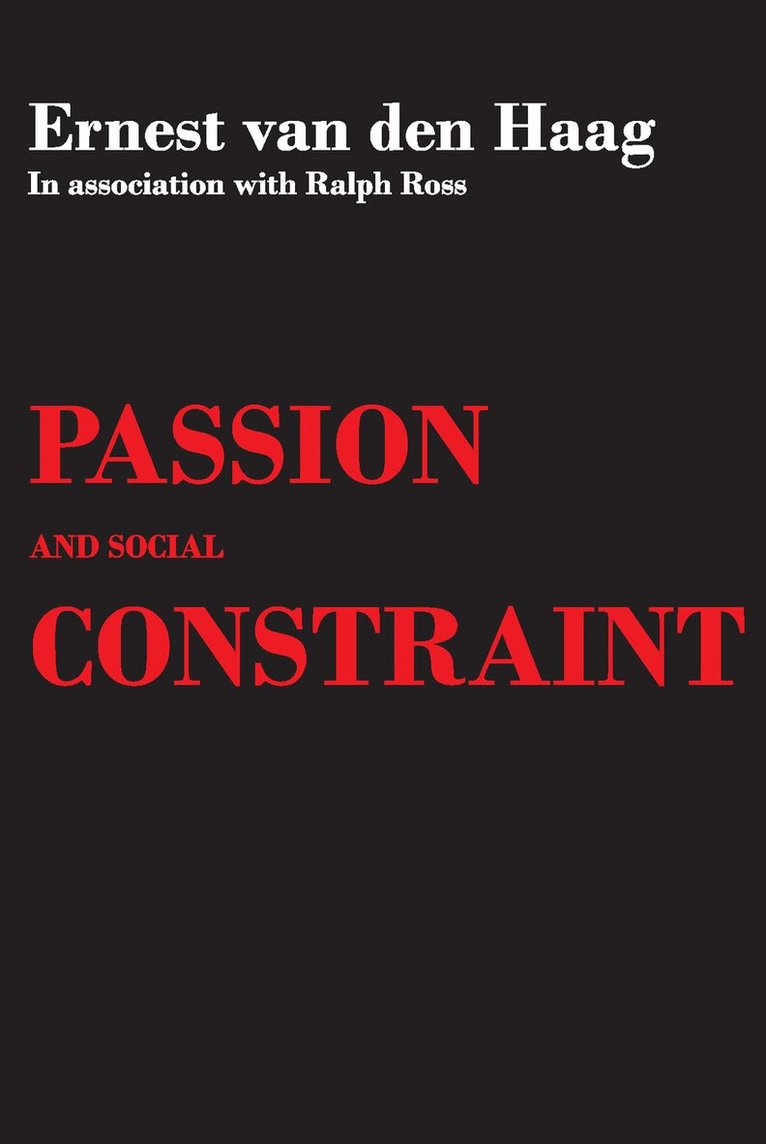
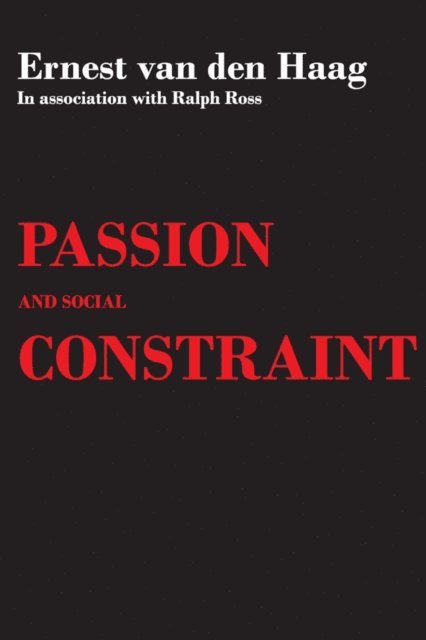
In intellectual and academic circles, Ernest van den Haag is respected for his brilliant mind, his outspoken and often highly controversial assertions, and a very unacademic, sharp, biting style.Passion and Social Constraint, before its adaptation into a book for the general reader, was part of an enormous textbook, which Dr. van den Haag wrote with Professor Ralph Ross called The Fabric of Society. It received an (unprecedented) rave review in the New Yorker: "àthis book is everything a text book should not be--cynical, witty, up-to-date, and shamelessly opinionatedà Altogether a rare treat." It attracted the attention of the experts in psychology and sociology and the devotion of students and will now have enormous appeal to the layman who wants insight into who he is: sexually, psychologically, and individually.In Passion and Social Constraint, Ernest van den Haag is deeply concerned with the necessity and difficulty of being an individual in a society which tends more and more to standardize every facet of life. Be deals with anxiety; sex, and the problem of-who is normal; the status of women; the authority of parents; the family as an industry in present-day America conflict and power, and who gets what; the "furnished souls" of popular culture; arid why it is that science cannot give us a measure for happiness or for despair. Van den Haag' s style will delight you (some of his phrases are destined for Bartlett), though his judgments will, sometimes stir you to anger.
447 kr
Skickas inom 10-15 vardagar
Thomas Hobbes in His Time was first published in 1975. Minnesota Archive Editions uses digital technology to make long-unavailable books once again accessible, and are published unaltered from the original University of Minnesota Press editions.Thomas Hobbes, the seventeenth-century English philosopher, is the subject of lively discussion among philosophers, historians, and political theorists today. Both as a participant in a revolutionary commonwealth and as a student of the science of human nature, Hobbes has achieved a new relevance to contemporary society. As the editors of this volume point out, moralists are apt to place him in the twentieth century, and historians are apt to portray him as an antique. The aim of these essays is to get an accurate account of how radical Hobbes was in his own revolutionary century.The essays are the fruit of years of cooperative study, going back to John Dewey's calling attention to Hobbe's interest in transforming the courts of common law into courts of equity. The recent discovery of more manuscripts and the publication of better editions of his writings have stimulated an extensive reinterpretation of Hobbe's ideas and goals.Even in his own time, Hobbes was subject to attacks from many sides. Although scholars now generally reject the stereotype of "Hobbism" which grew during four centuries of revolutionary developments, new stereotypes to describe his philosophy have emerged. By assessing Hobbes in terms of his own day, the book will serve to counteract much contemporary misunderstanding.The essays cover four aspects of Hobbe's thought: his political theory, his views on religion, his moral philosophy, and his theory of motion and philosophical method. With the exception of John Dewey's "The Motivation of Hobbes's Political Philosophy," all the essays were written especially for this book. The other essays and authors are "The Anglican Theory of Salvation in Hobbes" by Paul Johnson, San Bernardino State College; "Some Puzzles in Hobbes" by Ralph Ross, Scripps College, The Claremont Colleges; "The Piety of Hobbes" by Herbert W. Schneider, emeritus professor of Columbia University and Claremont Graduate School, The Claremont Colleges; "The Generation of the Public Person" by Theodore Waldman, Harvey Mudd College, The Claremont Colleges; and "The Philosophia Prima of Thomas Hobbes" by Craig Walton, University of Nevada.
2 113 kr
Skickas inom 10-15 vardagar
In intellectual and academic circles, Ernest van den Haag is respected for his brilliant mind, his outspoken and often highly controversial assertions, and a very unacademic, sharp, biting style.Passion and Social Constraint, before its adaptation into a book for the general reader, was part of an enormous textbook, which Dr. van den Haag wrote with Professor Ralph Ross called The Fabric of Society. It received an (unprecedented) rave review in the New Yorker: "àthis book is everything a text book should not be--cynical, witty, up-to-date, and shamelessly opinionatedà Altogether a rare treat." It attracted the attention of the experts in psychology and sociology and the devotion of students and will now have enormous appeal to the layman who wants insight into who he is: sexually, psychologically, and individually.In Passion and Social Constraint, Ernest van den Haag is deeply concerned with the necessity and difficulty of being an individual in a society which tends more and more to standardize every facet of life. Be deals with anxiety; sex, and the problem of-who is normal; the status of women; the authority of parents; the family as an industry in present-day America conflict and power, and who gets what; the "furnished souls" of popular culture; arid why it is that science cannot give us a measure for happiness or for despair. Van den Haag' s style will delight you (some of his phrases are destined for Bartlett), though his judgments will, sometimes stir you to anger.