Ramon H. Myers - Böcker
Visar alla böcker från författaren Ramon H. Myers. Handla med fri frakt och snabb leverans.
12 produkter
12 produkter
816 kr
Skickas inom 5-8 vardagar
The authoritarian Chinese regimes governing Taiwan, Mainland China, and Hong Kong allowed limited electoral competition during the last half century. In Taiwan that process evolved over more than three decades before leading to the formation of an opposition party under martial law in late September 1986 and the blossoming of full democracy in March 2000 when that opposition party replaced the ruling party. In Mainland China and Hong Kong, limited electoral competition has only evolved over the last fifteen years or so.This volume examines why and how limited electoral competition developed in Greater China. The editors use a typology and different concepts to analyse how the political centre in these three Chinese societies historically interacted with society and how different regime change took place. Their analysis attributes Taiwan's robust electoral competition under martial law to political breakthroughs in the political, ideological, economic, and organizational marketplaces.Without similar political breakthroughs in Mainland China and Hong Kong, their limited electoral processes are not likely to lead to the election of one or more opposition parties in Mainland China and the direct election of a Hong Kong governor and parliament. These two authoritarian regimes have adopted different institutions, or rules, to limit electoral competition. Moreover, different changes have been taking place in their political, ideological, economic, and organizational marketplaces than occurred in Taiwan. Therefore, whether these two Chinese societies can mimic the Taiwan democratization path remains problematic. Only the passage of time will reveal whether their limited electoral competitive processes can transform into full democracy.
Taiwan's Economic Transformation
Leadership, Property Rights and Institutional Change 1949-1965
Inbunden, Engelska, 2011
2 219 kr
Skickas inom 10-15 vardagar
This book tells the story of Taiwan’s economic revolution—how Taiwan transformed itself from a planned economy into a market economy between 1949 and 1965. The authors posit that it was the Kuomintang Government's endorsement of property rights reform and institutional change that enabled Taiwan to transform from an impoverished command economy to one of the fastest growing economies in the world. The book gives special attention to how a small group of political and economic leaders began adopting the new ideas and beliefs that created the vision that enabled them to embrace institutional and organizational innovations, actions which led to the formation of the new market economy. Using first-hand interview material with key government officials from the period, and analyses of hitherto unused Chinese-language archives including: the diaries of Chiang Kai-shek, Kuomintang party archives, and personal papers of Kuomintang leaders, as well as newspaper and journal articles published in Taiwan between 1949 and 1965, this book is both empirically rich, and gives the reader insights into Taiwan's developmental experience and the direction in which, under different circumstances, China's post-war expansion might have proceeded.Taiwan's Economic Transition will be an invaluable resource for anyone interested in the economic and political history and development of Taiwan. More broadly it will also appeal to scholars and students of China's historical and contemporary development, Asian economics, and Asian studies.
Del 4 - The China Quarterly Special Issues
The New Chinese Leadership
Challenges and Opportunities after the 16th Party Congress
Häftad, Engelska, 2004
376 kr
Skickas inom 7-10 vardagar
This volume presents a concise history of how China's Communist Party (CCP) selected a new generation of leaders in late 2002 and why the individuals, in their late 40s and 50s, were so well qualified to govern China. These leaders are trying to lead China to become a regional and world power in which their people can enjoy a modest living standard and take pride in the nation's achievements. Addressed to the expert or ordinary reader, these essays see China's leaders as challenged by a new trend, visible only in the last decade, of a widening gap between the losers in society and the winners of the recent economic and political reforms. The leaders of the largest, single ruling party and state authority in the world must somehow reverse that trend if China is to survive as one nation. This volume explains they are doing that by reconfiguring their huge command economy, promoting a market economy, and undertaking gradual political reforms. It is unflinching in its discussion of how China's leaders face mounting political corruption, spreading unemployment, growing disparity of wealth and income, and a crisis of belief.
712 kr
Skickas inom 7-10 vardagar
These essays, by thirteen specialists from Japan and the United States, provide a comprehensive view of the Japanese empire from its establishment in 1895 to its liquidation in 1945. They offer a variety of perspectives on subjects previously neglected by historians: the origin and evolution of the formal empire (which comprised Taiwan, Korea, Karafuto. the Kwantung Leased Territory, and the South Seas Mandated Islands), the institutions and policies by which it was governed, and the economic dynamics that impelled it. Seeking neither to justify the empire nor to condemn it, the contributors place it in the framework of Japanese history and in the context of colonialism as a global phenomenon. Contributors are Ching-chih Chen. Edward I-te Chen, Bruce Cumings, Peter Duus, Lewis H. Gann, Samuel Pao-San Ho, Marius B. Jansen, Mizoguchi Toshiyuki, Ramon H. Myers, Mark R. Peattie, Michael E. Robinson, E. Patricia Tsurumi. Yamada Sabur?, Yamamoto Y?zo?.
388 kr
Skickas inom 7-10 vardagar
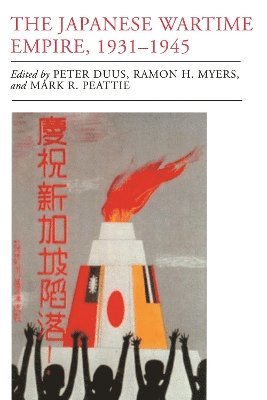
With this book the editors complete the three-volume series on modern Japanese colonialism and imperialism that began with The Japanese Colonial Empire, 1895-1945 (Princeton, 1983) and The Japanese Informal Empire in China, 1895-1937 (Princeton, 1989). The Japanese military takeover in Manchuria between 1931 and 1932 was a critical turning point in East Asian history. It marked the first surge of Japanese aggression beyond the boundaries of its older colonial empire and set Japan on a collision course with China and Western colonial powers from 1937 through 1945. These essays seek to illuminate some of the more significant processes and institutions during the period when the empire was at war: the creation of a Japanese-dominated East Asian economic bloc centered in northeast Asia, the mobilization of human and physical resources in the older established areas of Japanese colonial rule, and the penetration and occupation of Southeast Asia. Introduced by Peter Duus, the volume contains four sections: Japan's Wartime Empire and the Formal Colonies (Carter J. Eckert and Wan-yao Chou), Japan's Wartime Empire and Northeast Asia (Louise Young, Y. Tak Matsusaka, Ramon H.Myers, and Takafusa Nakamura), Japan's Wartime Empire and Southeast Asia (Mark R. Peattie, E. Bruce Reynolds, and Ken'ichi Goto), and Japan's Wartime Empire in Other Perspectives (George Hicks, Hideo Kobayashi, and L. H. Gann).
412 kr
Skickas inom 7-10 vardagar
Volume two of the acclaimed three-volume series on modern Japanese colonialism and imperialismThis book brings together essays by leading experts on the history of Japan to examine the period from 1895 to 1937 when Japan’s economic, social, political, and military influence in China expanded so rapidly that it supplanted the influence of competing Western powers. They discuss how Japan’s informal empire emerged in China after Japan entered the Treaty Port system in 1895 and how it shaped Japan’s own internal development. How did Japan’s informal empire expand in size and importance so that Japanese economic and security interests became heavily dependent on China? What influence did Japanese business groups, China experts, and military have on their government’s China policy? How did the Japanese in China deal with the threatening rise of Chinese nationalism? Exploring these and other questions, these essays show how the pursuit of an informal empire in China played a profound role in the emergence of modern Japan. The contributors are Banno Junji, Barbara J. Brooks, Alvin D. Coox, Peter Duus, Albert Feuerwerker, Kitaoka Shin’ichi, Sophia Lee, Mizoguchi Toshiyuki, Ramon H. Myers, Nakagane Katsuji, Mark R. Peattie, Douglas R. Reynolds, and William D. Wray.This is the second volume of a series on modern Japanese colonialism and imperialism. Volume one is The Japanese Colonial Empire, 1895–1945. Volume three is The Japanese Wartime Empire, 1931–1945.
1 612 kr
Skickas inom 7-10 vardagar
Volume two of the acclaimed three-volume series on modern Japanese colonialism and imperialismThis book brings together essays by leading experts on the history of Japan to examine the period from 1895 to 1937 when Japan’s economic, social, political, and military influence in China expanded so rapidly that it supplanted the influence of competing Western powers. They discuss how Japan’s informal empire emerged in China after Japan entered the Treaty Port system in 1895 and how it shaped Japan’s own internal development. How did Japan’s informal empire expand in size and importance so that Japanese economic and security interests became heavily dependent on China? What influence did Japanese business groups, China experts, and military have on their government’s China policy? How did the Japanese in China deal with the threatening rise of Chinese nationalism? Exploring these and other questions, these essays show how the pursuit of an informal empire in China played a profound role in the emergence of modern Japan. The contributors are Banno Junji, Barbara J. Brooks, Alvin D. Coox, Peter Duus, Albert Feuerwerker, Kitaoka Shin’ichi, Sophia Lee, Mizoguchi Toshiyuki, Ramon H. Myers, Nakagane Katsuji, Mark R. Peattie, Douglas R. Reynolds, and William D. Wray.This is the second volume of a series on modern Japanese colonialism and imperialism. Volume one is The Japanese Colonial Empire, 1895–1945. Volume three is The Japanese Wartime Empire, 1931–1945.
627 kr
Tillfälligt slut
Building upon a previous study of Japan's colonial empire, this volume examines the period from 1895 to 1937 when Japan's economic, social, political, and military influence in China expanded so rapidly that it supplanted the influence of Western powers competing there. These fourteen essays discuss how Japan's "informal empire" emerged in China and how that "empire" influenced Japan's own internal development. "Describes in rich detail Japan's organization of a wide range of cultural, educational, economic, military, and bureaucratic institutions that formed the mainstays of Japanese influence in China along with the trading, manufacturing, intelligence-gathering, and political intriguing which they managed."--Wen-hsin Yeh, The Journal of Asian Studies Originally published in 1989. The Princeton Legacy Library uses the latest print-on-demand technology to again make available previously out-of-print books from the distinguished backlist of Princeton University Press. These editions preserve the original texts of these important books while presenting them in durable paperback and hardcover editions.The goal of the Princeton Legacy Library is to vastly increase access to the rich scholarly heritage found in the thousands of books published by Princeton University Press since its founding in 1905.
1 781 kr
Skickas inom 7-10 vardagar
Building upon a previous study of Japan's colonial empire, this volume examines the period from 1895 to 1937 when Japan's economic, social, political, and military influence in China expanded so rapidly that it supplanted the influence of Western powers competing there. These fourteen essays discuss how Japan's "informal empire" emerged in China and how that "empire" influenced Japan's own internal development. "Describes in rich detail Japan's organization of a wide range of cultural, educational, economic, military, and bureaucratic institutions that formed the mainstays of Japanese influence in China along with the trading, manufacturing, intelligence-gathering, and political intriguing which they managed."--Wen-hsin Yeh, The Journal of Asian Studies Originally published in 1989. The Princeton Legacy Library uses the latest print-on-demand technology to again make available previously out-of-print books from the distinguished backlist of Princeton University Press. These editions preserve the original texts of these important books while presenting them in durable paperback and hardcover editions.The goal of the Princeton Legacy Library is to vastly increase access to the rich scholarly heritage found in the thousands of books published by Princeton University Press since its founding in 1905.
742 kr
Skickas inom 10-15 vardagar
This thoughtful volume is the first to evaluate comprehensively the formation and execution of U.S. policy toward China and Taiwan during the crucial twelve years of the Bush and Clinton administrations. Drawing on an unprecedented array of sources, a group of leading international experts explores the increasingly complex environment facing policymakers in the wake of the tragic events of Tiananmen, particularly the growing role played by interest group lobbies, media commentary, and Congress. All these influences combined to dismantle the bipartisan agreement that had supported positive relations with Beijing, replacing it with a more politicized and pluralized policy arena. The authors document how, within this new context, the Bush and Clinton administrations struggled to forge consensus, implement China policies, and maintain a modicum of relations with the PRC. The study focuses systematically on the range of domestic influences, but also considers the less-obvious but vital roles played by European and Asian nations, as well as Taiwan and China itself. Offering novel interpretations based on pathbreaking research, this book will be indispensable for all those interested in understanding the intricacies that influence the delicate relationship between the United States, China, and Taiwan.
387 kr
Skickas inom 5-8 vardagar
The political transformation of Taiwan from an authoritarian regime into a democracy is one of the great political sagas of the 20th century. Defeated on the China mainland, the Kuomintang established a new polity on Taiwan that allowed for four remarkable patterns of political development. These patterns reflect a complex political process of behavioral and institutional change in which the key requisites for democracy now exist in Taiwan. Taiwan's history of citizen participation in direct elections, along with the political institutional changes narrated here by Chao and Myers, produced an unprecedented, peaceful political turn-over of power from the KMT ruling party to the DPP, or Democratic Progressive Party, in March 2000.
Taiwan's Economic Transformation
Leadership, Property Rights and Institutional Change 1949-1965
Häftad, Engelska, 2015
691 kr
Skickas inom 10-15 vardagar
This book tells the story of Taiwan’s economic revolution—how Taiwan transformed itself from a planned economy into a market economy between 1949 and 1965. The authors posit that it was the Kuomintang Government's endorsement of property rights reform and institutional change that enabled Taiwan to transform from an impoverished command economy to one of the fastest growing economies in the world. The book gives special attention to how a small group of political and economic leaders began adopting the new ideas and beliefs that created the vision that enabled them to embrace institutional and organizational innovations, actions which led to the formation of the new market economy. Using first-hand interview material with key government officials from the period, and analyses of hitherto unused Chinese-language archives including: the diaries of Chiang Kai-shek, Kuomintang party archives, and personal papers of Kuomintang leaders, as well as newspaper and journal articles published in Taiwan between 1949 and 1965, this book is both empirically rich, and gives the reader insights into Taiwan's developmental experience and the direction in which, under different circumstances, China's post-war expansion might have proceeded.Taiwan's Economic Transition will be an invaluable resource for anyone interested in the economic and political history and development of Taiwan. More broadly it will also appeal to scholars and students of China's historical and contemporary development, Asian economics, and Asian studies.