Ranajit Guha - Böcker
Visar alla böcker från författaren Ranajit Guha. Handla med fri frakt och snabb leverans.
5 produkter
5 produkter
643 kr
Skickas inom 5-8 vardagar
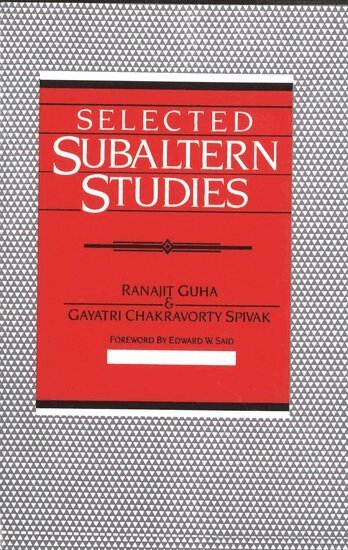
This book collects ten essays from the five volumes of Subaltern Studies that have so far appeared. The aim of the studies is to 'promote a systematic and informed discussion of subaltern themes in the field of South Asian studies, and thus help to rectify the elitist bias characteristic of much research and academic work in this particular area. The contributors...focus attention on what Gramsci called the subaltern classes and their condition, and also re-examine well-known events and themes in the new, more rounded perspective. The contributors encompass history, politics, economics and sociology; attitudes, ideologies, and belief systems.' Gayatri Chakravorty Spivak's essay 'Subaltern Studies: Deconstructing Historiography' introduces the volume and Edward Said, Professor of English and Comparative Literature at Columbia has provided a foreword.
474 kr
Skickas inom 3-6 vardagar
The past is not just, as has been famously said, another country with foreign customs: it is a contested and colonized terrain. Indigenous histories have been expropriated, eclipsed, sometimes even wholly eradicated, in the service of imperialist aims buttressed by a distinctly Western philosophy of history. Ranajit Guha, perhaps the most influential figure in postcolonial and subaltern studies at work today, offers a critique of such historiography by taking issue with the Hegelian concept of World-history. That concept, he contends, reduces the course of human history to the amoral record of states and empires, great men and clashing civilizations. It renders invisible the quotidian experience of ordinary people and casts off all that came before it into the nether-existence known as "Prehistory." On the Indian subcontinent, Guha believes, this Western way of looking at the past was so successfully insinuated by British colonization that few today can see clearly its ongoing and pernicious influence.He argues that to break out of this habit of mind and go beyond the Eurocentric and statist limit of World-history historians should learn from literature to make their narratives doubly inclusive: to extend them in scope not only to make room for the pasts of the so-called peoples without history but to address the historicality of everyday life as well. Only then, as Guha demonstrates through an examination of Rabindranath Tagore's critique of historiography, can we recapture a more fully human past of "experience and wonder."
Del 17 - Convergences: Inventories of the Present
Dominance without Hegemony
History and Power in Colonial India
Häftad, Engelska, 1998
442 kr
Skickas inom 7-10 vardagar
What is colonialism and what is a colonial state? Ranajit Guha points out that the colonial state in South Asia was fundamentally different from the metropolitan bourgeois state which sired it. The metropolitan state was hegemonic in character, and its claim to dominance was based on a power relation in which persuasion outweighed coercion. Conversely, the colonial state was non-hegemonic, and in its structure of dominance coercion was paramount. Indeed, the originality of the South Asian colonial state lay precisely in this difference: a historical paradox, it was an autocracy set up and sustained in the East by the foremost democracy of the Western world. It was not possible for that non-hegemonic state to assimilate the civil society of the colonized to itself. Thus the colonial state, as Guha defines it in this closely argued work, was a paradox--a dominance without hegemony.Dominance without Hegemony had a nationalist aspect as well. This arose from a structural split between the elite and subaltern domains of politics, and the consequent failure of the Indian bourgeoisie to integrate vast areas of the life and consciousness of the people into an alternative hegemony. That predicament is discussed in terms of the nationalist project of anticipating power by mobilizing the masses and producing an alternative historiography. In both endeavors the elite claimed to speak for the people constituted as a nation and sought to challenge the pretensions of an alien regime to represent the colonized. A rivalry between an aspirant to power and its incumbent, this was in essence a contest for hegemony.
291 kr
Skickas inom 7-10 vardagar
The Subaltern Studies Collective, founded in 1982, begun with the goal of establishing a new critique of both colonialist and nationalist perspectives in the historiography of colonized countries. These essays chart the course of subaltern history from an early concentration on peasant revolts and popular insurgency to an engagement with the more complex processes of domination and subordination, in a variety of the changing institutions and practices of evolving modernity.
319 kr
Skickas inom 7-10 vardagar
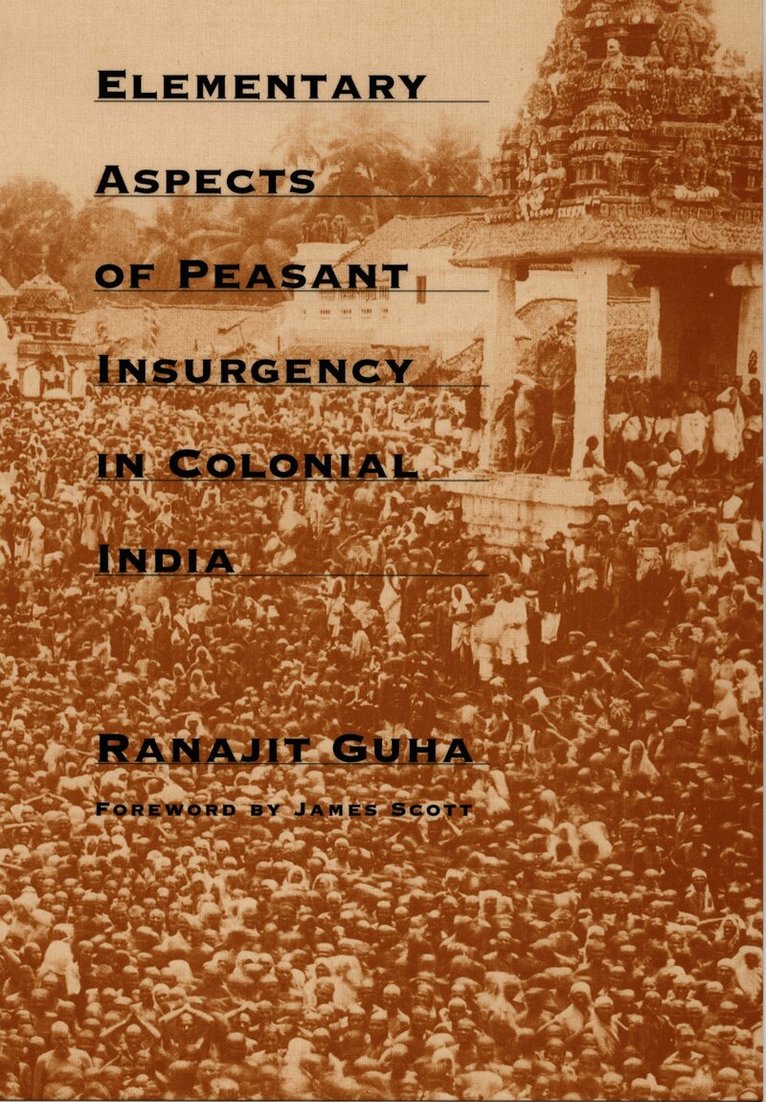
Foreword by James ScottThis classic work in subaltern studies explores the common elements present in rebel consciousness during the Indian colonial period. Ranajit Guha-intellectual founder of the groundbreaking and influential Subaltern Studies Group-describes from the peasants’ viewpoint the relations of dominance and subordination in rural India from 1783 to 1900. Challenging the idea that peasants were powerless agents who rebelled blindly against British imperialist oppression and local landlord exploitation, Guha emphasizes their awareness and will to effect political change. He suggests that the rebellions represented the birth of a theoretical consciousness and asserts that India’s long subaltern tradition lent power to the landmark insurgence led by Mahatma Gandhi. Yet as long as landlord authority remains dominant in a ruling culture, Guha claims, all mass struggles will tend to model themselves after the unfinished projects documented in this book. Students and scholars will welcome this paperback edition of Guha’s 1983 original, which was distributed on a limited scale in the United States. It will influence new generations studying colonialism, postcolonialism, subaltern studies, historiography, anthropology, and Indian, Asian, and Latin American history.