Raven Garvey - Böcker
Visar alla böcker från författaren Raven Garvey. Handla med fri frakt och snabb leverans.
4 produkter
4 produkter
987 kr
Skickas inom 10-15 vardagar
HunterGatherers
715 kr
Skickas inom 10-15 vardagar
Hunter-gatherer research has played a historically central role in the development of anthropological and evolutionary theory. Today, research in this traditional and enduringly vital field blurs lines of distinction between archaeology and ethnology, and seeks instead to develop perspectives and theories broadly applicable to anthropology and its many sub disciplines. In the groundbreaking first edition of Hunter-Gatherers: Archaeological and Evolutionary Theory (1991), Robert Bettinger presented an integrative perspective on hunter-gatherer research and advanced a theoretical approach compatible with both traditional anthropological and contemporary evolutionary theories.Hunter-Gatherers remains a well-respected and much-cited text, now over 20 years since initial publication. Yet, as in other vibrant fields of study, the last two decades have seen important empirical and theoretical advances. In this second edition of Hunter-Gatherers, co-authors Robert Bettinger, Raven Garvey, and Shannon Tushingham offer a revised and expanded version of the classic text, which includes a succinct and provocative critical synthesis of hunter-gatherer and evolutionary theory, from the Enlightenment to the present. New and expanded sections relate and react to recent developments—some of them the authors’ own—particularly in the realms of optimal foraging and cultural transmission theories.An exceptionally informative and ambitious volume on cultural evolutionary theory, Hunter-Gatherers, second edition, is an essential addition to the libraries of anthropologists, archaeologists, and human ecologists alike.
Patagonian Prehistory
Human Ecology and Cultural Evolution in the Land of Giants
Inbunden, Engelska, 2021
710 kr
Skickas inom 7-10 vardagar
Generally portrayed as a windswept wasteland of marginal use for human habitation, Patagonia is an unmatched testing ground for some of the world's most important questions about human ecology and cultural change. In this volume, archaeologist Raven Garvey presents a critical synthesis of Patagonian prehistory, bringing an evolutionary perspective and unconventional evidence to bear on enduringly contentious issues in New World archaeology, including initial human colonization of the Americas, widespread depopulation between 8,000 and 4,000 years ago, and the transition from foraging to farming. Garvey's novel hypotheses question common assumptions regarding Patagonia's suitability for prehistoric hunter-gatherers. She makes four primary arguments: (1) the surprising lack of clothing in parts of prehistoric Patagonia supports a relatively slow initial colonization of the Americas; (2) the sparse record of human habitation during the middle Holocene may be due to prehistoric behavioral changes and archaeological sampling methods rather than population decline; (3) farming never took root in Patagonia because risks associated with farming likely outweighed potential benefits; and, finally, (4) the broad trajectory of cultural change in Patagonia owes as much to feedback between population size and technology as to conditions in the rugged Patagonian outback itself.
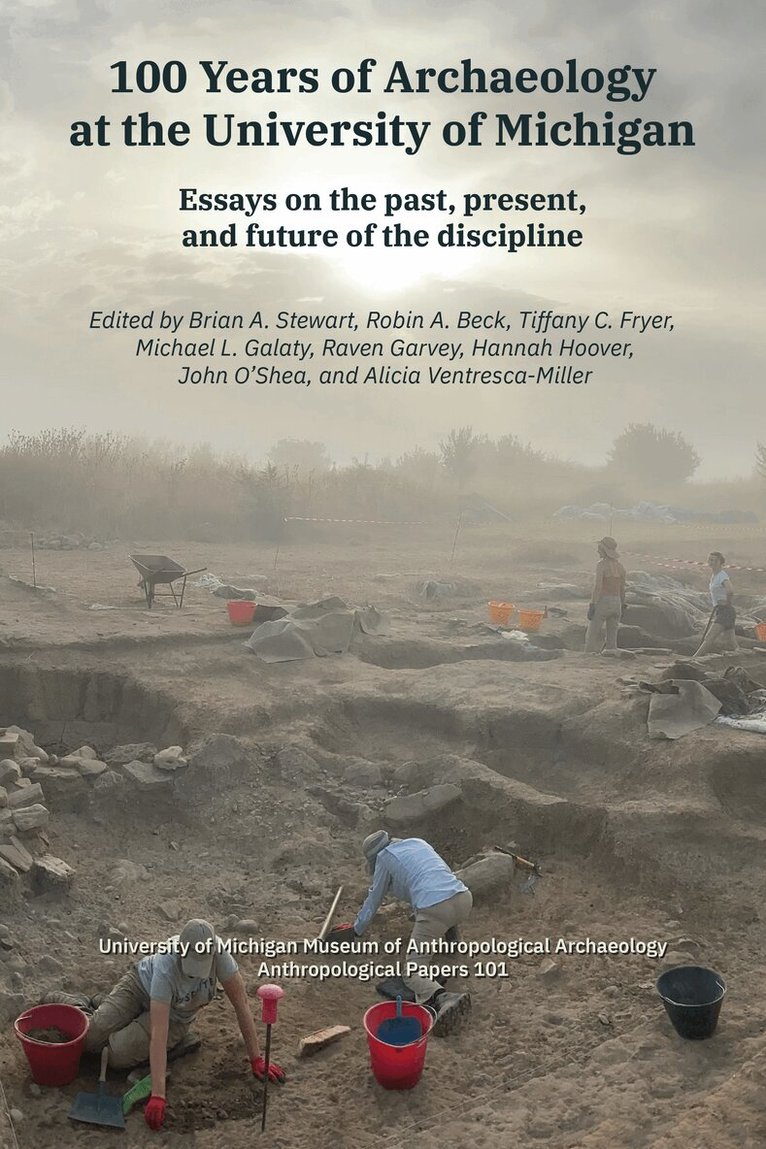
100 Years of Archaeology at the University of Michigan
Essays on the Past, Present, and Future of the Discipline
Häftad, Engelska, 2025
545 kr
Skickas inom 7-10 vardagar
The University of Michigan has been at the forefront of archaeological research for more than 100 years, since 1922, when the Museum of Anthropology (now the Museum of Anthropological Archaeology) was established on the Ann Arbor campus. The goal of its curators for many decades was to create a research and teaching program that emphasized methodological rigor in the analysis of archaeological materials, attempting to solve grand questions about human behavior through fieldwork, collections, and laboratory work. About fifty years ago, the Museum's emphasis shifted to developing archaeological theory when a new generation of curators with processualist leanings made Ann Arbor a testing ground for the so-called New Archaeology. Now, archaeology stands at a crossroads. Some archaeologists refer to the death of archaeological theory. Others stake out opposed camps of generalists and particularists. At U-M, as at many other universities, the past decade has seen a new commitment to collaborative archaeology, working with descendant communities and acknowledging the discipline's roots in colonialism and extraction. In 2022, to celebrate a century of existence, the University of Michigan Museum of Anthropological Archaeology (UMMAA) hosted an international conference to explore possibilities for a middle way: an archaeology for the next 100 years, combining humanistic and scientific approaches, which allows for both agents and systems, description and explanation, science and heritage. This volume is meant to be a snapshot of that conference and this moment in the development of the discipline. Included are most of the papers and posters presented, as well as photographs of the panels and the proceedings.