Ray Jackendoff - Böcker
Visar alla böcker från författaren Ray Jackendoff. Handla med fri frakt och snabb leverans.
12 produkter
12 produkter
589 kr
Skickas inom 5-8 vardagar
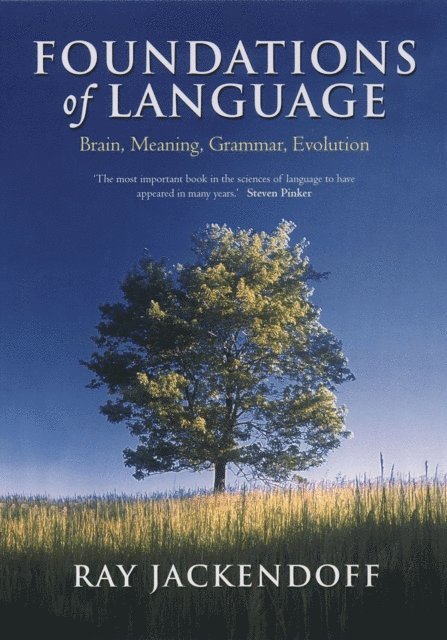
How does human language work? How do we put ideas into words that others can understand? Can linguistics shed light on the way the brain operates? Foundations of Language puts linguistics back at the centre of the search to understand human consciousness. Ray Jackendoff begins by surveying the developments in linguistics over the years since Noam Chomsky's Aspects of the Theory of Syntax. He goes on to propose a radical re-conception of how the brain processes language. This opens up vivid new perspectives on every major aspect of language and communication, including grammar, vocabulary, learning, the origins of human language, and how language relates to the real world. Foundations of Language makes important connections with other disciplines which have been isolated from linguistics for many years. It sets a new agenda for close cooperation between the study of language, mind, the brain, behaviour, and evolution.
2 491 kr
Skickas inom 7-10 vardagar
Already hailed as a masterpiece, Foundations of Language offers a brilliant overhaul of the last thirty-five years of research in generative linguistics and related fields. "Few books really deserve the cliché 'this should be read by every researcher in the field'," writes Steven Pinker, author of The Language Instinct, "but Ray Jackendoff's Foundations of Language does." Foundations of Language offers a radically new understanding of how language, the brain, and perception intermesh. The book renews the promise of early generative linguistics: that language can be a valuable entrée into understanding the human mind and brain. The approach is remarkably interdisciplinary. Behind its innovations is Jackendoff's fundamental proposal that the creativity of language derives from multiple parallel generative systems linked by interface components. This shift in basic architecture makes possible a radical reconception of mental grammar and how it is learned. As a consequence, Jackendoff is able to reintegrate linguistics with philosophy of mind, cognitive and developmental psychology, evolutionary biology, neuroscience, and computational linguistics. Among the major topics treated are language processing, the relation of language to perception, the innateness of language, and the evolution of the language capacity, as well as more standard issues in linguistic theory such as the roles of syntax and the lexicon. In addition, Jackendoff offers a sophisticated theory of semantics that incorporates insights from philosophy of language, logic and formal semantics, lexical semantics of various stripes, cognitive grammar, psycholinguistic and neurolinguistic approaches, and the author's own conceptual semantics.
267 kr
Skickas inom 5-8 vardagar
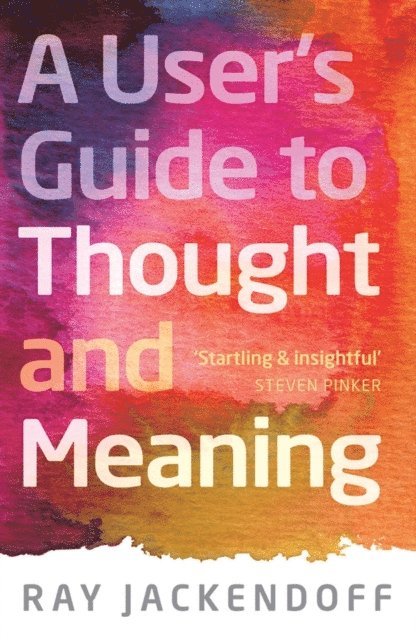
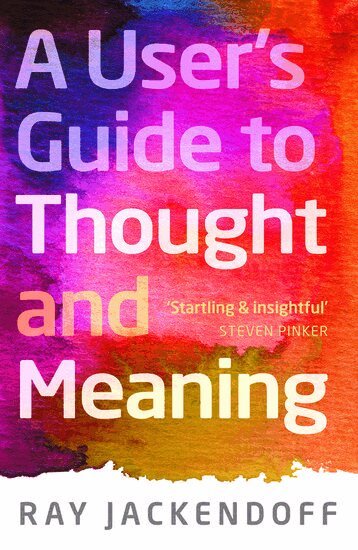
A User's Guide to Thought and Meaning presents a profound and arresting integration of the faculties of the mind - of how we think, speak, and see the world.Ray Jackendoff starts out by looking at languages and what the meanings of words and sentences actually do. He shows that meanings are more adaptive and complicated than they're commonly given credit for, and he is led to some basic questions: How do we perceive and act in the world? How do we talk about it? And how can the collection of neurons in the brain give rise to conscious experience? As it turns out, the organization of language, thought, and perception does not look much like the way we experience things, and only a small part of what the brain does is conscious. Jackendoff concludes that thought and meaning must be almost completely unconscious. What we experience as rational conscious thought - which we prize as setting us apart from the animals - in fact rides on a foundation of unconscious intuition. Rationality amounts to intuition enhanced by language.Written with an informality that belies both the originality of its insights and the radical nature of its conclusions, A User's Guide to Thought and Meaning is the author's most important book since the groundbreaking Foundations of Language in 2002.
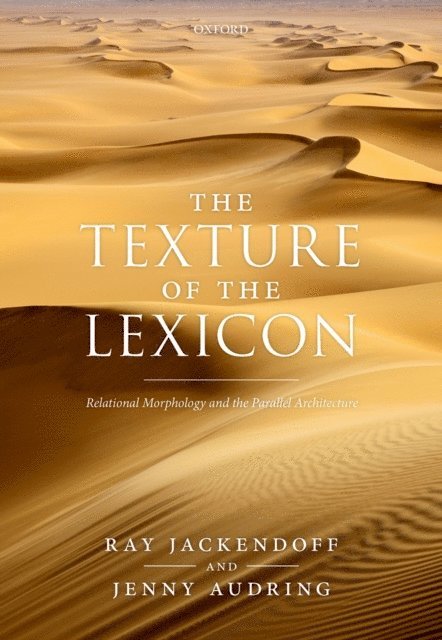
The Texture of the Lexicon
Relational Morphology and the Parallel Architecture
Inbunden, Engelska, 2019
1 014 kr
Skickas inom 5-8 vardagar
In this volume, Ray Jackendoff and Jenny Audring embark on a major reconceptualization of linguistic theory as seen through the lens of morphology. Their approach, Relational Morphology, extends the Parallel Architecture developed by Jackendoff in Foundations of Language (2002), Simpler Syntax (2005), and Meaning and the Lexicon (2010). The framework integrates morphology into the overall architecture of language, enabling it to interact insightfully with phonology, syntax, semantics, and above all, the lexicon. The first part of the book situates morphology in the language faculty, and introduces a novel formalism that unifies the treatment of all morphological patterns, inflectional or derivational, systematic or marginal. Central to the theory is the lexicon, which both incorporates the rules of grammar and explicitly encodes relationships among words and among grammatical patterns. Part II puts the theory to the test, applying it to a wide range of familiar and less familiar morphological phenomena. Part III connects Relational Morphology with issues of language processing and language acquisition, and shows how its formal tools can be extended to a variety of linguistic and nonlinguistic phenomena outside morphology. The value of Relational Morphology thus lies not only in the fact that it can account for a range of morphological phenomena, but also in how it integrates linguistic theory, psycholinguistics, and human cognition.
367 kr
Skickas
In this volume, Ray Jackendoff and Jenny Audring embark on a major reconceptualization of linguistic theory as seen through the lens of morphology. Their approach, Relational Morphology, extends the Parallel Architecture developed by Jackendoff in Foundations of Language (2002), Simpler Syntax (2005), and Meaning and the Lexicon (2010). The framework integrates morphology into the overall architecture of language, enabling it to interact insightfully with phonology, syntax, semantics, and above all, the lexicon. The first part of the book situates morphology in the language faculty, and introduces a novel formalism that unifies the treatment of all morphological patterns, inflectional or derivational, systematic or marginal. Central to the theory is the lexicon, which both incorporates the rules of grammar and explicitly encodes relationships among words and among grammatical patterns. Part II puts the theory to the test, applying it to a wide range of familiar and less familiar morphological phenomena. Part III connects Relational Morphology with issues of language processing and language acquisition, and shows how its formal tools can be extended to a variety of linguistic and nonlinguistic phenomena outside morphology. The value of Relational Morphology thus lies not only in the fact that it can account for a range of morphological phenomena, but also in how it integrates linguistic theory, psycholinguistics, and human cognition.
1 180 kr
Skickas inom 5-8 vardagar
Parentheticals, it is fair to say, are everywhere, and, as can easily be shown, they come in a huge variety of flavors. Two characteristics set them apart from ordinary arguments and adjuncts: they tend to show some freedom of position within their hosts, and they tend to be semantically opaque to scope of quantification, negation, and long-distance dependencies. This study demonstrates that parentheticals are independent pieces of language that are jammed into their host, subject to prosodic constraints, and they stand in some discourse relation to the host, serving as a side comment or as supporting material. But, crucially, parentheticals are "asyntactic": they are not syntactic constituents of their host.The analysis is couched in terms of Jackendoff's Parallel Architecture, in which phonology, syntax, and semantics are independent but linked generative systems, and in which words and rules of grammar are encoded in a common format. In support of the asyntactic treatment of parentheticals, this study develops accounts of prosody and discourse structure, components of the grammar that are new to the Parallel Architecture. The work presented here is innovative in several respects. First, it addresses and formalizes a wide range of parenthetical types, where most previous studies have dealt with only a limited selection. Second, it integrates the prosodic, syntactic, semantic, and discourse aspects of parentheticals, where most previous studies have dealt with only the prosody or only the semantics/discourse structure. Finally, many aspects of the analysis give reason to prefer the Parallel Architecture over other theories of grammatical structure.
1 020 kr
Skickas inom 5-8 vardagar
This groundbreaking book offers a new and compelling perspective on the structure of human language. The fundamental issue it addresses is the proper balance between syntax and semantics, between structure and derivation, and between rule systems and lexicon. It argues that the balance struck by mainstream generative grammar is wrong. It puts forward a new basis for syntactic theory, drawing on a wide range of frameworks, and charts new directions for research. In the past four decades, theories of syntactic structure have become more abstract, and syntactic derivations have become ever more complex. Peter Culicover and Ray Jackendoff trace this development through the history of contemporary syntactic theory, showing how much it has been driven by theory-internal rather than empirical considerations. They develop an alternative that is responsive to linguistic, cognitive, computational, and biological concerns. Simpler Syntax is addressed to linguists of all persuasions. It will also be of central interest to those concerned with language in psychology, human biology, evolution, computational science, and artificial intelligence.
643 kr
Skickas inom 5-8 vardagar
This groundbreaking book offers a new and compelling perspective on the structure of human language. The fundamental issue it addresses is the proper balance between syntax and semantics, between structure and derivation, and between rule systems and lexicon. It argues that the balance struck by mainstream generative grammar is wrong. It puts forward a new basis for syntactic theory, drawing on a wide range of frameworks, and charts new directions for research. In the past four decades, theories of syntactic structure have become more abstract, and syntactic derivations have become ever more complex. Peter Culicover and Ray Jackendoff trace this development through the history of contemporary syntactic theory, showing how much it has been driven by theory-internal rather than empirical considerations. They develop an alternative that is responsive to linguistic, cognitive, computational, and biological concerns. At the core of this alternative is the Simpler Syntax Hypothesis: the most explanatory syntactic theory is one that imputes the minimum structure necessary to mediate between phonology and meaning. A consequence of this hypothesis is a far richer mapping between syntax and semantics than is generally assumed. Through concrete analyses of numerous grammatical phenomena, some well studied and some new, the authors demonstrate the empirical and conceptual superiority of the Simpler Syntax approach.Simpler Syntax is addressed to linguists of all persuasions. It will also be of central interest to those concerned with language in psychology, human biology, evolution, computational science, and artificial intellige
1 076 kr
Skickas inom 7-10 vardagar
Meaning and the Lexicon brings together 35 years of pathbreaking work on language by Ray Jackendoff. It traces the development of his Parallel Architecture, in which phonology, syntax, and semantics are independent generative components, and in which knowledge of language consists of a repertoire of stored structures. Some of these structures, such as words and morphemes, are idiosyncratic mappings between phonology, syntax, and meaning; some, such as idioms, attach meaning to larger syntactic structures; other structures are purely syntactic or morphosyntactic; and yet others are pieces of meaning with no syntactic or phonological form. The Parallel Architecture also seeks to explain and understand how language is integrated with human cognition, particularly with vision. Professor Jackendoff examines inherently meaningful syntactic constructions, incorporating insights from Construction Grammar; and he looks at how aspects of meaning can be unexpressed but nevertheless understood, integrating approaches from Generative Lexicon theory. A recurring focus is the balance in grammar between idiosyncrasy, regularity, and semiregularity. The chapters cover a wide range of phenomena, from well-studied domains such as the mass-count distinction, event structure, resultatives, and noun-noun compounds, to offbeat aspects of English grammar such as the time-away construction (We're twistin' the night away), contrastive focus reduplication (Do you LIKE-him-like him?) and the noun-preposition-noun construction (week after week). Ray Jackendoff draws on work in a wide range of fields, including linguistics, cognitive science, and philosophy. His writing combines depth of thought with clarity and wit. Meaning and the Lexicon will be read and enjoyed by linguists of all theoretical persuasions, and will be of great interest to cognitive scientists, philosophers, and anyone interested in how language operates in the mind, brain, and human communication.
706 kr
Skickas inom 7-10 vardagar
Meaning and the Lexicon brings together 35 years of pathbreaking work on language by Ray Jackendoff. It traces the development of his Parallel Architecture, in which phonology, syntax, and semantics are independent generative components, and in which knowledge of language consists of a repertoire of stored structures. Some of these structures, such as words and morphemes, are idiosyncratic mappings between phonology, syntax, and meaning; some, such as idioms, attach meaning to larger syntactic structures; other structures are purely syntactic or morphosyntactic; and yet others are pieces of meaning with no syntactic or phonological form. The Parallel Architecture also seeks to explain and understand how language is integrated with human cognition, particularly with vision. Professor Jackendoff examines inherently meaningful syntactic constructions, incorporating insights from Construction Grammar; and he looks at how aspects of meaning can be unexpressed but nevertheless understood, integrating approaches from Generative Lexicon theory. A recurring focus is the balance in grammar between idiosyncrasy, regularity, and semiregularity. The chapters cover a wide range of phenomena, from well-studied domains such as the mass-count distinction, event structure, resultatives, and noun-noun compounds, to offbeat aspects of English grammar such as the time-away construction (We're twistin' the night away), contrastive focus reduplication (Do you LIKE-him-like him?) and the noun-preposition-noun construction (week after week). Ray Jackendoff draws on work in a wide range of fields, including linguistics, cognitive science, and philosophy. His writing combines depth of thought with clarity and wit. Meaning and the Lexicon will be read and enjoyed by linguists of all theoretical persuasions, and will be of great interest to cognitive scientists, philosophers, and anyone interested in how language operates in the mind, brain, and human communication.
566 kr
Skickas inom 3-6 vardagar
A User's Guide to Thought and Meaning presents a profound and arresting integration of the faculties of the mind - of how we think, speak, and see the world. Ray Jackendoff starts out by looking at languages and what the meanings of words and sentences actually do. He shows that meanings are more adaptive and complicated than they're commonly given credit for, and he is led to some basic questions: How do we perceive and act in the world? How do we talk about it? And how can the collection of neurons in the brain give rise to conscious experience? As it turns out, the organization of language, thought, and perception does not look much like the way we experience things, and only a small part of what the brain does is conscious. Jackendoff concludes that thought and meaning must be almost completely unconscious. What we experience as rational conscious thought - which we prize as setting us apart from the animals - in fact rides on a foundation of unconscious intuition. Rationality amounts to intuition enhanced by language.Written with an informality that belies both the originality of its insights and the radical nature of its conclusions, A User's Guide to Thought and Meaning is the author's most important book since the groundbreaking Foundations of Language in 2002.
1 636 kr
Skickas inom 7-10 vardagar
The contributions in this book are a representative cross-section of recent research on verb-particle constructions. The syntactic, semantic, morphological, and psycholinguistic phenomena associated with the constructions in English, Dutch, German, and Swedish are analyzed from the various different theoretical viewpoints.