Peter W. Culicover – författare
Visar alla böcker från författaren Peter W. Culicover. Handla med fri frakt och snabb leverans.
14 produkter
14 produkter
Del 1 - Foundations of Grammar
Syntactic Nuts
Hard Cases, Syntactic Theory, and Language Acquisition
Häftad, Engelska, 1999
814 kr
Skickas inom 5-8 vardagar
This book investigates the architecture of the language faculty by considering what the properties of language reveal about the mental abilities and processes involved in language acquisition. The language faculty, the author argues, must be able not only to accommodate what is general, exceptionless, and universal in language, but must also be capable of dealing with what is irregular, exceptional, and idiosyncratic. In Syntactic Nuts Peter Culicover shows that this is true not only of the lexicon, but for syntax. Marginal and exceptional cases, where there is no straightforward form-meaning correspondence, are dealt with by the language faculty easily and precisely as the general cases. In considering how and why this should be the author argues against the prevailing trend in generative grammar, which takes the learner as either incorporating maximally global generalisations as part of its innate capacity for language, or projecting global generalisations from a very limited input on the basis of innate mechanisms. He suggests that the learning mechanism does not generalize significantly beyond the evidence presented to it, and further that it seeks to form generalizations based on all and only the evidence presented to it. Syntactic Nuts makes a fundamental contribution to generative grammar and syntactic theory. It situates syntactic theory within cognitive science in a novel way. It contributes to an alternative, and yet in many ways traditional, perspective on the manner in which knowledge is represented and processed in the mind.
Del 1 - Foundations of Grammar
Syntactic Nuts
Hard Cases, Syntactic Theory, and Language Acquisition
Inbunden, Engelska, 1999
1 109 kr
Skickas
This book investigates the architecture of the language faculty by considering what the properties of language reveal about the mental abilities and processes involved in language acquisition. The language faculty, the author argues, must be able not only to accommodate what is general, exceptionless, and universal in language, but must also be capable of dealing with what is irregular, exceptional, and idiosyncratic. In Syntactic Nuts Peter Culicover shows that this is true not only of the lexicon, but for syntax. Marginal and exceptional cases, where there is no straightforward form-meaning correspondence, are dealt with by the language faculty easily and precisely as the general cases. In considering how and why this should be the author argues against the prevailing trend in generative grammar, which takes the learner as either incorporating maximally global generalisations as part of its innate capacity for language, or projecting global generalisations from a very limited input on the basis of innate mechanisms. He suggests that the learning mechanism does not generalize significantly beyond the evidence presented to it, and further that it seeks to form generalizations based on all and only the evidence presented to it. Syntactic Nuts makes a fundamental contribution to generative grammar and syntactic theory. It situates syntactic theory within cognitive science in a novel way. It contributes to an alternative, and yet in many ways traditional, perspective on the manner in which knowledge is represented and processed in the mind.
609 kr
Skickas inom 7-10 vardagar
Dynamical Grammar explores the consequences for language acquisition, language evolution, and linguistic theory of taking the underlying architecture of the language faculty to be that of a dynamical system. The authors investigate whether it is possible for a complex adaptive system to identify the categories, structures, and rules of a language given access only to instances of grammatical utterances of that language. The linguistic tradition says that this is impossible, but there is a growing body of literature in psychology and computer science arguing that grammar can be uncovered using purely statistical techniques applied to the distribution of forms in a string of words. The book goes on to discuss whether a learner requires information about structure that goes beyond the information that is contained in the meaning. Does the learner have to have knowledge of grammar per se prior to language acquisition, as has been traditionally assumed? The authors ask whether it is possible to adequately describe and explain linguistic phenomena if we restrict ourselves to the relatively impoverished apparatus that we require for language acquisition. They explore the consequences of adopting a radical form of minimalism to try to reconcile the linguistic facts with the book's perspective of language acquisition. Culicover and Nowak investigate to what extent it is possible to account for language variation in dynamical terms, as a consequence of the behaviour of the complex social network in which languages and the properties of languages are acquired by learners through interactions with other speakers over time.
2 718 kr
Skickas
This text explores the consequences for language acquisition, language evolution and linguistic theory of taking the underlying architecture of the language faculty to be that of a dynamical system. The authors investigate whether it is possible for a complex adaptive system to identify the categories, structures and rules of a language given access only to instances of grammatical utterances of that language. The linguistic tradition says that this is impossible, but there is a growing body of literature in psychology and computer science arguing that grammar can be uncovered using purely statistical techniques applied to the distribution of forms in a string of words. The book goes on to discuss whether a learner requires information about structure that goes beyond the information that is contained in the meaning. Does the learner have to have knowledge of grammar per se prior to language acquisition, as has been traditionally assumed? The authors ask whether it is possible to adequately describe and explain linguistic phenomena if we restrict ourselves to the relatively impoverished apparatus that we require for language acquisition.They explore the consequences of adopting a radical form of minimalism to try to reconcile the linguistic facts with the book's perspective of language acquisition. Culicover and Nowak investigate to what extent it is possible to account for language variation in dynamical terms, as a consequence of the behaviour of the complex social network in which languages and the properties of languages are acquired by learners through interactions with other speakers over time.
1 735 kr
Skickas
This volume explores how human languages become what they are, why they differ from one another in certain ways but not in others, and why they change in the ways that they do. Given that language is a universal creation of the human mind, the puzzle is why there are different languages at all: why do we not all speak the same language? Moreover, while there is considerable variation, in some ways grammars do show consistent patterns: why are languages similar in those respects, and why are those particular patterns preferred?Peter Culicover proposes that the solution to these puzzles is a constructional one. Grammars consist of constructions that carry out the function of expressing universal conceptual structure. While there are in principle many different ways of accomplishing this task, languages are under press to reduce constructional complexity. The result is that there is constructional change in the direction of less complexity, and grammatical patterns emerge that more efficiently reflect conceptual universals. The volume is divided into three parts: the first establishes the theoretical foundations; the second explores variation in argument structure, grammatical functions, and A-bar constructions, drawing on data from a variety of languages including English and Plains Cree; and the third examines constructional change, focusing primarily on Germanic. The study ends with observations and speculations on parameter theory, analogy, the origins of typological patterns, and Greenbergian 'universals'.
1 659 kr
Skickas inom 5-8 vardagar
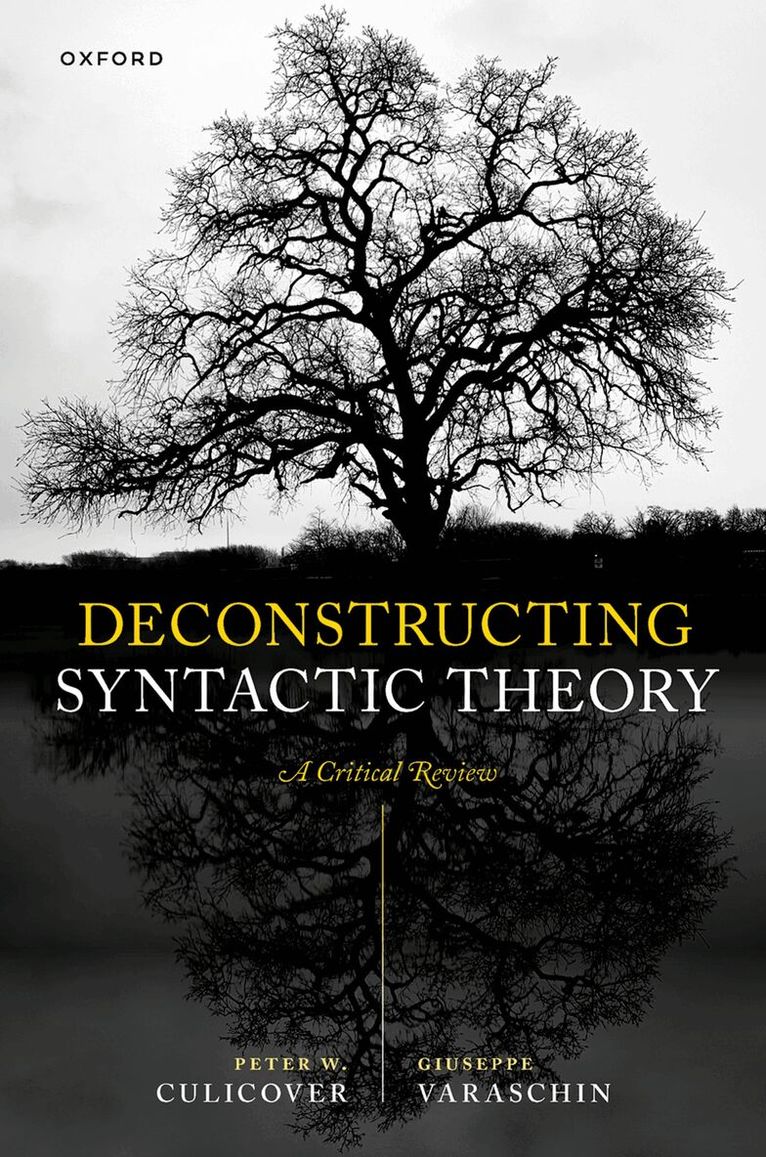
Deconstructing Syntactic Theory is a critical examination of the assumptions and methodologies of contemporary derivational syntactic theory. The study ranges from the earliest work inspired by Chomsky's Syntactic Structures and Aspects of the Theory of Syntax to the present-day Minimalist Program. The book begins with an examination of the relationship between syntactic structure, linear order, and meaning, and the role of uniformity, in motivating derivational analysis that assume movement and invisible structure. A central property of such analyses is that they are cryptoconstructional: construction-specific stipulations are assumed in order to derive the form and meaning of expressions. The second part looks at a range of technical and empirical problems of derivational syntax, which require theoretical stipulations and devices to properly constrain cryptoconstructional analyses. The focus is particularly on problems relating to movement and problems of invisibility. In Part III, the authors turn to the question of the independent justification of syntactic structure, arguing that much hierarchical structure is not only unnecessary, but also does not yield optimal analyses for a number of grammatical phenomena. Part IV focuses on the use of syntax to account for phenomena that are arguably not syntactic; it concludes that using syntax to model semantic phenomena is at best not necessary, and at worse empirically inadequate. Similarly, using syntax to model morphological relations works only for a narrow subset of cases and cannot be sustained more generally without causing significant internal problems. The book concludes with a review of minimalism, laying out aspects of the logic of the Minimalist Program, its assumptions, and their motivations and consequences. The authors argue that minimalism is best achieved by a leaner theory of linguistic representations, along the lines of the constructional architecture of Simpler Syntax, as proposed by Culicover and Jackendoff (2005).
1 792 kr
Skickas
In this book, Peter Culicover introduces the analysis of natural language within the broader question of how language works - of how people use languages to configure words and morphemes in order to express meanings. He focuses both on the syntactic and morphosyntactic devices that languages use, and on the conceptual structures that correspond to particular aspects of linguistic form. He seeks to explain linguistic forms and in the process to show how these correspond with meanings. The book's clear, step-by-step exposition is presented within the Simpler Syntax framework whose development has been led by the author and Ray Jackendoff over the last fifteen years. This integrates syntactic theory with the representation of conceptual structure and casts fresh light on the interface between syntax and semantics. It also enables elegant and economical analyses of natural language phenomena without recourse to such abstract devices as functional heads and uniform binary branching. Peter Culicover opens his account with an overview of the nature of language and the aims of its analysis. He then divides the book into parts devoted to syntactic categories, syntactic structure and argument structure, argument realization, unbounded dependencies, and clausal structure. He provides exercises, problems, and suggestions for further reading throughout the book.
881 kr
Skickas inom 5-8 vardagar
In this book, Peter Culicover introduces the analysis of natural language within the broader question of how language works - of how people use languages to configure words and morphemes in order to express meanings. He focuses both on the syntactic and morphosyntactic devices that languages use, and on the conceptual structures that correspond to particular aspects of linguistic form. He seeks to explain linguistic forms and in the process to show how these correspond with meanings. The book's clear, step-by-step exposition is presented within the Simpler Syntax framework whose development has been led by the author and Ray Jackendoff over the last fifteen years. This integrates syntactic theory with the representation of conceptual structure and casts fresh light on the interface between syntax and semantics. It also enables elegant and economical analyses of natural language phenomena without recourse to such abstract devices as functional heads and uniform binary branching. Peter Culicover opens his account with an overview of the nature of language and the aims of its analysis. He then divides the book into parts devoted to syntactic categories, syntactic structure and argument structure, argument realization, unbounded dependencies, and clausal structure. He provides exercises, problems, and suggestions for further reading throughout the book.
1 015 kr
Skickas inom 5-8 vardagar
This groundbreaking book offers a new and compelling perspective on the structure of human language. The fundamental issue it addresses is the proper balance between syntax and semantics, between structure and derivation, and between rule systems and lexicon. It argues that the balance struck by mainstream generative grammar is wrong. It puts forward a new basis for syntactic theory, drawing on a wide range of frameworks, and charts new directions for research. In the past four decades, theories of syntactic structure have become more abstract, and syntactic derivations have become ever more complex. Peter Culicover and Ray Jackendoff trace this development through the history of contemporary syntactic theory, showing how much it has been driven by theory-internal rather than empirical considerations. They develop an alternative that is responsive to linguistic, cognitive, computational, and biological concerns. Simpler Syntax is addressed to linguists of all persuasions. It will also be of central interest to those concerned with language in psychology, human biology, evolution, computational science, and artificial intelligence.
640 kr
Skickas inom 5-8 vardagar
This groundbreaking book offers a new and compelling perspective on the structure of human language. The fundamental issue it addresses is the proper balance between syntax and semantics, between structure and derivation, and between rule systems and lexicon. It argues that the balance struck by mainstream generative grammar is wrong. It puts forward a new basis for syntactic theory, drawing on a wide range of frameworks, and charts new directions for research. In the past four decades, theories of syntactic structure have become more abstract, and syntactic derivations have become ever more complex. Peter Culicover and Ray Jackendoff trace this development through the history of contemporary syntactic theory, showing how much it has been driven by theory-internal rather than empirical considerations. They develop an alternative that is responsive to linguistic, cognitive, computational, and biological concerns. At the core of this alternative is the Simpler Syntax Hypothesis: the most explanatory syntactic theory is one that imputes the minimum structure necessary to mediate between phonology and meaning. A consequence of this hypothesis is a far richer mapping between syntax and semantics than is generally assumed. Through concrete analyses of numerous grammatical phenomena, some well studied and some new, the authors demonstrate the empirical and conceptual superiority of the Simpler Syntax approach.Simpler Syntax is addressed to linguists of all persuasions. It will also be of central interest to those concerned with language in psychology, human biology, evolution, computational science, and artificial intellige
Grammar & Complexity
Language at the Intersection of Competence and Performance
Inbunden, Engelska, 2013
1 844 kr
Skickas inom 5-8 vardagar
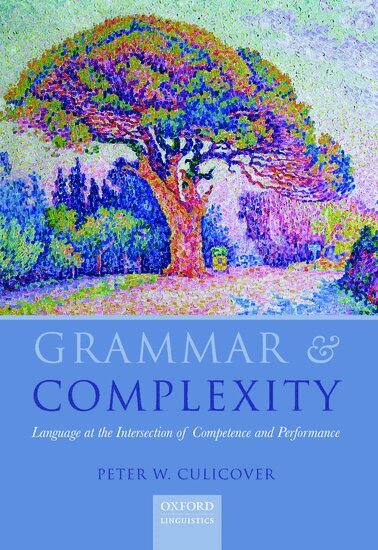
This book combines ideas about the architecture of grammar and language acquisition, processing, and change to explain why languages show regular patterns when there is so much irregularity in their use and so much complexity when there is such regularity in linguistic phenomena. Peter Culicover argues that the structure of language can be understood and explained in terms of two kinds of complexity: firstly that of the correspondence between form and meaning; secondly in the real-time processes involved in the construction of meanings in linguistic expressions. Mainstream syntactic theory has focused largely on regularities within and across languages, relegating to the periphery exceptional and idiosyncratic phenomena. But, the author argues, a languages irregular and unique features offer fundamental insights into the nature of language, how it changes, and how it is produced and understood. Peter Culicover's new book offers a pertinent and original contribution to key current debates in linguistic theory. It will interest scholars and advanced students of linguists of all theoretical persuasions.
Grammar & Complexity
Language at the Intersection of Competence and Performance
Häftad, Engelska, 2013
675 kr
Skickas inom 5-8 vardagar
This book combines ideas about the architecture of grammar and language acquisition, processing, and change to explain why languages show regular patterns when there is so much irregularity in their use and so much complexity when there is such regularity in linguistic phenomena. Peter Culicover argues that the structure of language can be understood and explained in terms of two kinds of complexity: firstly that of the correspondence between form and meaning; secondly in the real-time processes involved in the construction of meanings in linguistic expressions. Mainstream syntactic theory has focused largely on regularities within and across languages, relegating to the periphery exceptional and idiosyncratic phenomena. But, the author argues, a languages irregular and unique features offer fundamental insights into the nature of language, how it changes, and how it is produced and understood. Peter Culicover's new book offers a pertinent and original contribution to key current debates in linguistic theory. It will interest scholars and advanced students of linguists of all theoretical persuasions.
1 710 kr
Skickas inom 5-8 vardagar
This book brings together many of Peter Culicover's most significant observations on the nature of syntax and its place within the architecture of human language. Over four decades he has sought to understand the cognitive foundations of linguistic theory and the place of syntactic theory in explaining how language works. This has led him to specific proposals regarding the proper scope of syntactic theory and to a re-examination of the empirical basis of syntactic analyses, which reflect judgements reflecting not only linguistic competence but the complexity of the computations involved in acquiring and using language.After a brief a retrospective the author opens the book with the Simpler Syntax Hypothesis, an article written with Ray Jackendoff, that proposes significant restrictions on the scope of the syntactic component of the grammar. The work is then divided into parts concerned broadly with representations, structures, and computation. The chapters are provided with contextual headnotes and footnote references to subsequent work, but are otherwise printed essentially as they first appeared.Peter Culicover's lively and original perspectives on syntax and grammar will appeal to all theoretical linguists and their advanced students.
478 kr
Skickas inom 5-8 vardagar