• Fri frakt över 249 kr
  • •
  • Snabba leveranser
  • •
  • Billiga böcker
Kundservice

Du är på sajten för privatpersoner.

Företag, bibliotek eller offentlig verksamhet?

Du handlar på classic.bokus.com, där alla dina funktioner finns intakta.
Till classic.bokus.com
Bokus logotyp. Gå till startsidan.
  • Erbjudanden
  • Student
  • Topplistor
  • Barn & ungdom
  • Bokus Play
  • E-böcker
  • Ljudböcker
  • Pocketböcker
  • Spel och pussel

5% studentrabatt – använd koden KURSBOK27 →

Sidfot

Mina sidor

    Hjälp

    • Kundservice
    • Vanliga frågor och svar
    • Frakt och leverans
    • Retur vid ångerrätt
    • Reklamera vara
    • Betalning
    • Köpvillkor
    • Allmänna villkor
    • Information om webbplatsens tillgänglighet

    Om Bokus

    • Om oss
    • Pressrum
    • För studenter
    • För företag
    • För bibliotek och offentlig verksamhet
    • För leverantörer
    • Hållbarhet

    Populärt

    • Aktuella erbjudanden
    • Presentkort
    • Studentlitteratur
    • Nya böcker
    • Topplistor
    • Signerade böcker
    • Engelska böcker

    Inspiration

    • Boktips
    • BookTok
    • Barnbokskaraktärer
    • Populära författare
    Logotyp för Bokus
    Följ oss på Facebook (extern länk)Följ oss på Instagram (extern länk)Följ oss på YouTube (extern länk)Följ oss på TikTok (extern länk)
    bokus @ CookiesAnpassa cookiesIntegritetspolicyKöpvillkor
    Till Citymail hemsida (extern länk)Till Budbee hemsida (extern länk)Till Postnord hemsida (extern länk)Till Schenker hemsida (extern länk)Till Early Bird hemsida (extern länk)Till Walleys hemsida (extern länk)
    1. Språk och ordböcker
    2. Språkvetenskap och lingvistik

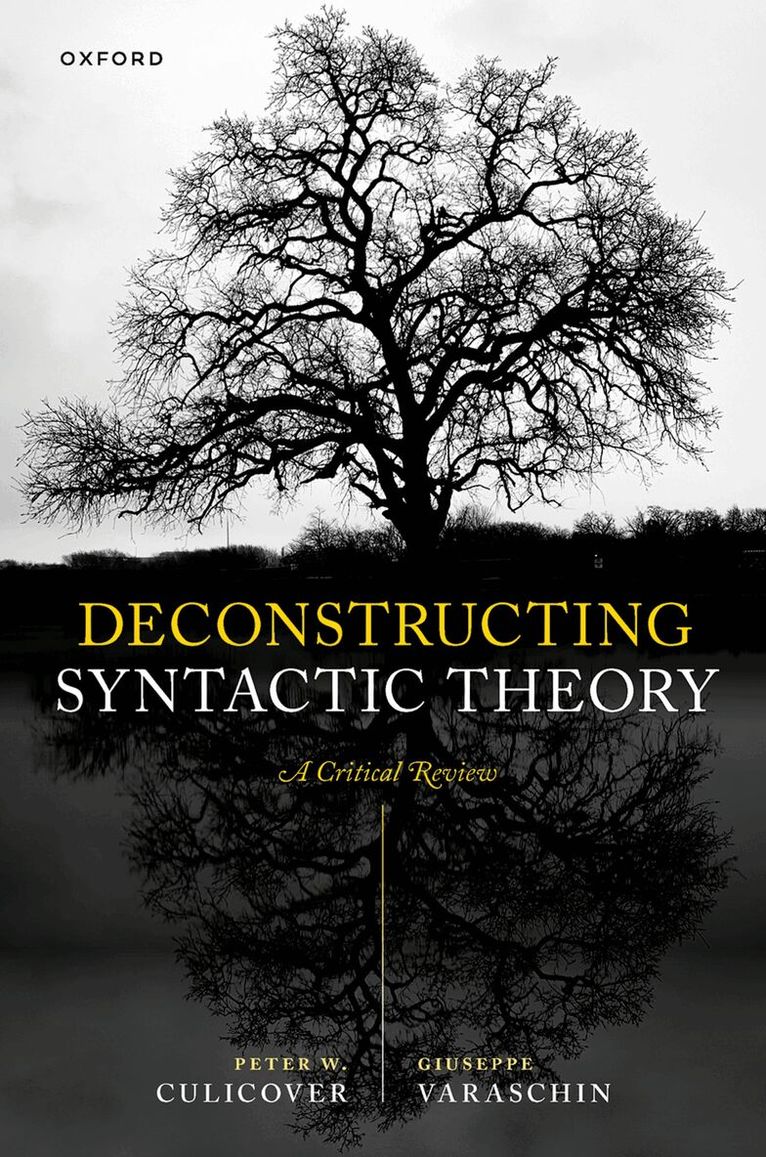
    Deconstructing Syntactic Theory

    A Critical Review

    AvPeter W. Culicover,Giuseppe Varaschin

    Inbunden, Engelska, 2025

    1 699 kr

    Beställningsvara. Skickas inom 5-8 vardagar. Fri frakt över 249 kr.

    Beskrivning

    Deconstructing Syntactic Theory is a critical examination of the assumptions and methodologies of contemporary derivational syntactic theory. The study ranges from the earliest work inspired by Chomsky's Syntactic Structures and Aspects of the Theory of Syntax to the present-day Minimalist Program. The book begins with an examination of the relationship between syntactic structure, linear order, and meaning, and the role of uniformity, in motivating derivational analysis that assume movement and invisible structure. A central property of such analyses is that they are cryptoconstructional: construction-specific stipulations are assumed in order to derive the form and meaning of expressions. The second part looks at a range of technical and empirical problems of derivational syntax, which require theoretical stipulations and devices to properly constrain cryptoconstructional analyses. The focus is particularly on problems relating to movement and problems of invisibility. In Part III, the authors turn to the question of the independent justification of syntactic structure, arguing that much hierarchical structure is not only unnecessary, but also does not yield optimal analyses for a number of grammatical phenomena. Part IV focuses on the use of syntax to account for phenomena that are arguably not syntactic; it concludes that using syntax to model semantic phenomena is at best not necessary, and at worse empirically inadequate. Similarly, using syntax to model morphological relations works only for a narrow subset of cases and cannot be sustained more generally without causing significant internal problems. The book concludes with a review of minimalism, laying out aspects of the logic of the Minimalist Program, its assumptions, and their motivations and consequences. The authors argue that minimalism is best achieved by a leaner theory of linguistic representations, along the lines of the constructional architecture of Simpler Syntax, as proposed by Culicover and Jackendoff (2005).

    Produktinformation

    • Utgivningsdatum:2025-06-12
    • Mått:165 x 240 x 28 mm
    • Vikt:743 g
    • Format:Inbunden
    • Språk:Engelska
    • Antal sidor:400
    • Förlag:OUP OXFORD
    • ISBN:9780198947783

    Utforska kategorier

    • Språkvetenskap och lingvistik inom Språk och ordböcker

    Mer om författaren

    Peter W. Culicover is Distinguished University Professor Emeritus at the Ohio State University, where he was founding Director of the Center for Cognitive Science (1989-2003) and Chair of the Department of Linguistics (1998-2006). His research is concerned primarily with understanding and explaining the syntactic structure of human languages, and he has explored such topics as language learnability, computational modeling of language acquisition and language change, the grammar of focus, grammatical constructions, the grammar of contemporary English, and the architecture of grammar. His many publications with OUP include Grammar and Complexity (2013), Explaining Syntax (2013), and Language Change, Variation, and Universals (2021).Giuseppe Varaschin is a researcher and lecturer in the Department of German Studies and Linguistics at Humboldt-Universität zu Berlin, where he is currently part of the research project "Building register into the architecture of language - an HPSG account". He specializes in syntactic theory and the syntax-semantics interface. His current work explores topics such as syntactic variation, social meaning, sociolinguistic perception, anaphora, agreement, and the architecture of grammar, with a focus on English, German, and Romance languages. He is also interested in developing computer-processable grammar fragments as a way of checking the formal consistency and large-scale empirical adequacy of theoretical proposals.

    Innehållsförteckning

    • Preface Acknowledgments 1: Overview Part I Order and Structure 2: Licensing order 3: Cryptoconstructionalism Part II Problems 4: Problems of movement 5: Problems of invisibility Part III Justifying Syntactic Structure 6: The case for flat structure 7: The explanatory role of syntactic structure Part IV Syntactocentrism 8: Syntactocentrism: Semantics 9: Syntactocentrism: Morphology Part V Minimalism 10: Whose minimalism? References Index