Rebecca C. Curtis - Böcker
Visar alla böcker från författaren Rebecca C. Curtis. Handla med fri frakt och snabb leverans.
7 produkter
7 produkter
1 096 kr
Skickas inom 10-15 vardagar
In the myth of Daphne and Apollo, Cupid fired two arrows: one causing flight from love, the other passionate attraction. Cupid aimed his first arrow at Daphne, a beautiful nymph who loved her freedom; the next struck Apollo, who lusted after Daphne. Daphne, frightened and intent upon virginity, fled Apollo but was unable to run fast enough. When her strength was almost gone, she sought protection in the familiar waters of her father's river. He answered her prayers: Her hair became leaves, and her feet, roots growing into the ground; she was transformed into a laurel tree. Apollo, kissing the sprouting bark, pledged to honor Daphne by placing a laurel wreath on the head of every hero who won a victory. Unable to evade the consequences of the arrow that wounded her, Daphne called upon the river, the creative power of both nature and time-a symbol of fertility, but also of oblivion-to help her survive when her strength was gone. Daphne's inner triumph in the face of injury is an appropriate sym bol for the types of transformation witnessed by psychologists. In his book on symbols, Circlot (1962, p. 173) writes that the crowning of the poet, artist, or conqueror with laurel leaves "presupposes a series of inner victories over the negative and dissipative influence of the basest forces. " Further, the tree "denotes the life of the cosmos: its consistence, growth, proliferation, generative, and regenerative processes" (Circlot, 1962, p. 328).
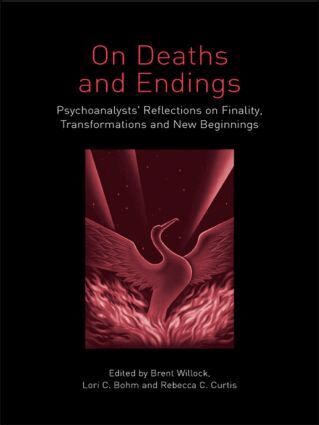
On Deaths and Endings
Psychoanalysts' Reflections on Finality, Transformations and New Beginnings
Inbunden, Engelska, 2007
1 898 kr
Skickas inom 10-15 vardagar
Winner of the 2008 Gradiva Award!Can something as negative as loss also be a positive, transformative experience?Is it possible that not only individuals but also societies can be developmentally arrested by problematic mourning? On Deaths and Endings brings together the work of psychoanalytic scholars and practitioners grappling with the manifold issues evoked by loss and finality.The book covers the impact of endings throughout the life cycle, including effects on children, adolescents, adults, those near death and entire societies. New psychoanalytic perspectives on bereavement are offered based on clinical work, scholarly research and the authors’ own, deeply personal experiences. The contributors present compelling, often moving, enquiries into subjects such as the reconfiguration of self-states subsequent to mourning, the role of ritual and memorials, the tragic impact of unmourned loss, modern conceptualisations of the death instinct, and terror-based losses.In that much psychotherapy is conducted with people who have suffered some form of loss, this book will be an invaluable resource for all mental health professionals. The emphasis on the potential of working through the vicissitudes of these experiences will provide inspiration and hope both to those who have endured personal loss and to anyone working with grieving patients.
On Deaths and Endings
Psychoanalysts' Reflections on Finality, Transformations and New Beginnings
Häftad, Engelska, 2007
599 kr
Skickas inom 10-15 vardagar
Winner of the 2008 Gradiva Award!Can something as negative as loss also be a positive, transformative experience?Is it possible that not only individuals but also societies can be developmentally arrested by problematic mourning? On Deaths and Endings brings together the work of psychoanalytic scholars and practitioners grappling with the manifold issues evoked by loss and finality.The book covers the impact of endings throughout the life cycle, including effects on children, adolescents, adults, those near death and entire societies. New psychoanalytic perspectives on bereavement are offered based on clinical work, scholarly research and the authors’ own, deeply personal experiences. The contributors present compelling, often moving, enquiries into subjects such as the reconfiguration of self-states subsequent to mourning, the role of ritual and memorials, the tragic impact of unmourned loss, modern conceptualisations of the death instinct, and terror-based losses.In that much psychotherapy is conducted with people who have suffered some form of loss, this book will be an invaluable resource for all mental health professionals. The emphasis on the potential of working through the vicissitudes of these experiences will provide inspiration and hope both to those who have endured personal loss and to anyone working with grieving patients.
566 kr
Tillfälligt slut
Self-Defeating Behaviors
Experimental Research, Clinical Impressions, and Practical Implications
Häftad, Engelska, 2011
552 kr
Skickas inom 10-15 vardagar
In the desert I saw a creature, naked, bestial, Who, squatting upon the ground, Held his heart in his hands. And ate of it. I said: "Is it good, friend?" "It is bitter-bitter," he answered; But I like it Because it is bitter, And because it is my heart. " Stephen Crane The Black Riders and Other Lines "It is the function of great art to purge and give meaning to human suffering," wrote Bernard Knox (1982, p. 149) in his introduction to Oedipus Rex. This is done by showing some causal connection between the hero's free will and his suffer ing, by bringing to the fore the interplay of the forces of destiny and human freedom. Knox states that Freud was wrong when he suggested that it was "the particular nature of the material" in Oedipus that makes the play so deeply moving, and not the contrast between destiny and human will. Knox believes that this play has an overpowering effect upon us, not only because we share the tendency of Oedipus to direct" our first sexual impulse towards our mother" and "our first murderous wish against our father," as Freud tells us, but also because the theological modification of the legend introduced by Sophocles calls into question the sacred beliefs of our time (Knox, 1982, pp. 133-137).
1 096 kr
Skickas inom 10-15 vardagar
In the myth of Daphne and Apollo, Cupid fired two arrows: one causing flight from love, the other passionate attraction. Cupid aimed his first arrow at Daphne, a beautiful nymph who loved her freedom; the next struck Apollo, who lusted after Daphne. Daphne, frightened and intent upon virginity, fled Apollo but was unable to run fast enough. When her strength was almost gone, she sought protection in the familiar waters of her father's river. He answered her prayers: Her hair became leaves, and her feet, roots growing into the ground; she was transformed into a laurel tree. Apollo, kissing the sprouting bark, pledged to honor Daphne by placing a laurel wreath on the head of every hero who won a victory. Unable to evade the consequences of the arrow that wounded her, Daphne called upon the river, the creative power of both nature and time-a symbol of fertility, but also of oblivion-to help her survive when her strength was gone. Daphne's inner triumph in the face of injury is an appropriate sym bol for the types of transformation witnessed by psychologists. In his book on symbols, Circlot (1962, p. 173) writes that the crowning of the poet, artist, or conqueror with laurel leaves "presupposes a series of inner victories over the negative and dissipative influence of the basest forces. " Further, the tree "denotes the life of the cosmos: its consistence, growth, proliferation, generative, and regenerative processes" (Circlot, 1962, p. 328).
Taboo or Not Taboo? Forbidden Thoughts, Forbidden Acts in Psychoanalysis and Psychotherapy
Forbidden Thoughts, Forbidden Acts in Psychoanalysis and Psychotherapy
Häftad, Engelska, 2009
747 kr
Skickas inom 10-15 vardagar
'Psychoanalysis has, from its inception, been a discipline concerned with overcoming the ill effects of certain social taboos. Given this focus, it might be assumed that psychoanalysis and its practitioners are free of the constraints imposed by restrictive taboos. This book challenges this idea by examining a sampling of the taboos that are rife in the field. It is not intended to offer a complete summary of all of the forbidden ideas, clinical procedures, behaviors and institutional practices in psychoanalysis, but rather to raise consciousness about the fact that even within a field which encourages freedom of expression, many issues remain difficult to fully discuss both in the consulting room and in professional discourse. The book provides a refreshing, thoughtful, honest look at many of the taboos present in psychoanalysis, even at this moment of greatly improved communication between the various theoretical schools in the field. Reading it provides a sense of freedom for the reader, as speaking of forbidden thoughts always does. We hope the book will inspire others to seriously consider the taboos that hamper their practices, and that further ideas on these issues will come to light.'- Lori Bohm, from the IntroductionTaboo or Not Taboo? Forbidden Thoughts, Forbidden Acts in Psychoanalysis and Psychotherapy has been awarded the Goethe Award for Psychoanalytic & Psychodynamic Scholarship for 2009.