Reitumetse Obakeng Mabokela - Böcker
Visar alla böcker från författaren Reitumetse Obakeng Mabokela. Handla med fri frakt och snabb leverans.
5 produkter
5 produkter
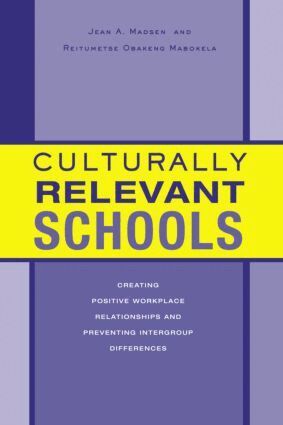
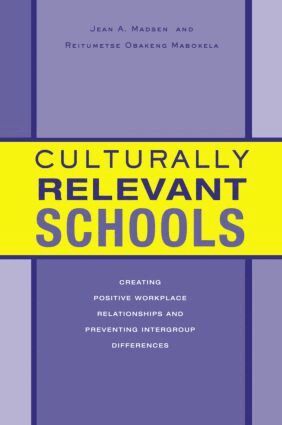
Culturally Relevant Schools
Creating Positive Workplace Relationships and Preventing Intergroup Differences
Inbunden, Engelska, 2005
558 kr
Skickas inom 10-15 vardagar
The authors provide teachers and school leaders concrete suggestions to address workplace relationships; to respond to intergroup conflict; to create positive exchanges among different ethnic groups of teachers; and to create a strategic process to address diversity issues.
Culturally Relevant Schools
Creating Positive Workplace Relationships and Preventing Intergroup Differences
Häftad, Engelska, 2005
282 kr
Skickas inom 10-15 vardagar
The authors provide teachers and school leaders concrete suggestions to address workplace relationships; to respond to intergroup conflict; to create positive exchanges among different ethnic groups of teachers; and to create a strategic process to address diversity issues.
2 037 kr
Skickas inom 10-15 vardagar
The South African higher education system has historically been characterized by racial and gender inequities inherited from the discriminatory policies of the apartheid era. Emerging from a higher education history plagued with deeply entrenched racial disparities, Voices of Conflict examines how academic programs and structures at the historically white universities have responded to the increasing enrollment of black students since the enactment of the Universities Amendment Act in 1983. Dr. Mabokela specifically seeks to understand the perceptions and attitudes of students, faculty, and administrators and to determine how these respective constituents have responded to changes in student demographics. Her study brings to light, with clarity and thoroughness, many too often overlooked and neglected issues in higher education in South Africa.
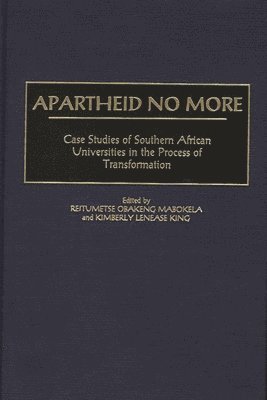
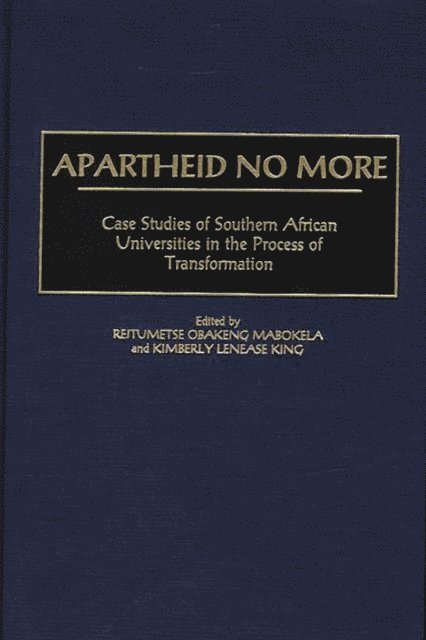
Apartheid No More
Case Studies of Southern African Universities in the Process of Transformation
Inbunden, Engelska, 2001
980 kr
Skickas inom 10-15 vardagar
The South African higher education system has historically been characterized by racial and gender inequities inherited from the discriminatory policies of the apartheid era. From the ascent to power of the National Party in 1948, tertiary institutions were divided along ethno-linguistic lines in accordance with the segregationist policies of the apartheid system. The 1990s ushered in a new political era characterized by the un-banning of political parties, the release of political prisoners, and the shift of political power from the Nationalist party to the government of national unity led by the African National Congress. Since the change of government in 1994 there has been a concerted effort to transform the system of higher education from one in which race, gender, and class determine access and success, to a more equitable one.The demise of apartheid in South Africa requires that educational institutions transform in order to reflect the changing nature of the country. This volume includes case studies on South African tertiary institutions immersed in the process of transformation, examining the issue of language policy at Afrikaans-medium institutions, the challenges that the historically white, English-medium institutions face when including a previously excluded group, the experiences of Black South African students enrolled at such institutions, and the challenges faced by historically disadvantaged institutions.
688 kr
Skickas inom 10-15 vardagar
The South African higher education system has historically been characterized by racial and gender inequities inherited from the discriminatory policies of the apartheid era. Emerging from a higher education history plagued with deeply entrenched racial disparities, Voices of Conflict examines how academic programs and structures at the historically white universities have responded to the increasing enrollment of black students since the enactment of the Universities Amendment Act in 1983. Dr. Mabokela specifically seeks to understand the perceptions and attitudes of students, faculty, and administrators and to determine how these respective constituents have responded to changes in student demographics. Her study brings to light, with clarity and thoroughness, many too often overlooked and neglected issues in higher education in South Africa.