Reuven Firestone - Böcker
Visar alla böcker från författaren Reuven Firestone. Handla med fri frakt och snabb leverans.
10 produkter
10 produkter
913 kr
Skickas inom 5-8 vardagar
Since the Islamic resurgence began to make news, the Islamic idea of holy war, or "jihad", has been the subject of tremendous media attention - much of it sensationalistic. This study attempts to discover where and when the idea of jihad originated, and to trace its early development. Firestone finds no evidence for religiously motivated warring in pre-Islamic Arabian cultures, or indeed for ideological warring of any kind, despite the common occurrence of intertribal raids and warring as a normal part of an ancient Arabian life. He seeks to discover the forces in early Islam that precipitated this powerful and successful war concept. Tracing the social and historical changes experienced during the transition from pre-Islamic Arabian culture to the religious civilization of Islam, Firestone concludes that, at base, jihad is an indigenous Arabian phenomenon. It resulted, he says, from the mixture of old Arabian culture with innovations in the traditional social structure and world view engendered by the introduction of Islamic monotheism. The cauldron in which this mixture produced its new product, says Firestone, was Medina, where the various forces came together in the formation of the religious community of Muslims known as the Umma. This historical reconstruction challenges the traditional "evolutionary theory" of holy war, which was first established by medieval Muslim scholars and has until now been accepted uncritically by Western scholarship. In its place Firestone offers a far more nuanced understanding, based on careful philological analysis of Islamic texts in conjunction with the application of contemporary methodologies in anthropology, history, and the study of religion. His analysis goes far towards explaining not only why the young Islamic polity was so successful militarily, but how the disparate populations that made up the followers of Muhammed came together as a cohesive movement in which religious identity replaced ancient kinship patterns as the basis of group loyalty.
371 kr
Skickas inom 5-8 vardagar
While there exists no evidence to date that the indigenous inhabitants of Arabia knew of holy war prior to Islam, holy war ideas and behaviors appear already among Muslims during the first generation. This book focuses on why and how such a seemingly radical development took place. Basing his hypothesis on evidence from the Qur'an and early Islamic literary sources, Firestone locates the origin of Islamic holy war and traces its evolution as a response to the changes affecting the new community of Muslims in its transition from ancient Arabian culture to the religious civilization of Islam.
877 kr
Skickas inom 5-8 vardagar
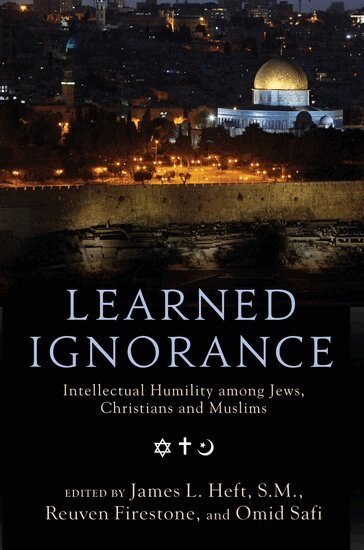
Constructive interreligious dialogue is only a recent phenomenon. Until the nineteenth century, most dialogue among believers was carried on as a debate aimed either to disprove the claims of the other, or to convert the other to one's own tradition. At the end of the nineteenth century, Protestant Christian missionaries of different denominations had created such a cacophony amongst themselves in the mission fields that they decided that it would be best if they could begin to overcome their own differences instead of confusing and even scandalizing the people whom they were trying to convert. By the middle of the twentieth century, the horrors of the Holocaust compelled Christians, especially mainline Protestants and Catholics, to enter into a serious dialogue with Jews, one of the consequences of which was the removal of claims by Christians to have replaced Judaism, and revising text books that communicated that message to Christian believers.Now, at the beginning of the twenty-first century, many branches of Christianity, not least the Catholic Church, are engaged in a world-wide constructive dialogue with Muslims, made all the more necessary by the terrorist attacks of September 11. In these new conversations, Muslim religious leaders took an important initiative when they sent their document,''A Common Word Between Us,'' to all Christians in the West. It is an extraordinary document, for it makes a theological argument (various Christians in the West, including officials at the Vatican, have claimed that a ''theological conversation'' with Muslims is not possible) based on texts drawn from the Hebrew Bible, the New Testament and the Qur'an, that Jewish, Christian, and Muslim believers share the God-given obligation to love God and each other in peace and justice. The Institute for Advanced Catholic Studies brought together an international group of sixteen Jewish, Catholic, and Muslim scholars to carry on an important theological exploration of the theme of ''learned ignorance.''
588 kr
Skickas inom 5-8 vardagar
Constructive interreligious dialogue is only a recent phenomenon. Until the nineteenth century, most dialogue among believers was carried on as a debate aimed either to disprove the claims of the other, or to convert the other to one's own tradition. At the end of the nineteenth century, Protestant Christian missionaries of different denominations had created such a cacophony amongst themselves in the mission fields that they decided that it would be best if they could begin to overcome their own differences instead of confusing and even scandalizing the people whom they were trying to convert. By the middle of the twentieth century, the horrors of the Holocaust compelled Christians, especially mainline Protestants and Catholics, to enter into a serious dialogue with Jews, one of the consequences of which was the removal of claims by Christians to have replaced Judaism, and revising text books that communicated that message to Christian believers.Now, at the beginning of the twenty-first century, many branches of Christianity, not least the Catholic Church, are engaged in a world-wide constructive dialogue with Muslims, made all the more necessary by the terrorist attacks of September 11. In these new conversations, Muslim religious leaders took an important initiative when they sent their document,''A Common Word Between Us,'' to all Christians in the West. It is an extraordinary document, for it makes a theological argument (various Christians in the West, including officials at the Vatican, have claimed that a ''theological conversation'' with Muslims is not possible) based on texts drawn from the Hebrew Bible, the New Testament and the Qur'an, that Jewish, Christian, and Muslim believers share the God-given obligation to love God and each other in peace and justice. The Institute for Advanced Catholic Studies brought together an international group of sixteen Jewish, Catholic, and Muslim scholars to carry on an important theological exploration of the theme of ''learned ignorance.''
764 kr
Skickas inom 5-8 vardagar
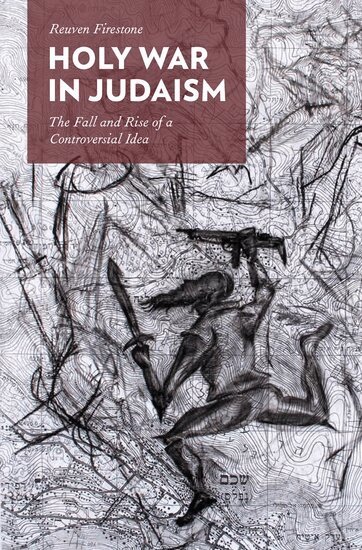
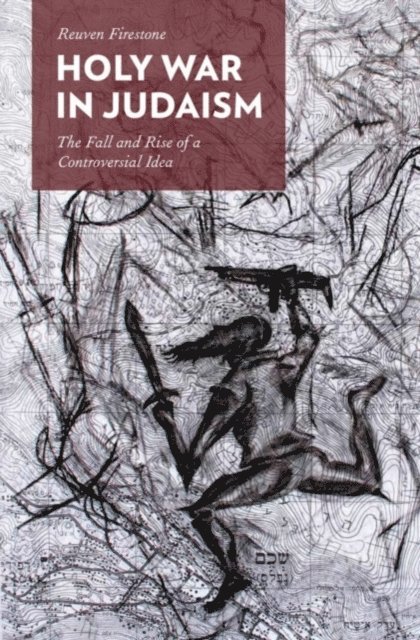
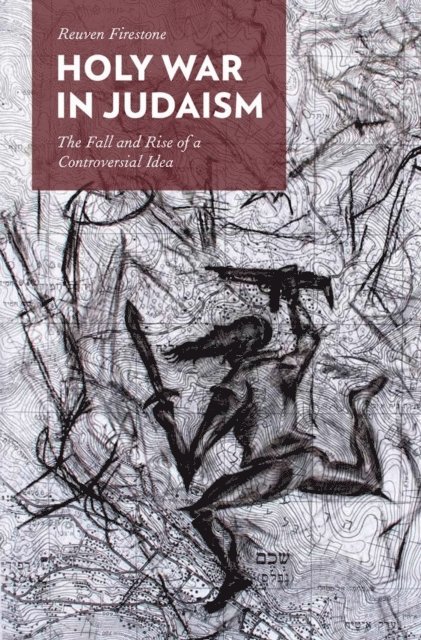
Holy War in Judaism is the first book to consider how the concept of ''holy war'' disappeared from Jewish thought for almost 2000 years, only to reemerge with renewed vigor in modern times. Holy war, sanctioned or even commanded by God, is a common and recurring theme in the Hebrew Bible, but Rabbinic Judaism largely avoided discussion of holy war in the Talmud and related literatures for the simple reason that it became extremely dangerous and self-destructive. The revival of the holy war idea occurred with the rise of Zionism, and as the need for organized Jewish engagement in military actions developed, Orthodox Jews faced a dilemma. There was great need for all to engage in combat for the survival of the infant state of Israel, but the Talmudic rabbis had virtually eliminated divine authorization for Jews to fight in Jewish armies. The first stage of the revival was sanction for Jews to fight in defense. The next stage emerged with the establishment of the state and allowed Orthodox Jews to enlist even when the community was not engaged in a war of survival. Once the notion of divinely sanctioned warring was revived, it became available to Jews who considered that the historical context justified more aggressive forms of warring. Among some Jews, divinely authorized war became associated not only with defense but also with a renewed kibbush or conquest, a term that became central to the discourse regarding war and peace and the lands conquered by the state of Israel in 1967. By the early 1980's, the rhetoric of holy war had entered the general political discourse of modern Israel. In this book Reuven Firestone identifies, analyzes, and explains the historical, conceptual, and intellectual processes that revived holy war ideas in modern Judaism. The book serves as a case study of the way in which one ancient religious concept, once deemed irrelevant or even dangerous, was successfully revived in order to fill a pressing contemporary need. It also helps to clarify the current political and religious situation in relation to war and peace in Israel and the Middle East.
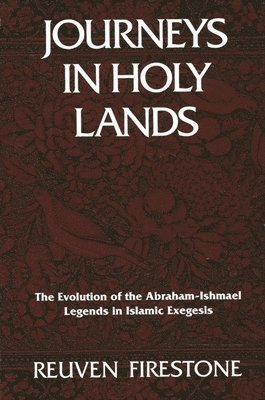
Journeys in Holy Lands
The Evolution of the Abraham-Ishmael Legends in Islamic Exegesis
Häftad, Engelska, 1990
566 kr
Skickas inom 3-6 vardagar
Scholars have long pointed to the great affinity between stories found in the Bible and the Qur'an, yet no explanation has been proposed that satisfactorily explains the odd combination of incredible likeness and unique divergence. Firestone provides a refreshing, new approach to scriptural issues of textuality, exegesis, and the origins and use of legend.This book clearly presents the full range of Islamic legends from the Qur'an and early Islamic exegesis about Abraham's journeys and adventures in the Land of Canaan and Arabia, many of them available for the first time in English translation. The author examines this broad sample of Islamic legends in relation to those found in Jewish, Christian, and pre-Islamic Arabian communities, and postulates an evolutionary journey of the literature. He presents a thorough textual analysis of the material and proposes a model for understanding early Islamic narrative based in literary theory, approaches to comparative religion, and the history of the pre-Islamic and early Islamic Middle East.
260 kr
Skickas inom 10-15 vardagar
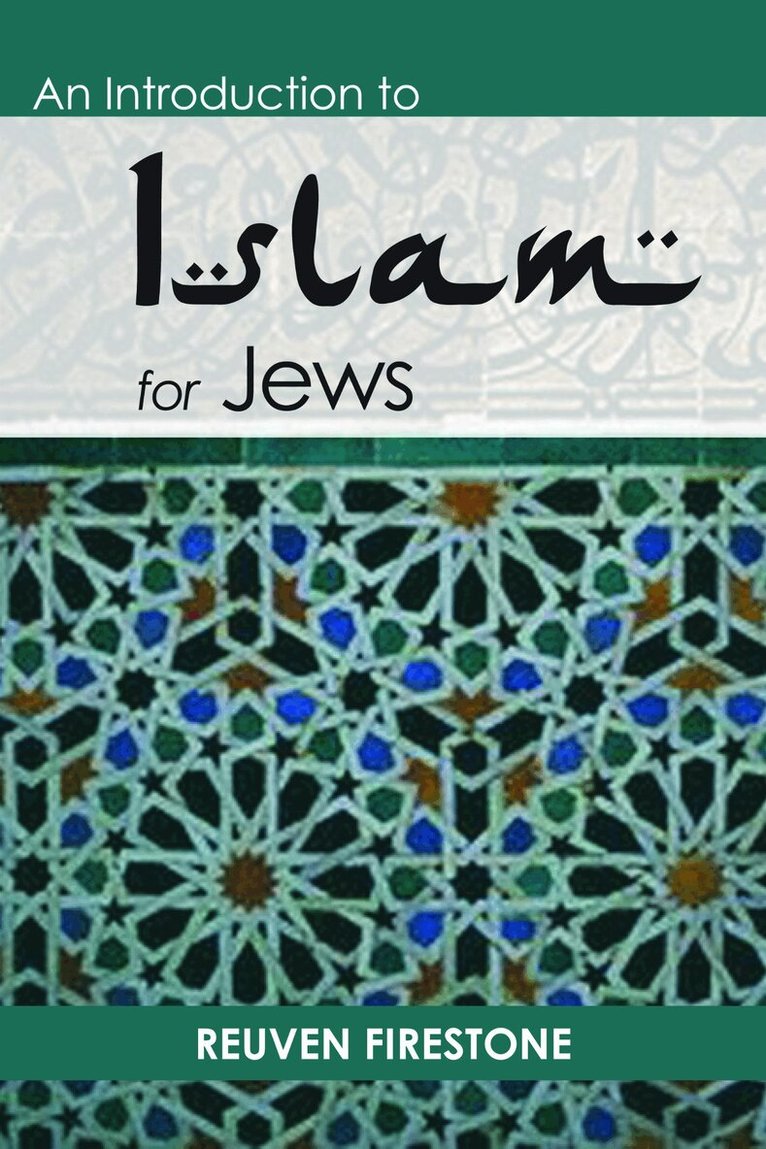
Muslim-Jewish relations in the United States, Israel, and Europe are tenuous. Jews and Muslims struggle to understand one another and know little about each other's traditions and beliefs. Firestone explains the remarkable similarities and profound differences between Judaism and Islam, the complex history of Jihad, the legal and religious positions of Jews in the world of Islam, how various expressions of Islam (Sunni, Shi`a, Sufi, Salafi, etc.) regard Jews, the range of Muslim views about Israel, and much more. He addresses these issues and others with candor and integrity, and he writes with language, symbols, and ideas that make sense to Jews. Exploring these subjects in today's vexed political climate is a delicate undertaking. Firestone draws on the research and writings of generations of Muslim, Jewish, and other scholars, as well as his own considerable expertise in this field. The book's tone is neither disparaging, apologetic, nor triumphal. Firestone provides many original sources in translation, as well as an appendix of additional key sources in context. Most importantly, this book is readable and reasoned, presenting to readers for the first time the complexity of Islam and its relationship toward Jews and Judaism.
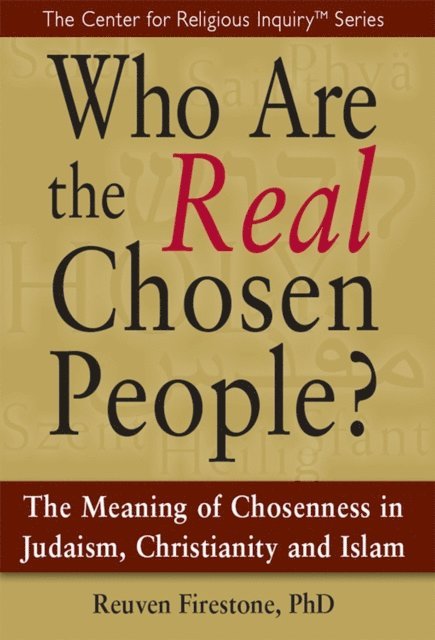
Who Are the Real Chosen People?
The Meaning of Choseness in Judaism, Christianity and Islam
Inbunden, Engelska, 2008
213 kr
Skickas inom 5-8 vardagar
What Does It Mean to Be "Chosen"? Why Did God Have to Choose?“To be chosen can have a range of meaning from the mundane to the holy, but in all cases it means to be singled out and preferred over others. In a deep sense that permeates much or most of Western culture, having been chosen communicates a sense of something that is extraordinary, is transcendent, and entitles a reward. What is assumed in this sense of the term is that God has done the choosing and the reward is something that is unequaled, for what could possibly equal divinely ordained eternal happiness?”—from the IntroductionReligious people who define themselves as monotheists have often advanced the idea that their relationship with God is unique and superior to all others. Theirs supersedes those who came before, and is superior to those who have followed. This phenomenon tends to be expressed in terms not only of supersessionism, but also “chosenness,” or “election.” Who is most beloved by God? What expression of the divine will is the most perfect? Which relationship reflects God's ultimate demands or desire?In this fascinating examination of the religious phenomenon of chosenness, Reuven Firestone explores the idea of covenant, and the expressions of supersessionism as articulated through the scriptures of the three major monotheistic religions: Judaism, Christianity and Islam. He explores how and why the ongoing competition and friction between these religions came about, and offers thoughts about how to overcome it.
357 kr
Skickas inom 5-8 vardagar
2 289 kr
Kommande
No detailed description available for "Polemics and Prophethood".