Ricardo Paes de Barros - Böcker
Visar alla böcker från författaren Ricardo Paes de Barros. Handla med fri frakt och snabb leverans.
3 produkter
3 produkter
280 kr
Skickas inom 10-15 vardagar
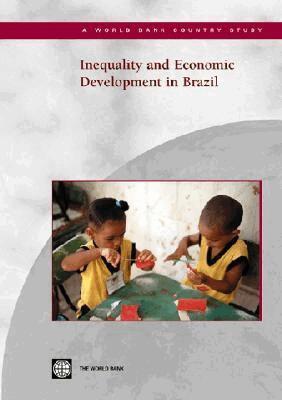
Inequality and Economic Development in Brazil is part of the World Bank Country Study series. These reports are published with the approval of the subject government to communicate the results of the Bank's work on the economic and related conditions of member countries to governments and to the development community.Excessive income inequality is unfair and undesirable on ethical grounds and can bring adverse effects on economic growth, health outcomes, social cohesion, and crime. Excessively unequal initial conditions are likely to lead to a perverse cycle of weak social mobility. Such is the case in countries like Brazil, where fertility differentials between educated and uneducated mothers are much greater.Brazil's income inequality has been very high and persistent over time, and has deep historic roots. Nonetheless, there have been important income improvements for the poorest, especially since stabilization in 1993. Brazil also has achieved major improvements in social indicators in the last few decades.This study addresses three questions:Why do inequalities matter for Brazil's development? Why does Brazil occupy a position of very high inequality in the international community? What should public policy do about it?
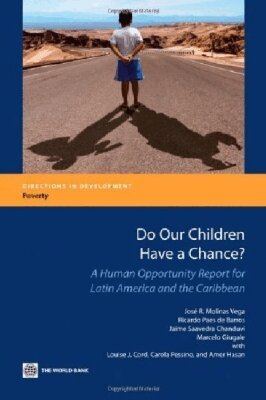
Do Our Children Have a Chance?
A Human Opportunity Report for Latin America and the Caribbean
Häftad, Engelska, 2011
280 kr
Skickas inom 10-15 vardagar
The Latin America and Caribbean (LAC) region is making progress in opening the doors of development to all. But it still has a long way to go. At the current pace, it would take, on average, a generation for the region to achieve universal access to the basic services that make for human opportunity. Intra-county regional disparities are large, and barely converging.This book assesses the status and evolution of human opportunity in LAC. It builds on the 2008 publication, Measuring Inequality of Opportunity, in several directions. First, it uses newly-available data to expand the set of opportunities and personal circumstances under analysis. The data is representative of some 200 million children living in 19 countries over the last 15 years. Second, it compares human opportunity in LAC with that of developed countries, among them the U.S. and France, two very different models of social policy. This allows for illuminating exercises in benchmarking and extrapolation. And third, it looks at human opportunity within countries - across regions, states and cities. This gives us a preliminary glimpse at the geographic dimension of equity, and at the role that different federal structures play.
2 593 kr
Skickas inom 7-10 vardagar
Since the late 1980s, almost all Latin American countries have undergone a series of far-reaching economic reforms, particularly in the areas of financial and capital account liberalization and trade. This book provides a comparative and analytical framework for assessing the impact of these reforms upon 16 countries in Latin America and the Caribbean, including: Argentina, Brazil, Chile, Colombia, Ecuador, El Salvador, Mexico, and Peru.The contributors analyse the complex interaction between macro policies, trade and financial liberalization. They illustrate that capital account liberalization in many cases has counteracted objectives of trade liberalization by provoking real exchange-rate appreciation and a profit squeeze in tradable goods sectors. The book concludes that structural shifts resulting from the reform process - such as greater demand for skilled labour and labour-saving investments in modern economic sectors - are major underlying causes of inequality and poverty. The authors ascertain that although these repercussions are strongly associated with the process of trade liberalization, in several instances the positive impact of macroeconomic stabilization and expansion of aggregate demand on employment and real incomes have counteracted these negative outcomes. Economic Liberalization, Distribution and Poverty will be of interest to scholars of economic development, policymakers in countries undergoing major economic reforms (Latin America, Africa, Asia and Eastern Europe), economic analysts at multilateral agencies (UN, IMF, World Bank, regional development banks, BIS), and international investment agencies including major banks. The book will also be important to aid agencies and those interested in a better understanding of the impact of globalization on the well-being of people across the globe.