Richard Bryant - Böcker
Visar alla böcker från författaren Richard Bryant. Handla med fri frakt och snabb leverans.
5 produkter
5 produkter
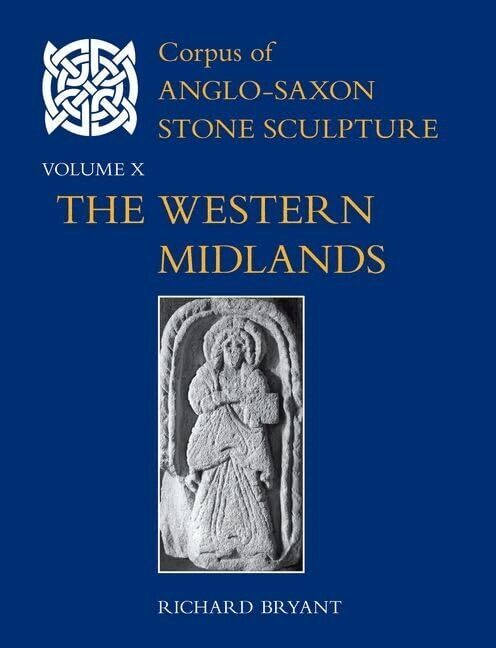
Del 10 - Corpus of Anglo-Saxon Stone Sculpture
Corpus of Anglo-Saxon Stone Sculpture, Volume X
The Western Midlands
Inbunden, Engelska, 2012
1 670 kr
Skickas inom 7-10 vardagar
The stone sculpture of Anglo-Saxon England forms an important source for archaeologists and historians - offering fascinating insights into the thought-world of early medieval people. This volume surveys the western Midland counties of Gloucestershire, Herefordshire, Shropshire, Warwickshire and Worcestershire, and provides an analytical catalogue of the Anglo-Saxon stone sculptures of that region.Introductory chapters set the material within an historical, topographical and art-historical context, and there are specialist contributions concerning the geology of the monuments and the analysis of surviving ninth-century paint. There is a full photographic record of each monument which includes many new illustrations. The monuments include important collections of material from Gloucester, Deerhurst and Shrewsbury, as well as individual sculptures of the highest quality such as the Cropthorne cross-head, cross-shafts from Acton Beauchamp and Wroxeter, and the small but exquisite Lechmere Stone from Hanley Castle in Worcestershire. Some of the early monuments from the western borders of the study area are linked to the traditions of the Celtic churches of the west, but much of the material was carved at a time when Mercian art was at its zenith in the late eighth to early tenth centuries. There is also a significant body of carvings from the later tenth and eleventh centuries, but Scandinavian influence - so apparent in Northumbria and much of the rest of Mercia - is notably absent from these western counties until the early eleventh century.This volume shows that Western Mercia offered a vibrant milieu in which influential artistic ideas could develop and spread, not just in carved stone but also in manuscripts, metalwork and other materials, and that, even in the unified Anglo-Saxon kingdom, Mercian craftsmen continued to produce works of the highest quality.
110 kr
Skickas inom 5-8 vardagar
365 kr
Skickas inom 3-6 vardagar
534 kr
Tillfälligt slut
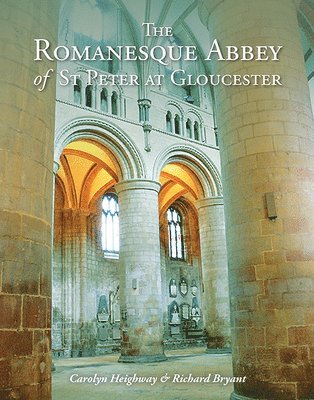
This book was inspired by the records made by Carolyn Heighway during the thirty years when she was archaeological consultant at Gloucester Cathedral. The survival of so much of the abbey of 1089 is remarkable, and often not appreciated by the casual visitor since it is ingeniously overlaid by Gothic alterations. Since 2000, surveys have been produced which enable accurate plans and elevations to be made which clarify the late 11th and early 12th century appearance of the building; deductions have also been made from archaeological observations. Since there are almost no documents for the abbey before the 15th century which relate to construction matters, the building itself is primary evidence, and archaeology is an important element. The book is lavishly illustrated with photographs, plans and measured drawings including accurate reconstructions; comparative scale plans of Worcester and Tewkesbury are also included. The late 11th-12th century church is described in detail, along with the surviving claustral buildings. There is a chapter on polychromy and on the surviving 11th-12th century sculpture, and a full bibliography. The whole is set in context by Malcolm Thurlby, who comments on the wider sources and associations.
420 kr
Skickas inom 3-6 vardagar
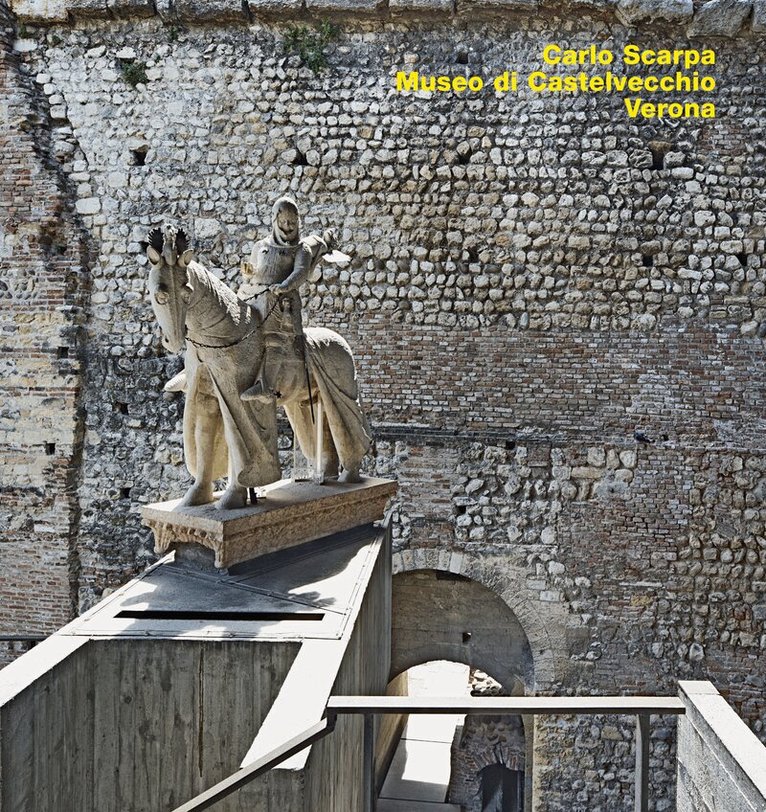
During the 1960s Italy's museum sector witnessed a fertile period of renewal. A generation of architects, working in partnership with the directors of museums, set about transforming into exhibition spaces a number of ancient monumental complexes located in the historic centres of some of the most important Italian cities. Among these was the brilliant and solitary Venetian architect Carlo Scarpa (19061978) who revitalised the discipline of museography by sagaciously combining it with restoration. His lucid intervention at Verona's Museo di Castelvecchio is emblematic of this approach: the medieval castle, the museum of ancient art, and modern architecture all harmoniously coexisting in a monument located at the heart of a city designated a UNESCO World Heritage Site. The far-sighted choice of Scarpa was owed to the then director of the museum, Licisco Magagnato, who tenaciously argued the case for the appointment of an architect specialising in this field to work on the city's principal museum of ancient art. The renovation work, which continued for more than a decade, took place in various phases (19581964, 1967 and 19681974) but in accordance with a remarkably consistent and coherent plan. In his work on Castelvecchio, carried out at a significant point in his career, Scarpa attained a remarkable balance between different aesthetic elements that is particularly evident in the sculpture gallery, where the renovations harmonise with the power of the 14th-century Veronese sculptures exhibited in this section of the museum. One of the most striking details is the location of the equestrian statue of Cangrande I della Scala. For the presentation of this work the architect conceived a backdrop of great poetry, drawing the visitor's attention to its historical stratifications and simultaneously creating an exemplary essay in modern architecture. This museum is the most perfectly resolved of Scarpa's works in terms of the complexity and coherence of its design, and today remains "outrageously" well preserved. It is therefore unsurprising that a photographer-artist such as Richard Bryant should have been attracted by the extraordinary compositional, spatial and luminous harmony of Castelvecchio. The book is introduced by an essay by Alba Di Lieto, the architect appointed to Verona City Council's Direzione Musei d'Arte e Monumenti, a scholar of Scarpa's drawings, and the author of monographs on his work. She describes the architect's renovation and locates it in the context of Italy's architectural panorama. She also offers insights into the cataloguing of Scarpa's graphic output in the context of the overall conservation of his work. The essay is followed by a brief history of the castle by Paola Marini, who was the director of Verona's civic museum network for 22 years. The essay is followed by a brief history of the castle by Paola Marini, who was the director of Verona's civic museum network for 22 years. In December 2015 she has taken on a new role as director of the Gallerie dell'Accademia in Venice the first of Scarpa's museum projects in 1949. Valeria Carullo writes in her postscript about her experience by assisting Richard Bryant in photographing the castle. She is curator of The Robert Elwall Photographs Collection in the RIBA British Architectural Library. Richard Bryant is one of the best-known architectural photographers, working all over the world. He and Hélène Binet are the only photographers with an honorary fellowship of the Royal Institute of British Architects.