Richard D. McKirahan - Böcker
Visar alla böcker från författaren Richard D. McKirahan. Handla med fri frakt och snabb leverans.
6 produkter
6 produkter
2 338 kr
Skickas inom 5-8 vardagar
In this part of the Posterior Analytics, Aristotle elaborates his assessment of how universal truths of science can be scientifically explained as inevitable in demonstrative proofs. But he introduces complications: some sciences discuss phenomena that can only be explained by higher sciences and again sometimes we reason out a cause from an effect, rather than an effect from a cause. Philoponus takes these issues further. Reasoning from particular to universal is the direction taken by induction, and in mathematics reasoning from a theorem to the higher principles from which it follows is considered particularly valuable. It corresponds to the direction of analysis, as opposed to synthesis.This volume contains an English translation of Philoponus' commentary, a detailed introduction, extensive explanatory notes and a bibliography.
228 kr
Skickas inom 11-20 vardagar
Vocabulary of the Ancient Commentators on Aristotle
Combining the Greek–English Indexes from the Eponymous Series Spanning Works from the 2nd Century CE to Late Antiquity
Inbunden, Engelska, 2022
1 833 kr
Skickas inom 10-15 vardagar
An astounding project of analysis on more than one hundred translations of ancient philosophical texts, this index of words found in the Ancient Commentators on Aristotle series comprises some 114,000 entries. It forms in effect a unique dictionary of philosophical terms from the post-Hellenistic period through to late antiquity and will be an essential reference tool for any scholar working on the meaning of these ancient texts. As traditional dictionaries have usually neglected to include translation examples from philosophical texts of this period, scholars interested in how meanings of words vary across time and author have been ill served. This index fills a huge gap, therefore, in the lexical analysis of ancient Greek and has application well beyond the reading of ancient philosophical commentaries. Bringing together the full indexes from 110 of the volumes published in Bloomsbury's Ancient Commentators on Aristotle series, McKirahan has combined each word entry and analysed how many times particular translations occur. He presents his findings numerically so that each meaning in turn has a note as to the number of times it is used. For meanings that are found between one and four times the volume details are also given so that readers may quickly and easily look up the texts themselves.
Vocabulary of the Ancient Commentators on Aristotle
Combining the Greek–English Indexes from the Eponymous Series Spanning Works from the 2nd Century CE to Late Antiquity
Häftad, Engelska, 2024
568 kr
Skickas inom 10-15 vardagar
An astounding project of analysis on more than one hundred translations of ancient philosophical texts, this index of words found in the Ancient Commentators on Aristotle series comprises some 114,000 entries. It forms in effect a unique dictionary of philosophical terms from the post-Hellenistic period through to late antiquity and will be an essential reference tool for any scholar working on the meaning of these ancient texts. As traditional dictionaries have usually neglected to include translation examples from philosophical texts of this period, scholars interested in how meanings of words vary across time and author have been ill served. This index fills a huge gap, therefore, in the lexical analysis of ancient Greek and has application well beyond the reading of ancient philosophical commentaries. Bringing together the full indexes from 110 of the volumes published in Bloomsbury's Ancient Commentators on Aristotle series, McKirahan has combined each word entry and analysed how many times particular translations occur. He presents his findings numerically so that each meaning in turn has a note as to the number of times it is used. For meanings that are found between one and four times the volume details are also given so that readers may quickly and easily look up the texts themselves.
347 kr
Skickas
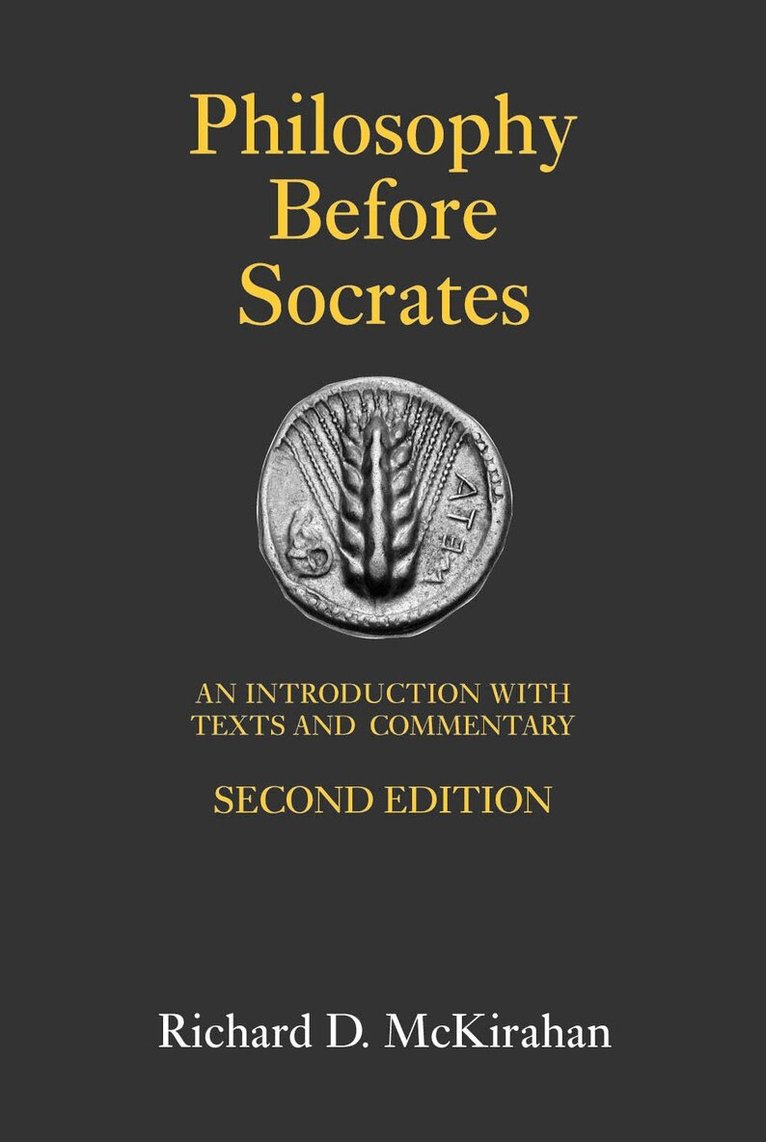
Since its publication in 1994, Richard McKirahan's Philosophy Before Socrates has become the standard sourcebook in Presocratic philosophy. It provides a wide survey of Greek science, metaphysics, and moral and political philosophy, from their roots in myth to the philosophers and Sophists of the fifth century. A comprehensive selection of fragments and testimonia, translated by the author, is presented in the context of a thorough and accessible discussion. An introductory chapter deals with the sources of Presocratic and Sophistic texts and the special problems of interpretation they present.In its second edition, this work has been updated and expanded to reflect important new discoveries and the most recent scholarship. Changes and additions have been made throughout, the most significant of which are found in the chapters on the Pythagoreans, Parmenides, Zeno, Anaxagoras, and Empedocles, and the new chapter on Philolaus. The translations of some passages have been revised, as have some interpretations and discussions. A new Appendix provides translations of three Hippocratic writings and the Derveni papyrus.
607 kr
Skickas inom 10-15 vardagar
Aristotle's Physics is about the causes of motion and culminates in a proof that God is needed as the ultimate cause of motion. Aristotle argues that things in motion need to be moved by something other than themselves - he rejects Plato's self-movers. On pain of regress, there must be an unmoved mover. If this unmoved mover is to cause motion eternally, it needs infinite power. It cannot, then, be a body, since bodies, being of finite size, cannot house infinite power. The unmoved mover is therefore an incorporeal God. Simplicius reveals that his teacher, Ammonius, harmonised Aristotle with Plato to counter Christian charges of pagan disagreement, by making Aristotle's God a cause of beginningless movement, but of beginningless existence of the universe. Eternal existence, not less than eternal motion, calls for an infinite, and hence incorporeal, force. By an irony, this anti-Christian interpretation turned Aristotle's God from a thinker into a certain kind of Creator, and so helped to make Aristotle's God acceptable to St Thomas Aquinas in the thirteenth century. This text provides a translation of Simplicius' commentary on Aristotle's work.