Richard F. Gombrich - Böcker
Visar alla böcker från författaren Richard F. Gombrich. Handla med fri frakt och snabb leverans.
8 produkter
8 produkter
2 100 kr
Skickas inom 10-15 vardagar
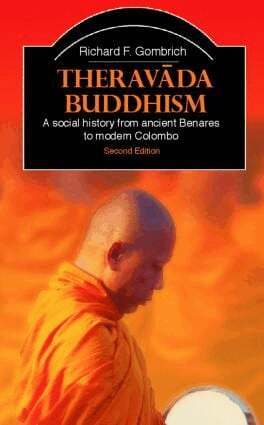
Written by the leading authority on Theravada Buddhism, this up-dated edition takes into account recent research to include the controversies over the date of the Buddha and current social and political developments in Sri Lanka. Gombrich explores the legacy of the Buddha's predecessors and the social and religious contexts against which Buddhism has developed and changed throughout history, demonstrating above all, how it has always influenced and been influenced by its social surroundings in a way which continues to this day.
628 kr
Skickas inom 10-15 vardagar
Written by the leading authority on Theravada Buddhism, this up-dated edition takes into account recent research to include the controversies over the date of the Buddha and current social and political developments in Sri Lanka. Gombrich explores the legacy of the Buddha's predecessors and the social and religious contexts against which Buddhism has developed and changed throughout history, demonstrating above all, how it has always influenced and been influenced by its social surroundings in a way which continues to this day.
2 100 kr
Skickas inom 10-15 vardagar
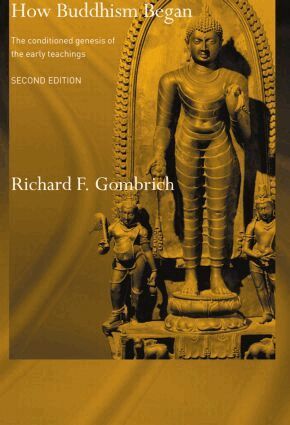
Written by one of the world's top scholars in the field of Pali Buddhism, this new and updated edition of How Buddhism Began, discusses various important doctrines and themes in early Buddhism. It takes 'early Buddhism' to be that reflected in the Pali canon, and to some extent assumes that these doctrines reflect the teachings of the Buddha himself. Two themes predominate. Firstly, the author argues that we cannot understand the Buddha unless we understand that he was debating with other religious teachers, notably Brahmins. The other main theme concerns metaphor, allegory and literalism. This accessible, well-written book is mandatory reading for all serious students of Buddhism.
668 kr
Skickas inom 10-15 vardagar
Written by one of the world's top scholars in the field of Pali Buddhism, this new and updated edition of How Buddhism Began, discusses various important doctrines and themes in early Buddhism. It takes 'early Buddhism' to be that reflected in the Pali canon, and to some extent assumes that these doctrines reflect the teachings of the Buddha himself. Two themes predominate. Firstly, the author argues that we cannot understand the Buddha unless we understand that he was debating with other religious teachers, notably Brahmins. The other main theme concerns metaphor, allegory and literalism. This accessible, well-written book is mandatory reading for all serious students of Buddhism.
2 493 kr
Skickas inom 5-8 vardagar
This book takes a fresh look at the earliest Buddhism texts and offers various suggestions how the teachings in them had developed. Two themes predominate. Firstly, it argues that we cannot understand the Buddha unless we understand that he was debating with other religious teachers, notably brahmins. For example, he denied the existence of a 'soul'; but what exactly was he denying? Another chapter suggests that the canonical story of the Buddha's encounter with a brigand who wore a garland of his victims' fingers probably reflects an encounter with a form of ecstatic religion. The other main theme concerns metaphor, allegory and literalism. By taking the words of the texts literally - despite the Buddha's warning not to - successive generations of his disciples created distinctions and developed doctrines far beyond his original intention. One chapter shows how this led to a scholastic categorisation of meditation. Failure to understand a basic metaphor also gave rise to the later argument between the Mahayana and the older tradition.Perhaps most important of all, a combination of literalism with ignorance of the Buddha's allusions to brahminism led buddhists to forget that the Buddha had preached that love, like christian charity, could itself be directly salvific.
294 kr
Skickas inom 7-10 vardagar
The short lyric poem appears with great frequency in Sanskrit collections and displays a wide range of themes. Bhartri·hari is the most famous composer. Ámaru and Bílhana also offer excellent examples.This anthology of the Love Lyrics of three Indian poets conjures up an atmosphere of love both sensual and social, ever in tension with love's rejection or repression. The flavor of all these poems- Ámaru's seventh-century C.E. "Hundred Poems," Bhartri·hari's anthology "Love, Politics, Disenchantment," from the fourth century, and Bílhana's eleventh-century "Fifty Stanzas of a Thief"—is the universalized aesthetic experience of love.Co-published by New York University Press and the JJC FoundationFor more on this title and other titles in the Clay Sanskrit series, please visit http://www.claysanskritlibrary.org
1 177 kr
Skickas inom 5-8 vardagar
In "What the Buddha Thought", Richard Gombrich argues that the Buddha was one of the most brilliant and original thinkers of all time. Intended to serve as an introduction to the Buddha's thought, and hence even to Buddhism itself, the book also has larger aims: it argues that we can know far more about the Buddha than it is fashionable among scholars to admit, and that his thought has a greater coherence than is usually recognised. It contains much new material. Interpreters both ancient and modern have taken little account of the historical context of the Buddha's teachings; but by relating them to early brahminical texts, and also to ancient Jainism, Gombrich gives a much richer picture of the Buddha's meaning, especially when his satire and irony are appreciated. Incidentally, since many of the Buddha's allusions can only be traced in the Pali versions of surviving texts, the book establishes the importance of the Pali Canon as evidence. The book contains much new material. The author stresses the Buddha's capacity for abstraction: though he made extensive use of metaphor, he did not found his arguments upon it, as earlier thinkers had done.He ethicized and radically reinterpreted older ideas of karma (human action) and rebirth. Similarly, building on older texts, he argued for the fundamental importance of love and compassion, and analysed fire as a process which could stand as a model for every component of conscious experience. Morally, the Buddha's theory of karma provided a principle of individuation and asserted each individual's responsibility for his own destiny. To make the book completely accessible to the general reader, the author provides an introductory section of 'Background Information,' for easy reference.
309 kr
Skickas inom 5-8 vardagar
In "What the Buddha Thought", Richard Gombrich argues that the Buddha was one of the most brilliant and original thinkers of all time. Intended to serve as an introduction to the Buddha's thought, and hence even to Buddhism itself, the book also has larger aims: it argues that we can know far more about the Buddha than it is fashionable among scholars to admit, and that his thought has a greater coherence than is usually recognised. It contains much new material. Interpreters both ancient and modern have taken little account of the historical context of the Buddha's teachings; but by relating them to early brahminical texts, and also to ancient Jainism, Gombrich gives a much richer picture of the Buddha's meaning, especially when his satire and irony are appreciated. Incidentally, since many of the Buddha's allusions can only be traced in the Pali versions of surviving texts, the book establishes the importance of the Pali Canon as evidence. The book contains much new material. The author stresses the Buddha's capacity for abstraction: though he made extensive use of metaphor, he did not found his arguments upon it, as earlier thinkers had done.He ethicized and radically reinterpreted older ideas of karma (human action) and rebirth. Similarly, building on older texts, he argued for the fundamental importance of love and compassion, and analysed fire as a process which could stand as a model for every component of conscious experience. Morally, the Buddha's theory of karma provided a principle of individuation and asserted each individual's responsibility for his own destiny. To make the book completely accessible to the general reader, the author provides an introductory section of 'Background Information,' for easy reference.