Richard J.A. Talbert - Böcker
Visar alla böcker från författaren Richard J.A. Talbert. Handla med fri frakt och snabb leverans.
8 produkter
8 produkter
930 kr
Skickas inom 5-8 vardagar
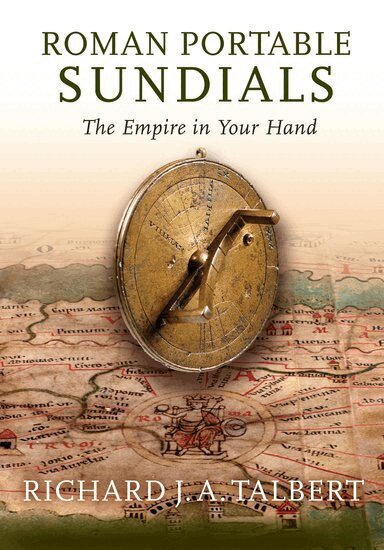
In an unscientific era when maps were rarities, how did ancient Romans envisage their far flung empire? This was done by various means for certain, including with the aid of an ingenious type of portable sundial that has barely attracted notice. As the Romans understood before the first century BCE, to track the passage of the sun across the sky hour-by-hour one needed to know one's latitude and the time of year, and that, furthermore, sundials did not have to be fixed objects. These portable instruments, crafted in bronze, were adjustable for the changes of latitude to be expected on long journeys--say, for instance, from Britain to Spain, or from Alexandria to Rome, or even on a Mediterranean tour. For convenient reference, these sundials incorporated lists of twenty to thirty names of cities or regions, each with its specific latitude. One of the insights of Roman Portable Sundials is that the choice of locations offers unique clues to the mental world-map and self-identity of individuals able to visualize Rome's vast empire latitudinally. The sixteen such sundials known to date share common features but designers also vied to create enhancements. Comparison with modern calculations shows that often the latitudes listed are incorrect, in which case the sundial may not perform at its best. But then the nature of Romans' time-consciousness (or lack of it) must be taken into consideration. Richard Talbert suspects that owners might prize these sundials not so much for practical use but rather as prestige objects attesting to scientific awareness as well as imperial mastery of time and space. In retrospect, they may be seen as Roman precursors to comparable Islamic and European instruments from the Middle Ages onwards, and even to today's luxury watches which display eye-catching proof of their purchasers' wealth, sophistication, and cosmopolitanism. Richly enhanced with detailed photographs, line drawings, maps, a gazetteer, and a table of latitudes and locations, Roman Portable Sundials brings these overlooked gadgets out of the shadows at last to reveal their hitherto untapped layers of meaning.
428 kr
Skickas inom 5-8 vardagar
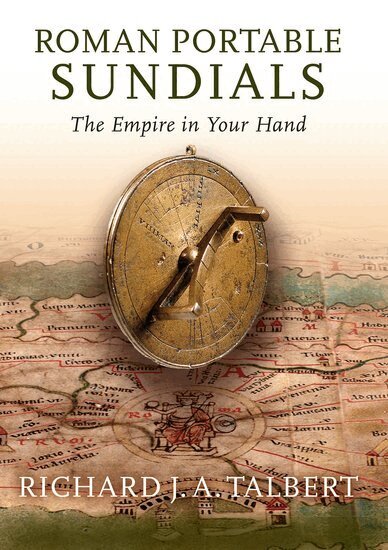
In an unscientific era when maps were rarities, how did ancient Romans envisage their far flung empire? This was done by various means for certain, including with the aid of an ingenious type of portable sundial that has barely attracted notice. As the Romans understood before the first century BCE, to track the passage of the sun across the sky hour-by-hour one needed to know one's latitude and the time of year, and that, furthermore, sundials did not have to be fixed objects. These portable instruments, crafted in bronze, were adjustable for the changes of latitude to be expected on long journeys--say, for instance, from Britain to Spain, or from Alexandria to Rome, or even on a Mediterranean tour. For convenient reference, these sundials incorporated lists of twenty to thirty names of cities or regions, each with its specific latitude. One of the insights of Roman Portable Sundials is that the choice of locations offers unique clues to the mental world-map and self-identity of individuals able to visualize Rome's vast empire latitudinally. The sixteen such sundials known to date share common features but designers also vied to create enhancements. Comparison with modern calculations shows that often the latitudes listed are incorrect, in which case the sundial may not perform at its best. But then the nature of Romans' time-consciousness (or lack of it) must be taken into consideration. Richard Talbert suspects that owners might prize these sundials not so much for practical use but rather as prestige objects attesting to scientific awareness as well as imperial mastery of time and space. In retrospect, they may be seen as Roman precursors to comparable Islamic and European instruments from the Middle Ages onwards, and even to today's luxury watches which display eye-catching proof of their purchasers' wealth, sophistication, and cosmopolitanism. Richly enhanced with detailed photographs, line drawings, maps, a gazetteer, and a table of latitudes and locations, Roman Portable Sundials brings these overlooked gadgets out of the shadows at last to reveal their hitherto untapped layers of meaning.
646 kr
Skickas inom 10-15 vardagar
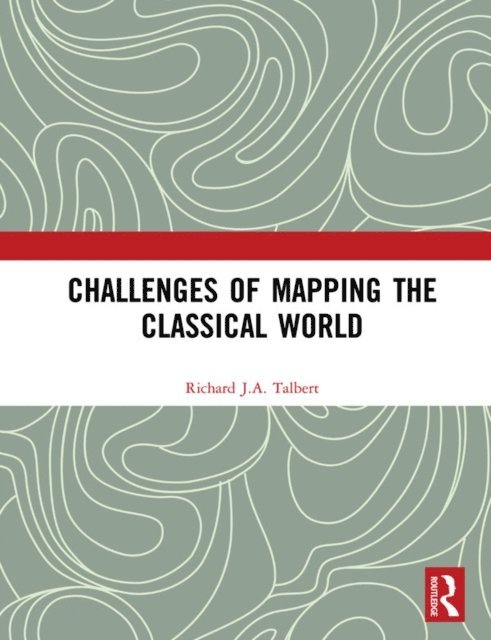
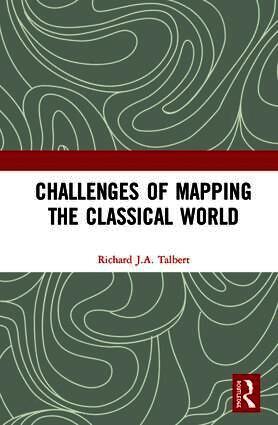
Challenges of Mapping the Classical World collects together in one volume fourteen varied items written by Richard Talbert over the past thirty years. They cohere around the theme of mapping the classical world since the nineteenth century. All were originally prompted by Talbert’s commission in the late 1980s to produce a definitive classical atlas after more than a century of failed attempts by the Kieperts and others. These he evaluates, as well as probing the Smith/Grove atlas, a successful twenty-year initiative launched in the mid-1850s, with a cartographic approach that departs radically from established practice. Talbert’s initial vision for the international collaborative project that resulted in the Barrington Atlas of the Greek and Roman World (2000) is presented, and the successive twice-yearly reports on its progress from 1991 through to completion are published here for the first time. A further item reflects retrospectively on the project’s cartographic challenges and on how developments in digital map production were decisive in overcoming them. This volume will be invaluable to anyone with an interest in the development and growing impact of mapping the classical world.
4 086 kr
Skickas inom 7-10 vardagar
In 102 full-color maps spread over 175 pages, the Barrington Atlas re-creates the entire world of the Greeks and Romans from the British Isles to the Indian subcontinent and deep into North Africa. It spans the territory of more than 75 modern countries. Its large format (13 1/4 x 18 in. or 33.7 x 46.4 cm) has been custom-designed by the leading cartographic supplier, MapQuest.com, Inc., and is unrivaled for range, clarity, and detail. Over 70 experts, aided by an equal number of consultants, have worked from satellite-generated aeronautical charts to return the modern landscape to its ancient appearance, and to mark ancient names and features in accordance with the most up-to-date historical scholarship and archaeological discoveries. Chronologically, the Barrington Atlas spans archaic Greece to the Late Roman Empire, and no more than two standard scales (1:500,000 and 1:1,000,000) are used to represent most regions. Since the 1870s, all attempts to map the classical world comprehensively have failed. The Barrington Atlas has finally achieved that elusive and challenging goal.It began in 1988 at the University of North Carolina, Chapel Hill, under the direction of the distinguished ancient historian Richard Talbert, and has been developed with approximately $4.5 million in funding support. The resulting Barrington Atlas is a reference work of permanent value. It has an exceptionally broad appeal to everyone worldwide with an interest in the ancient Greeks and Romans, the lands they penetrated, and the peoples and cultures they encountered in Europe, North Africa, and Western Asia. Scholars and libraries should find it essential. It is also for students, travelers, lovers of fine cartography, and anyone eager to retrace Alexander's eastward marches, cross the Alps with Hannibal, traverse the Eastern Mediterranean with St. Paul, or ponder the roads, aqueducts, and defense works of the Roman Empire. For the new millennium the Barrington Atlas brings the ancient past back to life in an unforgettably vivid and inspiring way. Map-by-Map Directory A Map-by-Map Directory to the Barrington Atlas is available online (http://press.princeton.edu/B_ATLAS/B_ATLAS.PDF) and in a separate two-volume print edition of close to 1,500 pages.The Directory is designed to provide information about every place or feature in the Barrington Atlas. The section for each map comprises: * a concise text drawing attention to special difficulties in mapping a region, such as extensive landscape change since antiquity, or uneven modern exploration.* a listing of every name and feature on the map, with basic data about the period of occupation, the modern equivalents of ancient placenames, the modern country within which they are located, and brief references to relevant ancient testimony or modern studies.* a bibliography of works cited. The Map-by-Map Directory is an essential accompaniment to the Barrington Atlas. As a uniquely rich, comprehensive, up-to-date distillation of evidence and scholarship, it has no match elsewhere and opens the way to an immense variety of further research initiatives
3 640 kr
Skickas inom 7-10 vardagar
In 102 full-color maps spread over 175 pages, the Barrington Atlas re-creates the entire world of the Greeks and Romans from the British Isles to the Indian subcontinent and deep into North Africa. It spans the territory of more than 75 modern countries. Its large format (13 1/4 x 18 in. or 33.7 x 46.4 cm) has been custom-designed by the leading cartographic supplier, MapQuest.com, Inc., and is unrivaled for range, clarity, and detail. Over 70 experts, aided by an equal number of consultants, have worked from satellite-generated aeronautical charts to return the modern landscape to its ancient appearance, and to mark ancient names and features in accordance with the most up-to-date historical scholarship and archaeological discoveries. Chronologically, the Barrington Atlas spans archaic Greece to the Late Roman Empire, and no more than two standard scales (1:500,000 and 1:1,000,000) are used to represent most regions. Since the 1870s, all attempts to map the classical world comprehensively have failed. The Barrington Atlas has finally achieved that elusive and challenging goal.It began in 1988 at the University of North Carolina, Chapel Hill, under the direction of the distinguished ancient historian Richard Talbert, and has been developed with approximately $4.5 million in funding support. The resulting Barrington Atlas is a reference work of permanent value. It has an exceptionally broad appeal to everyone worldwide with an interest in the ancient Greeks and Romans, the lands they penetrated, and the peoples and cultures they encountered in Europe, North Africa, and Western Asia. Scholars and libraries should find it essential. It is also for students, travelers, lovers of fine cartography, and anyone eager to retrace Alexander's eastward marches, cross the Alps with Hannibal, traverse the Eastern Mediterranean with St. Paul, or ponder the roads, aqueducts, and defense works of the Roman Empire. For the new millennium the Barrington Atlas brings the ancient past back to life in an unforgettably vivid and inspiring way. Map-by-Map Directory A Map-by-Map Directory to the Barrington Atlas is available online (http://press.princeton.edu/B_ATLAS/B_ATLAS.PDF) and in a separate two-volume print edition of close to 1,500 pages.The Directory is designed to provide information about every place or feature in the Barrington Atlas. The section for each map comprises: * a concise text drawing attention to special difficulties in mapping a region, such as extensive landscape change since antiquity, or uneven modern exploration.* a listing of every name and feature on the map, with basic data about the period of occupation, the modern equivalents of ancient placenames, the modern country within which they are located, and brief references to relevant ancient testimony or modern studies.* a bibliography of works cited. The Map-by-Map Directory is an essential accompaniment to the Barrington Atlas. As a uniquely rich, comprehensive, up-to-date distillation of evidence and scholarship, it has no match elsewhere and opens the way to an immense variety of further research initiatives
556 kr
Skickas inom 7-10 vardagar
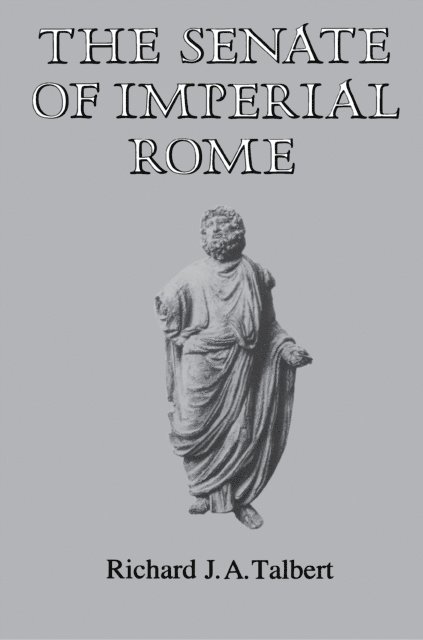
Richard J. A. Talbert examines the composition, procedure, and functions of the Roman senate during the Principate (30 B.C.-A.D. 238). Although it is of central importance to the period, this great council has not previously received such scholarly treatment. Offering a fresh approach to major ancient authors (Pliny and Tacitus in particular), the book also draws on inscriptions and legal writers never before fully exploited for the study of the senate.
2 159 kr
Skickas inom 10-15 vardagar
Challenges of Mapping the Classical World collects together in one volume fourteen varied items written by Richard Talbert over the past thirty years. They cohere around the theme of mapping the classical world since the nineteenth century. All were originally prompted by Talbert’s commission in the late 1980s to produce a definitive classical atlas after more than a century of failed attempts by the Kieperts and others. These he evaluates, as well as probing the Smith/Grove atlas, a successful twenty-year initiative launched in the mid-1850s, with a cartographic approach that departs radically from established practice. Talbert’s initial vision for the international collaborative project that resulted in the Barrington Atlas of the Greek and Roman World (2000) is presented, and the successive twice-yearly reports on its progress from 1991 through to completion are published here for the first time. A further item reflects retrospectively on the project’s cartographic challenges and on how developments in digital map production were decisive in overcoming them. This volume will be invaluable to anyone with an interest in the development and growing impact of mapping the classical world.
Del 10 - Technology and Change in History
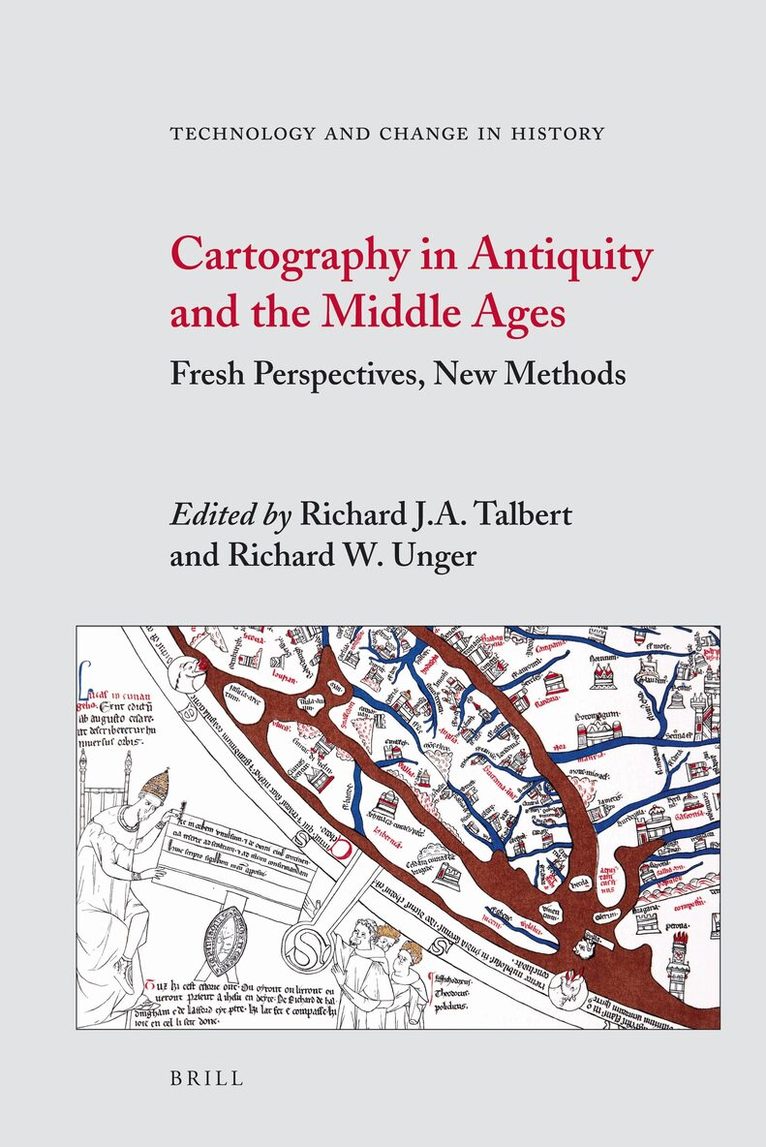
Cartography in Antiquity and the Middle Ages
Fresh Perspectives, New Methods
Inbunden, Engelska, 2008
2 491 kr
Skickas inom 5-8 vardagar
In scope, this book matches The History of Cartography, vol. 1 (1987) edited by Brian Harley and David Woodward. Now, twenty years after the appearance of that seminal work, classicists and medievalists from Europe and North America highlight, distill and reflect on the remarkably productive progress made since in many different areas of the study of maps. The interaction between experts on antiquity and on the Middle Ages evident in the thirteen contributions offers a guide to the future and illustrates close relationships in the evolving practice of cartography over the first millennium and a half of the Christian era.Contributors are Emily Albu, Raymond Clemens, Lucy Donkin, Evelyn Edson, Tom Elliott, Patrick Gauthier Dalché, Benjamin Kedar, Maja Kominko, Natalia Lozovsky, Yossef Rapoport, Emilie Savage-Smith, Camille Serchuk, Richard Talbert, and Jennifer Trimble.