Richard Janko - Böcker
Visar alla böcker från författaren Richard Janko. Handla med fri frakt och snabb leverans.
9 produkter
9 produkter
6 777 kr
Skickas inom 7-10 vardagar
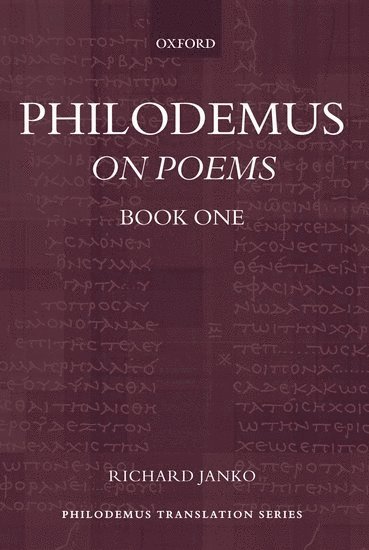
The On Poems by Philodemus (c. 110-35 BC), the Epicurean philosopher and poet who taught Virgil and influenced Horace, is our main source for Hellenistic literary theory. In Book 1 Philodemus summarizes a survey of previously unknown poetic and aesthetic theories. Compiled by Crates of Mallos this survey reviews the critical theories of earlier Epicureans, Peripatetics, and Stoics, who argued in some way that sound is the source of poetic excellence, and that the ear, unaided by the mind, can judge it. Philodemus led the reaction against this invasion of Hellenistic literary criticism by musical theory, arguing that form and content are interrelated, and that substantive content, not pretty sound, is what makes poetry worthwhile. The 200 fragments of Book 1 were entirely jumbled after its discovery at the site of Vesuvius' destruction of Herculaneum. This edition reconstitutes their original sequence, according to a new method, while exploiting previously unknown manuscript sources and new techniques for reading the extant pieces. In thus restoring this important aesthetic treatise from antiquity, it makes a major addition to the corpus of classical literature.
Philodemus: On Poems, Book 2
With the fragments of Heracleodorus and Pausimachus
Inbunden, Engelska, 2020
3 127 kr
Skickas inom 3-6 vardagar
The On Poems by Philodemus of Gadara (c.110-35 BC), the Epicurean philosopher and poet who taught Vergil and influenced Horace, is our main source for Hellenistic literary and critical theory, bridging the gap between Aristotle and Horace. In Book 2 Philodemus rebuts two almost unknown critics, Heracleodorus and Pausimachus, who argued, respectively, that the sound arising from the word-order (synthesis) is the source of poetic excellence, regardless of the content and word-choice, and that the pure sound of the vowels and consonants, which vary in quality, is that source. By putting together fragments from both the summary and the rebuttal of these theorists, we can form a full picture of their thought.Philodemus led the Augustan reaction against this invasion of literary criticism by musical theory, arguing that form and content are interrelated, and that well-expressed content, not pretty sound, is what makes poetry worthwhile. Book 2 reveals just how much and how inventively Horace drew on the ideas of all three writers in composing his Ars Poetica.The extensive remains of this scroll, carbonized in the eruption of Vesuvius, were thoroughly jumbled after their rediscovery in the Villa of the Papyri at Herculaneum. This edition painstakingly reconstructs their original sequence according to new methods, while exploiting previously unknown manuscript sources and technologies for ordering and reading the extant pieces. In thus restoring this lengthy aesthetic treatise from antiquity, it makes another major addition to the corpus of classical literature.
863 kr
Skickas inom 7-10 vardagar
The On Poems by the Epicurean philosopher and poet Philodemus of Gadara (1st century BC) survived amid the library of the Villa of the Papyri at Herculaneum, which was buried by the eruption of Vesuvius in AD 79. The papyrus-rolls in this, the only library that survives from the ancient world, are with the aid of advanced technology at last able to be read, reconstructed, and translated. The On Poems, in five books, offers unique insights into ancient literary criticism from Aristotle to Horace. Book 1 was published in 2000. This volume contains the Greek text, translation, and scholarly commentary on Books 3 and 4, together with the fragments of Aristotle's lost dialogue On Poets, which sheds light on Aristotle's views on such controversial questions as mimesis, catharsis, and the origins of tragedy and comedy.
2 368 kr
Skickas inom 7-10 vardagar
The On Poems by Philodemus (c.110-35 BC), the Epicurean philosopher and poet who taught Virgil and influenced Horace, is our main source for Hellenistic literary theory. In Book 1 Philodemus summarizes a survey of previously unknown poetic and aesthetic theories. Compiled by Crates of Mallos this survey reviews the critical theories of earlier Epicureans, Peripatetics, and Stoics, who argued in some way that sound is the source of poetic excellence, and that the ear, unaided by the mind, can judge it. Philodemus led the reaction against this invasion of Hellenistic literary criticism by musical theory, arguing that form and content are interrelated, and that substantive content, not pretty sound, is what makes poetry worthwhile. The 200 fragments of Book 1 were entirely jumbled after its discovery at the site of Vesuvius' destruction of Herculaneum. This edition reconstitutes their original sequence, according to a new method, while exploiting previously unknown manuscript sources and new techniques for reading the extant pieces. In thus restoring this important aesthetic treatise from antiquity, it makes a major addition to the corpus of classical literature.
2 923 kr
Skickas inom 5-8 vardagar
The On Poems by the Epicurean philosopher and poet Philodemus of Gadara (1st century BC) survived amid the library of the Villa of the Papyri at Herculaneum, which was buried by the eruption of Vesuvius in AD 79. The papyrus-rolls in this, the only library that survives from the ancient world, are with the aid of advanced technology at last able to be read, reconstructed, and translated. The On Poems, in five books, offers unique insights into ancient literary criticism from Aristotle to Horace. Book 1 was published in 2000. This volume contains the Greek text, translation, and scholarly commentary on Books 3 and 4, together with the fragments of Aristotle's lost dialogue On Poets, many of which come from Book 4. These shed light on Aristotle's views on such controversial questions as mimesis, catharsis, and the origins of tragedy and comedy.
493 kr
Skickas inom 7-10 vardagar
This book investigates the history of the ancient Greek tradition of oral epic poetry which culminated in the Iliad and Odyssey. These masterpieces did not exhaust the tradition, and poems were composed in the same style for several generations afterwards. One group of such poems is the 'Homeric Hymns', ascribed to Homer in antiquity. In fact the origins of these Hymns are as mysterious as those of the Homeric epics themselves with little external evidence to assist. This book will be of interest to scholars concerned with Greek philology and dialects, Homeric epic and Greek literature of the Archaic period. It should also find readers amongst specialists in other oral poetries and those using computers in the Humanities.
963 kr
Skickas inom 7-10 vardagar
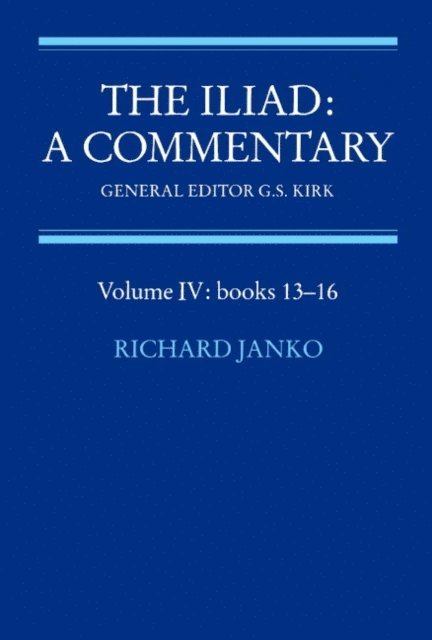
This, the fourth volume in the six-volume Commentary on The Iliad being prepared under the General Editorship of Professor G. S. Kirk, covers Books 13-16, including the Battle for the Ships, the Deception of Zeus and the Death of Patroklos. Three introductory essays discuss the role of Homer's gods in his poetry; the origins and development of the epic diction; and the transmission of the text, from the bard's lips to our own manuscripts. It is now widely recognised that the first masterpiece of Western literature is an oral poem; Professor Janko's detailed commentary aims to show how this recognition can clarify many linguistic and textual problems, entailing a radical reassessment of the work of Homer's Alexandrian editors. The commentary also explores the poet's subtle creativity in adapting traditional materials, whether formulae, typical scenes, mythology or imagery, so as best to move, inspire and entertain his audience, ancient and modern alike. Discussion of the poem's literary qualities and structure is, where possible, kept separate from that of more technical matters.
551 kr
Skickas inom 5-8 vardagar
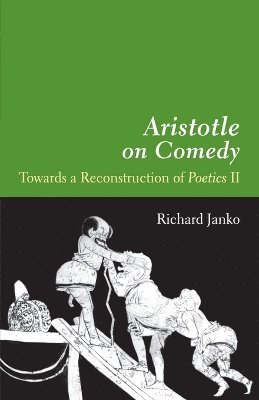
In 1839 the "Tractatus Coislinianus", a summarised treatise on comedy, was published from a tenth-century manuscript. Its discoverer suggested that it derived from the lost second book of Aristotle's "Poetics", which inaugurated the systematic study of comedy, but it was soon condemned as an ignorant compilation verging on forgery, and thus matters stood until the first publication of "Aristotle on Comedy" in 1984. Richard Janko's edition of the text is accompanied by a facing translation, interpretive essays, reconstruction and commentary. This edition contains a new preface and additional bibliography.
1 700 kr
Kommande