Richard McElreath - Böcker
Visar alla böcker från författaren Richard McElreath. Handla med fri frakt och snabb leverans.
4 produkter
4 produkter
1 282 kr
Skickas inom 10-15 vardagar
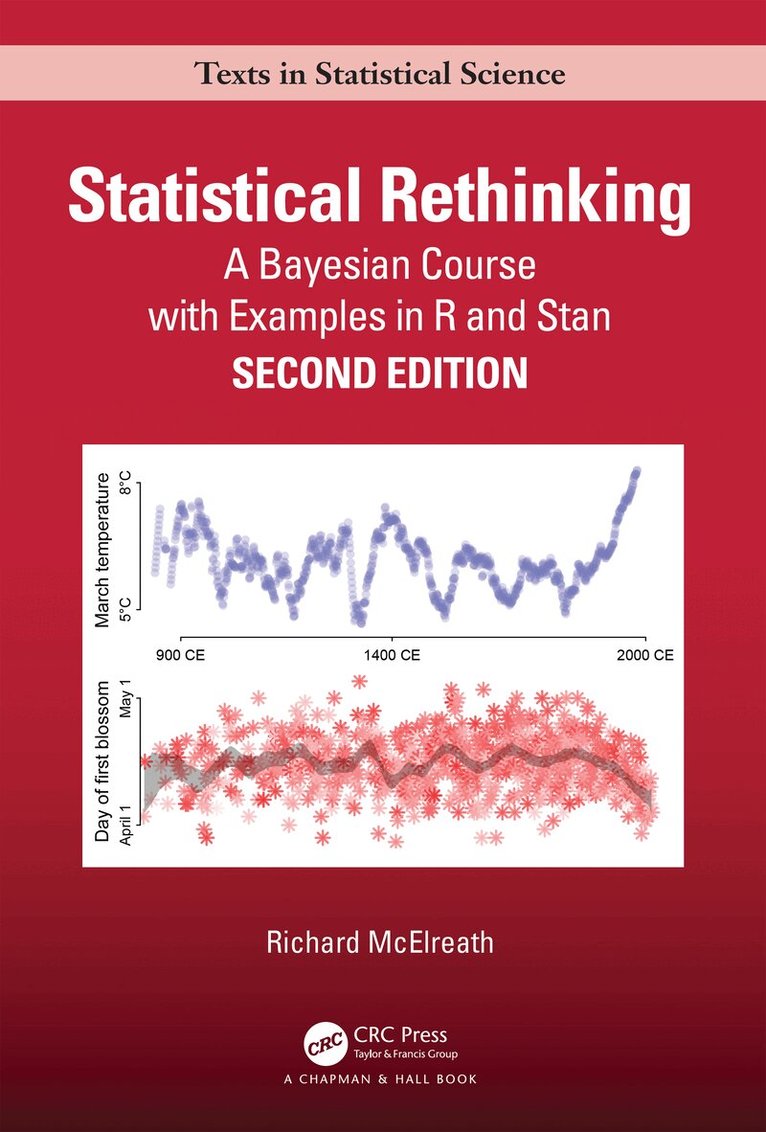
Winner of the 2024 De Groot Prize awarded by the International Society for Bayesian Analysis (ISBA)Statistical Rethinking: A Bayesian Course with Examples in R and Stan builds your knowledge of and confidence in making inferences from data. Reflecting the need for scripting in today's model-based statistics, the book pushes you to perform step-by-step calculations that are usually automated. This unique computational approach ensures that you understand enough of the details to make reasonable choices and interpretations in your own modeling work.The text presents causal inference and generalized linear multilevel models from a simple Bayesian perspective that builds on information theory and maximum entropy. The core material ranges from the basics of regression to advanced multilevel models. It also presents measurement error, missing data, and Gaussian process models for spatial and phylogenetic confounding.The second edition emphasizes the directed acyclic graph (DAG) approach to causal inference, integrating DAGs into many examples. The new edition also contains new material on the design of prior distributions, splines, ordered categorical predictors, social relations models, cross-validation, importance sampling, instrumental variables, and Hamiltonian Monte Carlo. It ends with an entirely new chapter that goes beyond generalized linear modeling, showing how domain-specific scientific models can be built into statistical analyses.FeaturesIntegrates working code into the main text. Illustrates concepts through worked data analysis examples. Emphasizes understanding assumptions and how assumptions are reflected in code. Offers more detailed explanations of the mathematics in optional sections. Presents examples of using the dagitty R package to analyze causal graphs. Provides the rethinking R package on the author's website and on GitHub.
298 kr
Skickas inom 7-10 vardagar
Over the last several decades, mathematical models have become central to the study of social evolution, both in biology and the social sciences. But students in these disciplines often seriously lack the tools to understand them. A primer on behavioral modeling that includes both mathematics and evolutionary theory, "Mathematical Models of Social Evolution" aims to make the student and professional researcher in biology and the social sciences fully conversant in the language of the field. Teaching biological concepts from which models can be developed, Richard McElreath and Robert Boyd introduce readers to many of the typical mathematical tools that are used to analyze evolutionary models and end each chapter with a set of problems that draw upon these techniques. "Mathematical Models of Social Evolution" equips behaviorists and evolutionary biologists with the mathematical knowledge to truly understand the models on which their research depends.Ultimately, McElreath and Boyd's goal is to impart the fundamental concepts that underlie modern biological understandings of the evolution of behavior so that readers will be able to more fully appreciate journal articles and scientific literature and start building models of their own.
680 kr
Kommande
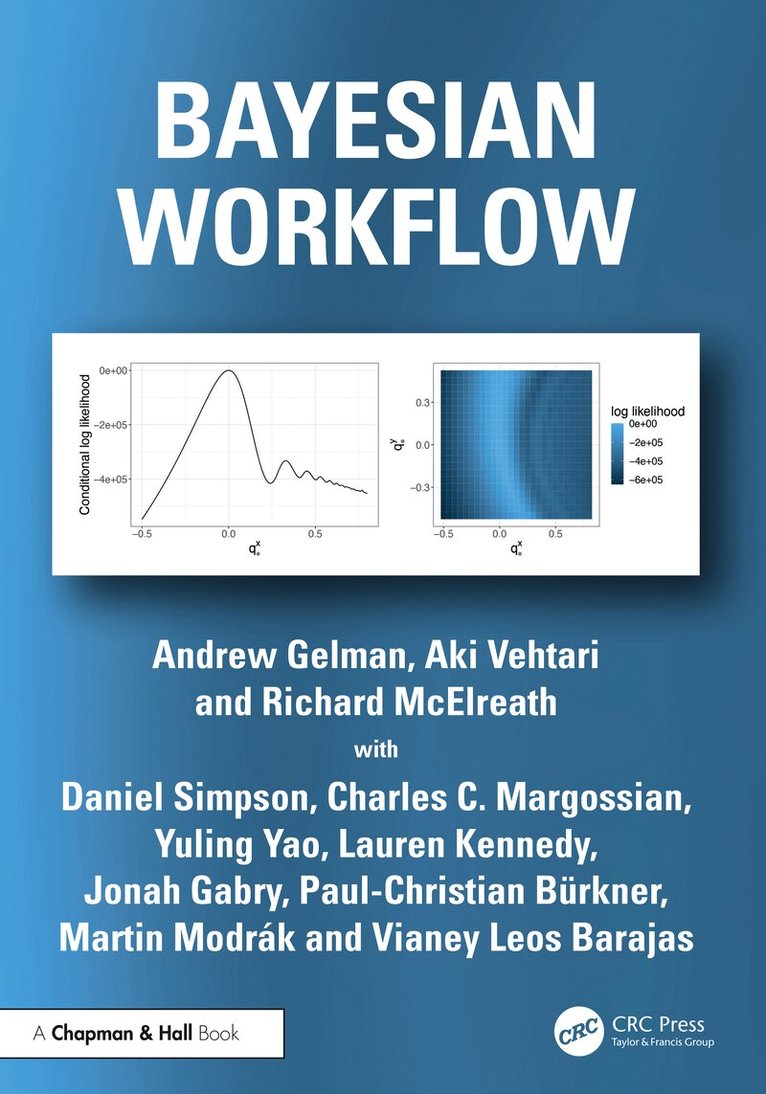
Bayesian statistics and statistical practice have evolved over the years, driven by advancements in theory, methods, and computational tools. This book explores the intricate workflows of applied Bayesian statistics, aiming to uncover the tacit knowledge often overlooked in published papers and textbooks. By systematizing the process of Bayesian model development, the book seeks to improve applied analyses and inspire future innovations in theory, methods, and software. It emphasizes the importance of iterative model building, model checking, computational troubleshooting, and simulated-data experimentation, offering a comprehensive perspective on statistical analysis.Through detailed examples and practical guidance, the book bridges the gap between theory and application, empowering practitioners and researchers to navigate the complexities of Bayesian inference. It is not a checklist or cookbook but a flexible framework for understanding and resolving challenges in statistical modeling and decision-making under uncertainty.Features:Covers all aspects of Bayesian statistical workflow, including model building, inference, validation, troubleshooting, and understandingDemonstrates iterative model development and computational problem-solving through real-world case studiesExplores computational challenges, calibration checking, and connections between modeling and computationHighlights the importance of checking models under diverse conditions to understand their limitations and improve their robustnessDiscusses how Bayesian principles apply to non-Bayesian methods in statistics and machine learningIncludes code snippets, exercises, and links to full datasets and code in R and Stan, with applicability to other programming environments like Python and JuliaThis book is designed for practitioners of applied Bayesian statistics, particularly users of probabilistic programming languages such as Stan, as well as developers of methods and software tailored to these users. It also targets researchers in Bayesian theory and methods, offering insights into understudied aspects of statistical workflows. Instructors and students will find adaptable exercises and case studies to enhance their learning experience. Beyond Bayesian inference, the book’s principles are relevant to users of non-Bayesian methods, making it a valuable resource for statisticians, data scientists, and machine learning professionals seeking to improve their modeling and decision-making processes.
1 802 kr
Kommande
Bayesian statistics and statistical practice have evolved over the years, driven by advancements in theory, methods, and computational tools. This book explores the intricate workflows of applied Bayesian statistics, aiming to uncover the tacit knowledge often overlooked in published papers and textbooks. By systematizing the process of Bayesian model development, the book seeks to improve applied analyses and inspire future innovations in theory, methods, and software. It emphasizes the importance of iterative model building, model checking, computational troubleshooting, and simulated-data experimentation, offering a comprehensive perspective on statistical analysis.Through detailed examples and practical guidance, the book bridges the gap between theory and application, empowering practitioners and researchers to navigate the complexities of Bayesian inference. It is not a checklist or cookbook but a flexible framework for understanding and resolving challenges in statistical modeling and decision-making under uncertainty.Features:Covers all aspects of Bayesian statistical workflow, including model building, inference, validation, troubleshooting, and understandingDemonstrates iterative model development and computational problem-solving through real-world case studiesExplores computational challenges, calibration checking, and connections between modeling and computationHighlights the importance of checking models under diverse conditions to understand their limitations and improve their robustnessDiscusses how Bayesian principles apply to non-Bayesian methods in statistics and machine learningIncludes code snippets, exercises, and links to full datasets and code in R and Stan, with applicability to other programming environments like Python and JuliaThis book is designed for practitioners of applied Bayesian statistics, particularly users of probabilistic programming languages such as Stan, as well as developers of methods and software tailored to these users. It also targets researchers in Bayesian theory and methods, offering insights into understudied aspects of statistical workflows. Instructors and students will find adaptable exercises and case studies to enhance their learning experience. Beyond Bayesian inference, the book’s principles are relevant to users of non-Bayesian methods, making it a valuable resource for statisticians, data scientists, and machine learning professionals seeking to improve their modeling and decision-making processes.