Richard Stren - Böcker
Visar alla böcker från författaren Richard Stren. Handla med fri frakt och snabb leverans.
8 produkter
8 produkter
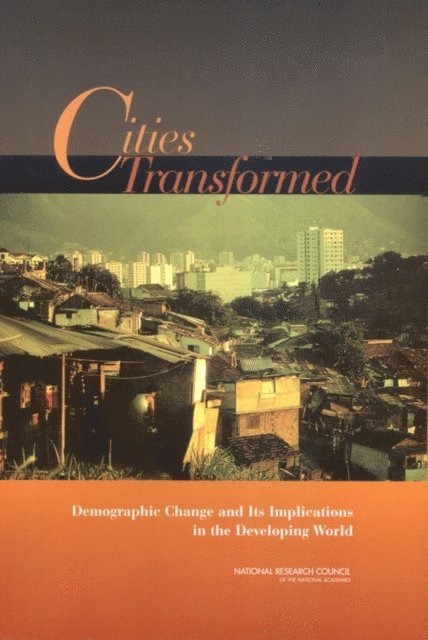
Cities Transformed
Demographic Change and Its Implications in the Developing World
Inbunden, Engelska, 2003
936 kr
Tillfälligt slut
Virtually all of the growth in the worlda (TM)s population for the foreseeable future will take place in the cities and towns of the developing world. Over the next twenty years, most developing countries will for the first time become more urban than rural. The benefits from urbanization cannot be overlooked, but the speed and sheer scale of this transformation present many challenges. A new cast of policy makers is emerging to take up the many responsibilities of urban governancea "as many national governments decentralize and devolve their functions, programs in poverty, health, education, and public services are increasingly being deposited in the hands of untested municipal and regional governments. Demographers have been surprisingly slow to devote attention to the implications of the urban transformation. Drawing from a wide variety of data sources, many of them previously inaccessible, Cities Transformed explores the implications of various urban contexts for marriage, fertility, health, schooling, and childrena (TM)s lives. It should be of interest to all involved in city-level research, policy, planning, and investment decisions.
705 kr
Skickas inom 11-20 vardagar
The network is the pervasive organizational image of the new millennium. This book examines one particular kind of network - the 'knowledge network' - whose primary mandate is to create and disseminate knowledge based on multidisciplinary research that is informed by problem-solving as well as theoretical agendas. In their examination of five knowledge networks based in Canadian universities, and in most cases working closely with researchers in developing countries, the authors demonstrate the ability of networks to cross disciplinary boundaries, to blend the operational with the theoretical, and to respond to broad social processes. Operating through networks, rather than through formal, hierarchical structures, diverse communities of researchers create different kinds of knowledge and disseminate their results effectively across disciplinary, sectoral, and spatial boundaries. Analysis of networks in health, environment, urban, and educational fields suggests that old categories of 'north' and 'south' are becoming blurred, and that the new structures of knowledge creation and dissemination help to sustain collaborative research.
420 kr
Skickas inom 10-15 vardagar
Cities are a locus of human diversity, where people with varying degrees of wealth and status share an association within a particular urban boundary. Despite the common geography, sharp social divisions characterize many cities. High levels of urban violence bear witness to the difficult challenge of creating socially cohesive and inclusive cities. The devastated inner cities of many large American urban centres exemplify the failure of urban development. With an enlightened democratic approach to policy reform, however, cities can achieve social sustainability.Some cities have been more successful than others in creating environments conducive to the cohabitation of a diverse population. In this collection of original essays, case studies of ten cities (Montreal and Toronto in Canada, Miami and Baltimore in the United States, Geneva and Rotterdam in Europe, Sao Paulo and San Salvador in South America, and Nairobi and Cape Town in South Africa) are presented and analysed in terms of social sustainability. The volume as a whole looks at the policies, institutions, and planning and social processes that can have the effect of integrating diverse groups and cultural practices in a just and equitable fashion.The authors conclude that policies conducive to social sustainability should, among other things, seek to promote fiscal equalization, weave communities within the metropolis into a cohesive whole, and ideally, provide transport systems that ensure equal access to public services and workplaces, all within the framework of an open and democratic local governance structure.
318 kr
Skickas inom 10-15 vardagar
The network is the pervasive organizational image of the new millennium. This book examines one particular kind of network - the 'knowledge network' - whose primary mandate is to create and disseminate knowledge based on multidisciplinary research that is informed by problem-solving as well as theoretical agendas. In their examination of five knowledge networks based in Canadian universities, and in most cases working closely with researchers in developing countries, the authors demonstrate the ability of networks to cross disciplinary boundaries, to blend the operational with the theoretical, and to respond to broad social processes. Operating through networks, rather than through formal, hierarchical structures, diverse communities of researchers create different kinds of knowledge and disseminate their results effectively across disciplinary, sectoral, and spatial boundaries. Analysis of networks in health, environment, urban, and educational fields suggests that old categories of 'north' and 'south' are becoming blurred, and that the new structures of knowledge creation and dissemination help to sustain collaborative research.
434 kr
Skickas inom 10-15 vardagar
This volume examines wide-ranging issues confronting cites, and reviews tools, strategies and practices to address them. It examines nine 'windows' of urban management in the context of the new urban strategy of the World Bank. The book recognizes that cities are crucial in efforts to address poverty and development issues. It combines theoretical discussions of new, fundamental principles of urban management with practical discussions that show how concepts are translated into policy tools and strategies.Chapter 1 discusses the forces of globalization and how these affect cities in general and metropolitan management and governance in particular. Chapter 2 introduces the elements of strategic planning and evaluates successful experiences in city strategy and governance. In light of decentralization, chapter 3 analyzes subnational financial management, particularly its technical, participatory, and political aspects. Chapter 4 deals with revenue raising issues and approaches. Chapter 5 considers private sector involvement in provision of public services, using case studies of public-private partnerships. Chapter 6 discusses the role of land and real estate markets in urban development, and explains why and how local governments should intervene in their operations. Urban poverty is the focus of chapter 7, with examples of how it is addressed. Chapter 8 analyzes problems of the urban environment and preconditions for successful environmental management, with specific urban cases. Chapter 9 examines the relationship between transportation and metropolitan growth, and how to deal with urban transport problems.
617 kr
Skickas inom 10-15 vardagar
For too long, cities have been thought of as environmental blackspots, with high levels of air and soil pollution, overcrowding, poor sanitation and growing waste disposal problems. This book takes a more positive attitude: cities can be made to work sustainably. Their high population density can work in the environment's favour if they can achieve efficient use of resources such as energy and water supplies, and improve transport and infrastructure. The best cities today are clean, resource efficient, green and pleasant, and not only act as cultural and entertainment centres, but also harbour great varieties of wildlife. Making Cities Work looks at the vital role which local authorities can - and must - play in safeguarding and developing our towns and cities. Their role is crucial, and the aim of the book is to make governments, international bodies and local authority associations aware of how potential environmental and social problems can be overcome, and what can be achieved. This book is being written by urban development experts, based on material supplied by the world's leading city associations. It is being edited by one of the world's most highly regarded cultural ecologists, and has been commissioned by UNHCS for the Habitat II conference. Clearly written, accessible, and fully illustrated throughout with photographs, figures and graphs, it is ideal for students, fascinating reading for the general public, and essential for those involved in local authorities, planning and development.
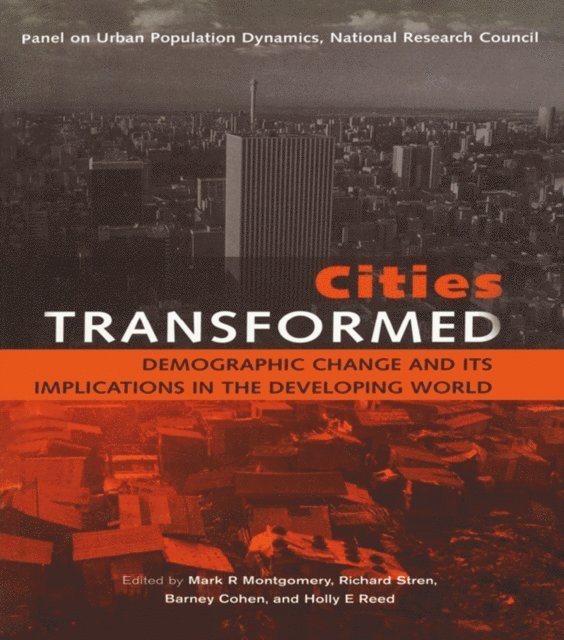
Cities Transformed
Demographic Change and Its Implications in the Developing World
Inbunden, Engelska, 2004
666 kr
Tillfälligt slut
Over the next 20 years, most low-income countries will, for the first time, become more urban than rural. Understanding demographic trends in the cities of the developing world is critical to those countries - their societies, economies, and environments. The benefits from urbanization cannot be overlooked, but the speed and sheer scale of this transformation presents many challenges. In this uniquely thorough and authoritative volume, 16 of the world's leading scholars on urban population and development have worked together to produce the most comprehensive and detailed analysis of the changes taking place in cities and their implications and impacts. They focus on population dynamics, social and economic differentiation, fertility and reproductive health, mortality and morbidity, labor force, and urban governance.As many national governments decentralize and devolve their functions, the nature of urban management and governance is undergoing fundamental transformation, with programs in poverty alleviation, health, education, and public services increasingly being deposited in the hands of untested municipal and regional governments. Cities Transformed identifies a new class of policy maker emerging to take up the growing responsibilities.Drawing from a wide variety of data sources, many of them previously inaccessible, this essential text will become the benchmark for all involved in city-level research, policy, planning, and investment decisions. The National Research Council is a private, non-profit institution based in Washington, DC, providing services to the US government, the public, and the scientific and engineering communities. The editors are members of the Council's Panel on Urban Population Dynamics.
1 921 kr
Skickas inom 10-15 vardagar
For too long, cities have been thought of as environmental blackspots, with high levels of air and soil pollution, overcrowding, poor sanitation and growing waste disposal problems. This book takes a more positive attitude: cities can be made to work sustainably. Their high population density can work in the environment's favour if they can achieve efficient use of resources such as energy and water supplies, and improve transport and infrastructure. The best cities today are clean, resource efficient, green and pleasant, and not only act as cultural and entertainment centres, but also harbour great varieties of wildlife. Making Cities Work looks at the vital role which local authorities can - and must - play in safeguarding and developing our towns and cities. Their role is crucial, and the aim of the book is to make governments, international bodies and local authority associations aware of how potential environmental and social problems can be overcome, and what can be achieved. This book is being written by urban development experts, based on material supplied by the world's leading city associations. It is being edited by one of the world's most highly regarded cultural ecologists, and has been commissioned by UNHCS for the Habitat II conference. Clearly written, accessible, and fully illustrated throughout with photographs, figures and graphs, it is ideal for students, fascinating reading for the general public, and essential for those involved in local authorities, planning and development.