Risto Miikkulainen - Böcker
Visar alla böcker från författaren Risto Miikkulainen. Handla med fri frakt och snabb leverans.
4 produkter
4 produkter
Subsymbolic Natural Language Processing
An Integrated Model of Scripts, Lexicon, and Memory
Inbunden, Engelska, 1993
664 kr
Tillfälligt slut
1 096 kr
Skickas inom 10-15 vardagar
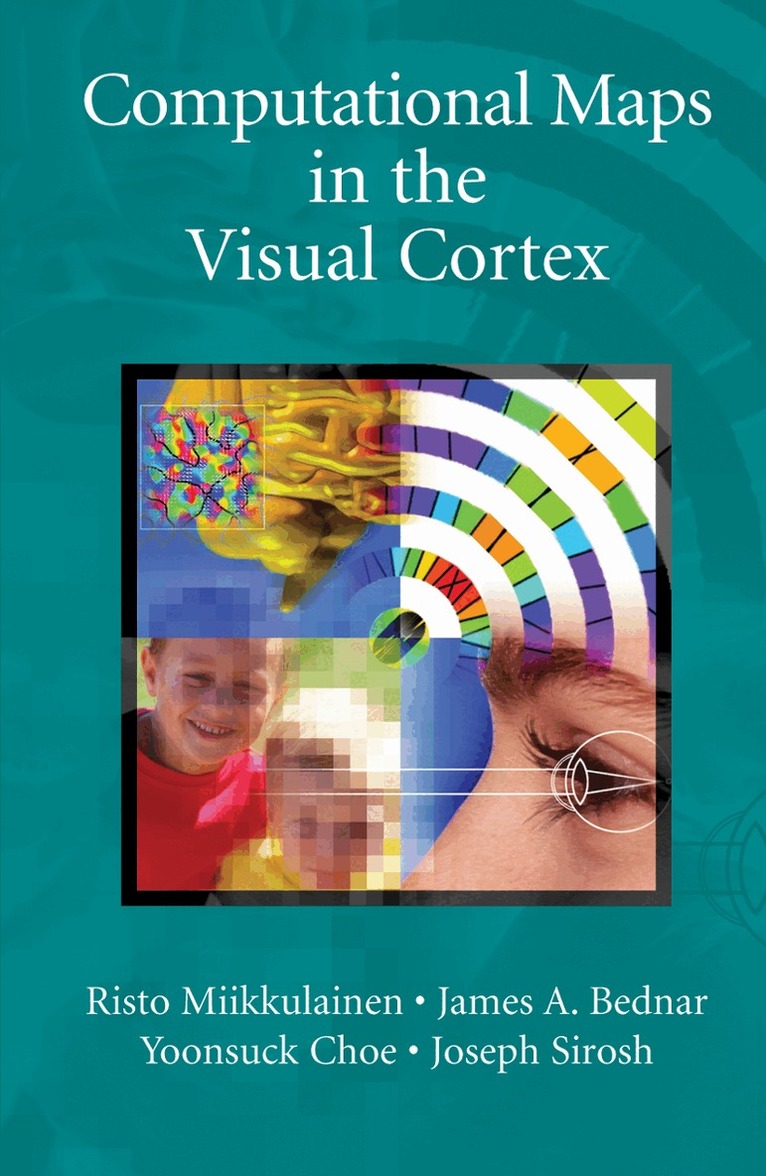
Biological structures can be seen as collections of special devices coordinated by a matrix of organization. Devices are dif?cult to evolve and are meticulously conserved through the eons. Organization is a ?uid medium capable of rapid adaptation. The brain carries organizational ?uidity to the extreme. In its context, typical devices are ion channels, transmitters and receptors, signaling pathways, whole individual neurons or speci?c circuit patterns. The border line between what is to be called device and what a feat of organization is ?owing, given that in time organized s- systems solidify into devices. In spite of the neurosciences’ traditional concentration on devices, their aiming point on the horizon must be to understand the principles by which the nervous system ties vast arrays of internal and external variables into one coherent purposeful functional whole — to understand the brain’s mechanism of organization. For that purpose a crucial methodology is in silico experimentation. Computer simulation is a convenient tool for testing functional ideas, a sharp weapon for d- tinguishing those that work from those that don’t. To be sure, many alternatives can only be decided by direct experiment on the substrate, not by modeling. However, if a functional idea can be debunked as ?awed once tried in silico it would be a waste to make it the subject of a decade of experimentation or discussion. The venture of understanding the function and organization of the visual system illustrates this danger.
1 096 kr
Skickas inom 10-15 vardagar
Biological structures can be seen as collections of special devices coordinated by a matrix of organization. Devices are dif?cult to evolve and are meticulously conserved through the eons. Organization is a ?uid medium capable of rapid adaptation. The brain carries organizational ?uidity to the extreme. In its context, typical devices are ion channels, transmitters and receptors, signaling pathways, whole individual neurons or speci?c circuit patterns. The border line between what is to be called device and what a feat of organization is ?owing, given that in time organized s- systems solidify into devices. In spite of the neurosciences’ traditional concentration on devices, their aiming point on the horizon must be to understand the principles by which the nervous system ties vast arrays of internal and external variables into one coherent purposeful functional whole — to understand the brain’s mechanism of organization. For that purpose a crucial methodology is in silico experimentation. Computer simulation is a convenient tool for testing functional ideas, a sharp weapon for d- tinguishing those that work from those that don’t. To be sure, many alternatives can only be decided by direct experiment on the substrate, not by modeling. However, if a functional idea can be debunked as ?awed once tried in silico it would be a waste to make it the subject of a decade of experimentation or discussion. The venture of understanding the function and organization of the visual system illustrates this danger.
Advances in Self-Organizing Maps
7th International Workshop, WSOM 2009, St. Augustine, Florida, June 8-10, 2009. Proceedings
Häftad, Engelska, 2009
552 kr
Skickas inom 10-15 vardagar
th These proceedings contain refereed papers presented at the 7 WSOM held at the Casa Monica Hotel, St. Augustine, Florida, June 8–10, 2009. We designed the wo- shop to serve as a regular forum for researchers in academia and industry who are interested in the exciting field of self-organizing maps (SOM). The program includes excellent examples of the use of SOM in many areas of social sciences, economics, computational biology, engineering, time series analysis, data visualization and c- puter science as well a vibrant set of theoretical papers that keep pushing the envelope of the original SOM. Our deep appreciation is extended to Teuvo Kohonen and Ping Li for the plenary talks and Amaury Lendasse for the organization of the special sessions. Our sincere thanks go to the members of the Technical Committee and other reviewers for their excellent and timely reviews, and above all to the authors whose contributions made this workshop possible. Special thanks go to Julie Veal for her dedication and hard work in coordinating the many details necessary to put together the program and local arrangements. Jose C. Principe Risto Miikkulainen