• Fri frakt över 249 kr
  • •
  • Snabba leveranser
  • •
  • Billiga böcker
Kundservice

Du är på sajten för privatpersoner.

Företag, bibliotek eller offentlig verksamhet?

Du handlar på classic.bokus.com, där alla dina funktioner finns intakta.
Till classic.bokus.com
Bokus logotyp. Gå till startsidan.
  • Erbjudanden
  • Nyheter
  • Student
  • Topplistor
  • Barn & ungdom
  • Bokus Play
  • E-böcker
  • Pocketböcker
  • Spel & pussel

10% rabatt på allt med kod NYSTART10 →

Sidfot

Mina sidor

    Hjälp

    • Kundservice
    • Vanliga frågor och svar
    • Frakt och leverans
    • Retur vid ångerrätt
    • Reklamera vara
    • Betalning
    • Köpvillkor
    • Allmänna villkor
    • Information om webbplatsens tillgänglighet

    Om Bokus

    • Om oss
    • Pressrum
    • För studenter
    • För företag
    • För bibliotek och offentlig verksamhet
    • För leverantörer
    • Hållbarhet

    Populärt

    • Aktuella erbjudanden
    • Presentkort
    • Studentlitteratur
    • Nya böcker
    • Topplistor
    • Signerade böcker
    • Engelska böcker

    Inspiration

    • Boktips
    • BookTok
    • Populära bokserier
    • Barnbokskaraktärer
    • Populära författare
    Logotyp för Bokus
    Följ oss på Facebook (extern länk)Följ oss på Instagram (extern länk)Följ oss på YouTube (extern länk)Följ oss på TikTok (extern länk)
    bokus @ CookiesAnpassa cookiesIntegritetspolicyKöpvillkor
    Till Citymail hemsida (extern länk)Till Budbee hemsida (extern länk)Till Postnord hemsida (extern länk)Till Schenker hemsida (extern länk)Till Early Bird hemsida (extern länk)Till Walleys hemsida (extern länk)
    1. Naturvetenskap och teknik
    2. Matematik och naturvetenskap
    3. Biologi
    4. Biovetenskap

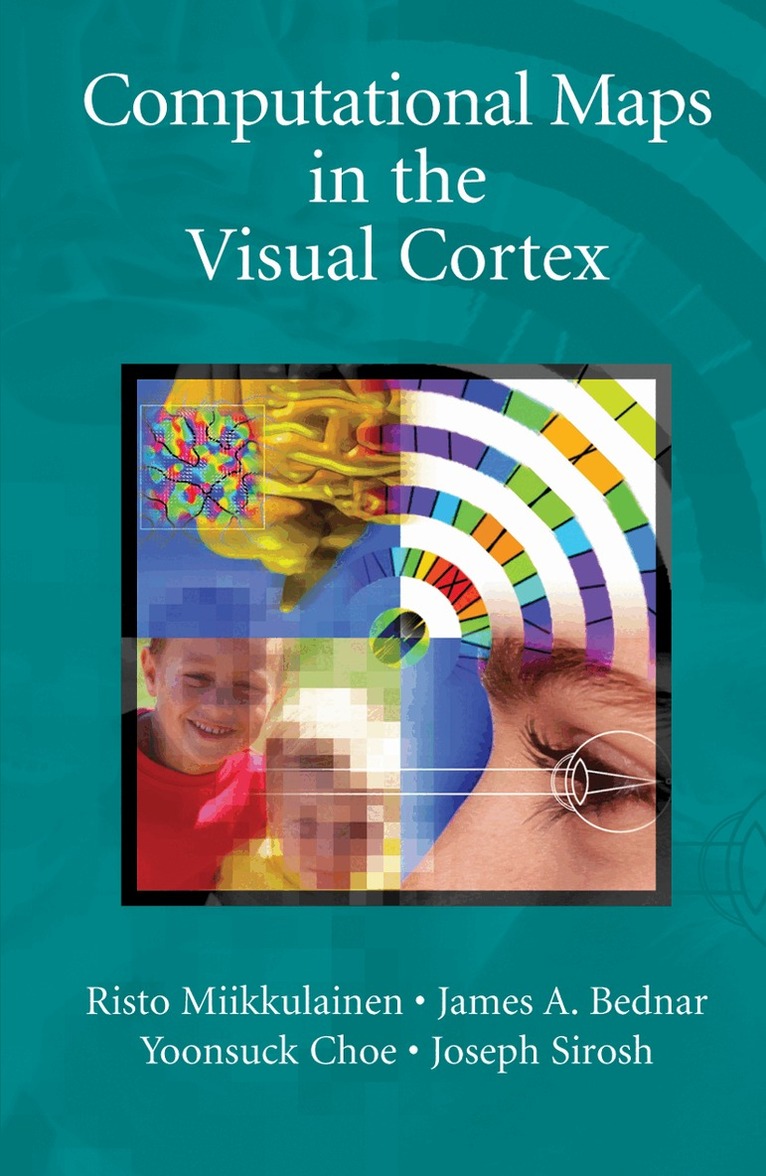
    Computational Maps in the Visual Cortex

    AvRisto Miikkulainen,James A. Bednar

    Häftad, Engelska, 2010

    1 117 kr

    Beställningsvara. Skickas inom 10-15 vardagar. Fri frakt över 249 kr.

    Fler format och utgåvor

    Inbunden

    1 117 kr

    Beskrivning

    Biological structures can be seen as collections of special devices coordinated by a matrix of organization. Devices are dif?cult to evolve and are meticulously conserved through the eons. Organization is a ?uid medium capable of rapid adaptation. The brain carries organizational ?uidity to the extreme. In its context, typical devices are ion channels, transmitters and receptors, signaling pathways, whole individual neurons or speci?c circuit patterns. The border line between what is to be called device and what a feat of organization is ?owing, given that in time organized s- systems solidify into devices. In spite of the neurosciences’ traditional concentration on devices, their aiming point on the horizon must be to understand the principles by which the nervous system ties vast arrays of internal and external variables into one coherent purposeful functional whole — to understand the brain’s mechanism of organization. For that purpose a crucial methodology is in silico experimentation. Computer simulation is a convenient tool for testing functional ideas, a sharp weapon for d- tinguishing those that work from those that don’t. To be sure, many alternatives can only be decided by direct experiment on the substrate, not by modeling. However, if a functional idea can be debunked as ?awed once tried in silico it would be a waste to make it the subject of a decade of experimentation or discussion. The venture of understanding the function and organization of the visual system illustrates this danger.

    Produktinformation

    • Utgivningsdatum:2010-10-15
    • Mått:155 x 235 x 31 mm
    • Vikt:855 g
    • Format:Häftad
    • Språk:Engelska
    • Antal sidor:538
    • Förlag:Springer-Verlag New York Inc.
    • ISBN:9781441919588

    Utforska kategorier

    • Biovetenskap inom Naturvetenskap och teknik
    • Oftalmologi inom Medicin

    Recensioner i media

    From the reviews: "An increasingly important technique used by basic scientists to understand brain development and function is theoretical/computational modeling. ... Computational Maps in the Visual Cortex provides a good review of this area, though strongly emphasizing the models developed over the past several years by Miikkulainen's group in the Computer Science department at the University of Texas. ... the book will be a useful reference for researchers interested in theoretical approaches for understanding certain properties of the visual cortex." (Geoffrey J. Goodhill, Clinical Experimental Ophthalmology, Issue 34, 2006) "The hardcover book of 24.2x16.3x3 cm size presents a comprehensive, unified computational theory of the visual cortex as a laterally connected self-organizing map ... . All chapters are clearly structured and well written. With more than 170 figures, 47 in full color, the chapters are richly illustrated. ... The book is written for computational scientists and neuroscientists working in the field of the visual cortex. The book will be a valuable complement to every scientific library." (R. M. Muri, Graefe's Archive for Clinical and Experimental Ophthalmology, Vol. 245, 2007)

    Innehållsförteckning

    • Biological Background.- Computational Foundations.- LISSOM: A Computational Map Model of V1.- Development of Maps and Connections.- Understanding Plasticity.- Understanding Visual Performance: The Tilt Aftereffect.- HLISSOM: A Hierarchical Model.- Understanding Low-Level Development: Orientation Maps.- Understanding High-Level Development: Face Detection.- PGLISSOM: A Perceptual Grouping Model.- Temporal Coding.- Understanding Perceptual Grouping: Contour Integration.- Computations in Visual Maps.- Scaling LISSOM simulations.- Discussion: Biological Assumptions and Predictions.- Future Work: Computational Directions.- Conclusion.