Robert C. Hockett - Böcker
Visar alla böcker från författaren Robert C. Hockett. Handla med fri frakt och snabb leverans.
7 produkter
7 produkter
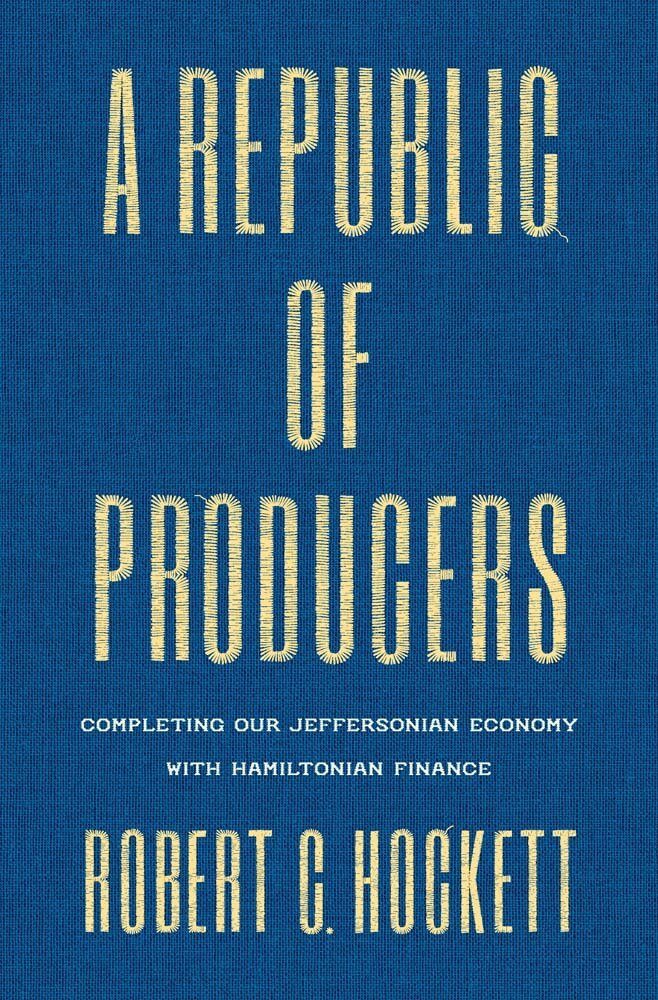
Republic of Producers
Completing Our Jeffersonian Economy with Hamiltonian Finance
Inbunden, Engelska, 2026
609 kr
Skickas inom 7-10 vardagar
A radically original solution to our most intractable economic problems: wage stagnation, productive atrophy, and wealth inequality This sweeping and ambitious book locates the source of American economic and social decline in a simple but profound observation: the nation’s forms of citizen ownership have not kept up with its sources of wealth. In the early republic, the Jeffersonian ideal of an agrarian citizenry, whose productive assets lay primarily in land ownership and their own education, more or less matched the productive sources of wealth in the nation as a whole. But as we grew from an agrarian nation to an industrial one, the forms of citizen ownership did not change with the economy: instead, efforts toward land ownership were transferred to ownership in unproductive real estate—that is, homes. It is the effort to draw wealth from limited and relatively unproductive sources that makes the average American citizen fall farther and farther behind in income, and also caused the artificial inflation of real estate that led to the 2008 crash. Advancing a theory of “income-compositional symmetry,” Robert C. Hockett argues that in order to remedy wage stagnation, productive atrophy, and extreme wealth inequality, industrial, financial, and commercial forms of ownership need to be as universally accessible to citizens as land and education. Hockett presents a unique, financially engineered program for doing so, showing how it coheres with our political and legal traditions as well as what he calls our “endowment psychologies.”
329 kr
Skickas inom 10-15 vardagar
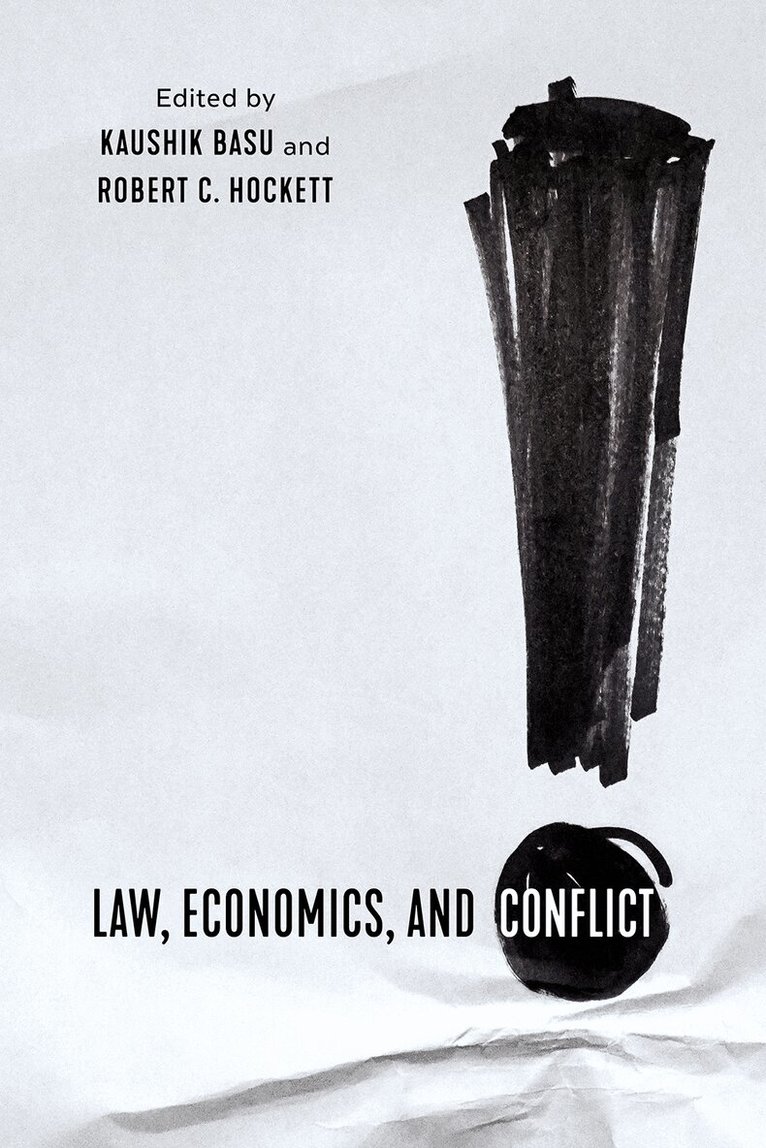
In Law, Economics, and Conflict, Kaushik Basu and Robert C. Hockett bring together international experts to offer new perspectives on how to take analytic tools from the realm of academic research out into the real world to address pressing policy questions. As the essays discuss, political polarization, regional conflicts, climate change, and the dramatic technological breakthroughs of the digital age have all left the standard tools of regulation floundering in the twenty-first century. These failures have, in turn, precipitated significant questions about the fundamentals of law and economics.The contributors address law and economics in diverse settings and situations, including central banking and the use of capital controls, fighting corruption in China, rural credit markets in India, pawnshops in the United States, the limitations of antitrust law, and the role of international monetary regimes. Collectively, the essays in Law, Economics, and Conflict rethink how the insights of law and economics can inform policies that provide individuals with the space and means to work, innovate, and prosper—while guiding states and international organization to regulate in ways that limit conflict, reduce national and global inequality, and ensure fairness.Contributors: Kaushik Basu; Kimberly Bolch; University of Oxford; Marieke Bos, Stockholm School of Economics; Susan Payne Carter, US Military Academy at West Point; Peter Cornelisse, Erasmus University Rotterdam; Gaël Giraud, Georgetown University; Nicole Hassoun, Binghamton University; Robert C. Hockett; Karla Hoff, Columbia University and World Bank; Yair Listokin, Yale Law School; Cheryl Long, Xiamen University and Wang Yanan Institute for Study of Economics (WISE); Luis Felipe López-Calva, UN Development Programme; Célestin Monga, Harvard University; Paige Marta Skiba, Vanderbilt Law School; Anand V. Swamy, Williams College; Erik Thorbecke, Cornell University; James Walsh, University of Oxford.Contributors: Kimberly B. Bolch, Marieke Bos, Susan Payne Carter, Peter A. Cornelisse, Gaël Giraud, Nicole Hassoun, Karla Hoff, Yair Listokin, Cheryl Long, Luis F. López-Calva, Célestin Monga, Paige Marta Skiba, Anand V. Swamy, Erik Thorbecke, James Walsh
1 347 kr
Skickas inom 10-15 vardagar
In Law, Economics, and Conflict, Kaushik Basu and Robert C. Hockett bring together international experts to offer new perspectives on how to take analytic tools from the realm of academic research out into the real world to address pressing policy questions. As the essays discuss, political polarization, regional conflicts, climate change, and the dramatic technological breakthroughs of the digital age have all left the standard tools of regulation floundering in the twenty-first century. These failures have, in turn, precipitated significant questions about the fundamentals of law and economics.The contributors address law and economics in diverse settings and situations, including central banking and the use of capital controls, fighting corruption in China, rural credit markets in India, pawnshops in the United States, the limitations of antitrust law, and the role of international monetary regimes. Collectively, the essays in Law, Economics, and Conflict rethink how the insights of law and economics can inform policies that provide individuals with the space and means to work, innovate, and prosper—while guiding states and international organization to regulate in ways that limit conflict, reduce national and global inequality, and ensure fairness.Contributors: Kaushik Basu; Kimberly Bolch; University of Oxford; Marieke Bos, Stockholm School of Economics; Susan Payne Carter, US Military Academy at West Point; Peter Cornelisse, Erasmus University Rotterdam; Gaël Giraud, Georgetown University; Nicole Hassoun, Binghamton University; Robert C. Hockett; Karla Hoff, Columbia University and World Bank; Yair Listokin, Yale Law School; Cheryl Long, Xiamen University and Wang Yanan Institute for Study of Economics (WISE); Luis Felipe López-Calva, UN Development Programme; Célestin Monga, Harvard University; Paige Marta Skiba, Vanderbilt Law School; Anand V. Swamy, Williams College; Erik Thorbecke, Cornell University; James Walsh, University of Oxford.Contributors: Kimberly B. Bolch, Marieke Bos, Susan Payne Carter, Peter A. Cornelisse, Gaël Giraud, Nicole Hassoun, Karla Hoff, Yair Listokin, Cheryl Long, Luis F. López-Calva, Célestin Monga, Paige Marta Skiba, Anand V. Swamy, Erik Thorbecke, James Walsh
258 kr
Skickas inom 7-10 vardagar
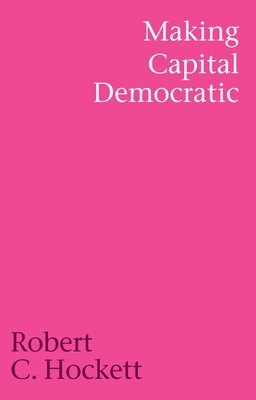
The “software” that structures our financial system and, through it, our broader economy is made up of certain basic concepts that guide how we think and hence act. These concepts include money, credit, finance, investment, and – above all – capital. This conceptual software manifests itself in our current “operating system” of institutions and practices. But our concepts and the system itself are radically out of date both as representations of monetary, financial, productive, and distributive reality and thus as realizations of democratically productive potential. Robert Hockett shows that this mismatch has serious consequences and argues that it’s time for a complete overhaul of our economic understanding. The underlying conceptual problem, Hockett contends, is that we miss the extent to which our financial systems are deeply and ineradicably public. Money is an inherent emanation of our basic social contract; capital in turn emerges as almost entirely publicly generated. Our systems of finance and investment must therefore be publicly and democratically determined. Leaving them in the hands of private powers means resigning ourselves to current health and income inequalities, evermore frequent financial crises, and economic stagnation and decline – to say nothing of social and political deterioration across the developed world.Lucid and passionately argued, Making Capital Democratic is a seamless blend of philosophy and economics that calls for profound intellectual and institutional changes that would befit a democracy that is democratic in more than just name.The “software” that structures our financial system and, through it, our broader economy is made up of certain basic concepts that guide how we think and hence act. These concepts include money, credit, finance, investment, and – above all – capital. This conceptual software manifests itself in our current “operating system” of institutions and practices. But our concepts and the system itself are radically out of date both as representations of monetary, financial, productive, and distributive reality and thus as realizations of democratically productive potential. Robert Hockett shows that this mismatch has serious consequences and argues that it’s time for a complete overhaul of our economic understanding. The underlying conceptual problem, Hockett contends, is that we miss the extent to which our financial systems are deeply and ineradicably public. Money is an inherent emanation of our basic social contract; capital in turn emerges as almost entirely publicly generated. Our systems of finance and investment must therefore be publicly and democratically determined. Leaving them in the hands of private powers means resigning ourselves to current health and income inequalities, evermore frequent financial crises, and economic stagnation and decline – to say nothing of social and political deterioration across the developed world. Lucid and passionately argued, Making Capital Democratic is a seamless blend of philosophy and economics that calls for profound intellectual and institutional changes that would befit a democracy that is democratic in more than just name.
225 kr
Skickas
Climate scientists have determined that we must act now to prevent an irreversible and catastrophic climatic tipping point, beyond which neither our own nor many other species can be assumed likely to survive. On the way to that bleak ending, moreover, extreme socio-economic injustice and associated political breakdown—now well underway in nations already hard-hit by environmental crisis—can be expected to hasten as well.The time has thus come to plan carefully, thoroughly, and on a scale commensurate with the crisis we face. This book, written by one of the key architects of the Green New Deal and prefaced by Representative Alexandria Ocasio-Cortez's former Chief of Staff, indicates how to structure Green New Deal finance in a manner that advances the cross-cutting goals of maximum financial and economic inclusion, maximally democratic decision-making, and an appropriate division of roles both among all levels of government and among public and private sector decision-makers.Integrating into one complete and coherent financial architecture such bold ideas as a 'People's Fed,' an interdepartmental National Investment Council, integrated state and regional public banks, a Democratic Digital Dollar and digital Taxpayer Savings and Transaction Accounts made part of the monetary policy transmission belt, and an economy-wide Price Stabilization Fund, this book is critical reading for policymakers and citizens looking for a fresh path forward towards a revived and sustainable, progressive and productive America.
660 kr
Skickas inom 10-15 vardagar
This book is the first of its kind in several overlapping and rapidly developing fields that now dominate news headlines – among them the fields of crypto-currency, digital payments platforms, ‘fintech,’ and central bank digital currencies (‘CBDCs’). With crypto and fintech now threatening to transform finance in destabilizing and anti-democratic ways, and with China and other nations now digitizing their national currencies in the form of CBDCs that make the US dollar and national payments infrastructure look ever more quaint and outmoded, this book shows both why the US and other democratic commercial societies must, and how they can, democratically digitize their currencies, their national payments systems, and the authorities that respectively issue and administer them – in the US, the Federal Reserve System (‘the Fed’).
497 kr
Skickas inom 10-15 vardagar
This book provides insight into the history, goals, and potential of the Federal Reserve System (Fed). Synthesizing into a unified vision research and reflections developed over 15 years in the academy and at banking institutions, Robert C. Hockett recovers the sensible founding vision of the early 20th century Fed and updates it to solve the new challenges of the 21st century, especially as America now strives to recover its lost productive preeminence worldwide after decades of "outsourcing" and consequent "deindustrialization."The book presents both the original 1913 Fed and Hockett's modern restored Fed as a unique public/private and federal/local partnership specifically inspired by German industrial development banking and adapted to continent-spanning American conditions. It shows that the original Fed's focus on endogenous money and productive (not speculative) credit allocation was sound and effective as far as it went, while its ignoring exogenous sources of monetary disturbance prevented its properly handling the bubble and bust of the late 1920s and early 1930s. The reaction to that error after the mid-1930s, the book shows, fell into the opposite error, pretending that monetary aggregates could be adequately modulated without being forthrightly allocated in productive rather than speculative directions. A "Goldilocks Fed" must both productively allocate endogenous money and sensibly modulate exogenous money - twin prerequisites to both productive investment and financial stability. Hockett illustrates how the twelve regional Federal Reserve District Banks were founded for just these purposes and can be revitalized to achieve them anew.