Robert D. Hume - Böcker
Visar alla böcker från författaren Robert D. Hume. Handla med fri frakt och snabb leverans.
8 produkter
8 produkter
943 kr
Skickas inom 7-10 vardagar
Originally published in 1976, this highly acclaimed, full-scale account of Restoration drama is now available for the first time in a paperback edition. Following the changing patterns of drama decade by decade from 1660 to 1710, the author fully explores the diversity of the plays as they reflect the fads and fashions of a small, highly competitive theatre world constantly buffeted by political and social change. Anxious to avoid misleading generalizations - such as the dominance of `comedy of manners' and the rise of `sentimental' drama - Hume carries out a detailed, chronological survey of some five hundred plays, chronicling the emergence of numerous dramatic modes and their interaction and mutual influence. This meticulous documentation is set within the context of a critical discussion of theories of comedy and tragedy prevalent in the period.
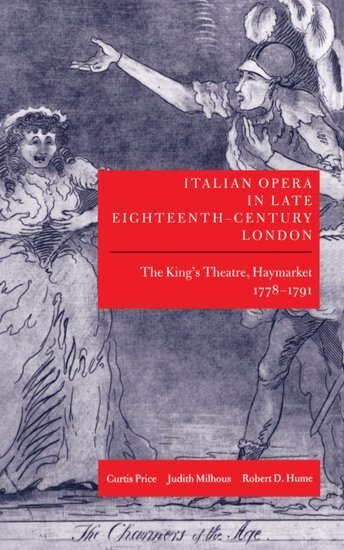
Italian Opera in Late Eighteenth-Century London: Volume 1: The King's Theatre, Haymarket, 1778-1791
Inbunden, Engelska, 1995
3 111 kr
Skickas inom 5-8 vardagar
This interdisciplinary study attempts to make sense of what has long been regarded as a chaotic period in the history of opera in London. In 1778 R. B. Sheridan acquired the King's Theatre and its resident opera company in what we would now call a leveraged buy-out, plunging the opera into escalating debts that were to haunt it into the 1840s. The 1780s and early 1790s were a stormy but exciting era: the company hired some of the foremost singers and dancers in Europe; ballet d'action came to London, with Noverre himself as ballet master; the company employed such composers as Sacchini, Anfossi, Cherubini and ultimately Haydn; it went bankrupt and carried on through years of wrangling in Canchery; the King's Theatre burned down in 1789 and was rebuilt and re-opened in defiance of the Lord Chamberlain's refusal to license the new building. Drawing on librettos and scores, ballet scenarios, pamphlets, scattered manuscripts, legal records, architectural drawings, newspapers and other sources, the authors reconstruct the history of the company its shifting artistic policies, analysing opera and ballet repertoy, performers, production circumstances, finances and managerial infighting.
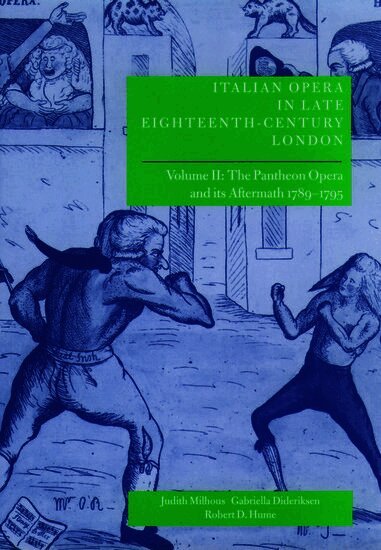
Italian Opera in Late Eighteenth-Century London: Volume 2: The Pantheon Opera and its Aftermath 1789-1795
Inbunden, Engelska, 2001
6 986 kr
Skickas inom 7-10 vardagar
Following on from the volume on the King's Theatre, Haymarket (published by OUP in 1995), this interdisciplinary study of opera and ballet now turns to London's Pantheon Opera during the period 1789-98. The discovery of six cartons of previously unknown manuscripts in the possession of the Duke of Bedford makes possible the rewriting of a hitherto dark and little understood chapter in the history of opera in London. The King's Theatre, Haymarket, burnt down in 1789. To replace it, the fifth Duke of Bedford and the Marquis of Salisbury secretly backed a new opera company, to be housed in the Pantheon, an elegant exhibition hall hastily converted to house the venture. Part 1 of this book tells a tale of intrigue, blackmail, bankruptcy, arson, and high-society infighting against a background of exalted artistic aspirations and genuine love of opera. The Pantheon tried to engage Mozart to compete against Haydn, and hired some of the most notable singers and dancers in Europe. Mismanagement led to huge losses, and the theatre burnt in highly suspicious circumstances in 1792. The backers tried to impose an artistic vision and financial controls on the management of the rebuilt King's Theatre, Haymarket, when opera returned there in 1793, but by 1795 their failure was evident. The second part of the book is a detailed analysis of the opera and ballet repertoire, personnel, management, costumes, staging practices, and finances of the company, based on the Bedford archive and a wealth of hitherto unused sources. What emerges is the fullest operational analysis ever published of any pre-nineteenth-century English theatre or opera company.
Plays, Poems, and Miscellaneous Writings associated with George Villiers, Second Duke of Buckingham
Volume I
Inbunden, Engelska, 2007
6 930 kr
Skickas inom 5-8 vardagar
George Villiers, Second Duke of Buckingham (1628-1687) was one of the most scandalous and controversial figures of the Restoration period. He was the principal author of The Rehearsal (1671), an enormously successful burlesque play that ridiculed John Dryden and the rhymed heroic drama. Historians remember Buckingham as an opponent who helped topple Clarendon from power in 1667, as a member of the 'Cabal' government in the early 1670s, and as an ally of the Earl of Shaftesbury in the political crisis of 1678-1683. The duke was prominent among the 'court wits' (Rochester, Etherege, Sedley, Dorset, Wycherley, and their circle); he was closely associated with such writers as Butler and Cowley; he was a conspicuous champion of religious toleration and a friend of William Penn. No edition of Buckingham has been published since 1775, partly because his work presents horrendous attribution problems. He was (probably) adapter or co-author of six plays (two of them vastly successful for more than a century) including one in French that appears here in English for the first time. He is also associated with nine topical pieces (variously political, religious, and satiric) and some twenty poems of wildly varying type. The 'Buckingham' commonplace book has previously been published only in fragmentary form. Almost all of these works present major difficulties in both attribution and annotation, here seriously addressed for the first time. This edition is a companion venture to Harold Love's important edition of Rochester (OUP, 1999).
Plays, Poems, and Miscellaneous Writings associated with George Villiers, Second Duke of Buckingham
Volume II
Inbunden, Engelska, 2007
4 951 kr
Skickas inom 7-10 vardagar
George Villiers, Second Duke of Buckingham (1628-1687) was one of the most scandalous and controversial figures of the Restoration period. He was the principal author of The Rehearsal (1671), an enormously successful burlesque play that ridiculed John Dryden and the rhymed heroic drama. Historians remember Buckingham as an opponent who helped topple Clarendon from power in 1667, as a member of the 'Cabal' government in the early 1670s, and as an ally of the Earl of Shaftesbury in the political crisis of 1678-1683. The duke was prominent among the 'court wits' (Rochester, Etherege, Sedley, Dorset, Wycherley, and their circle); he was closely associated with such writers as Butler and Cowley; he was a conspicuous champion of religious toleration and a friend of William Penn. No edition of Buckingham has been published since 1775, partly because his work presents horrendous attribution problems. He was (probably) adapter or co-author of six plays (two of them vastly successful for more than a century) including one in French that appears here in English for the first time. He is also associated with nine topical pieces (variously political, religious, and satiric) and some twenty poems of wildly varying type. The 'Buckingham' commonplace book has previously been published only in fragmentary form. Almost all of these works present major difficulties in both attribution and annotation, here seriously addressed for the first time. This edition is a companion venture to Harold Love's important edition of Rochester (OUP, 1999).
990 kr
Skickas inom 10-15 vardagar
"There was a challenge lately intended for the Duke of Buckingham upon Sir William Coventrys account. . . . The occasion . . .was a new play to be acted on Saturday last called the Country gentleman. . . . But the King hath prevented all; and the play is not acted."-Samuel Pepys, 2 March 1669This edition makes available for the first time The Country Gentleman, a play written by Sir Robert Howard and the Duke of Buckingham, personally suppressed by King Charles II in 1669. Its vicious personal attack on Sir William Coventry provoked a scandal. Consequently, it was banned before public performance and very naturally never printed. The play was long presumed lost.Fortunately, Pepys recorded the whole affair in some detail, and his description of the play's central satiric scene with "two tables . . . with a round hole in the middle" made it possible to identify an untitled, undated, anonymous MS in the Folger Library as a complete scribal copy of the play. This find is only the second such recovery of a "lost" Restoration play in the twentieth century.The Introduction gives a full account of the play's scandalous genesis-a lurid tale of political intrigue, a prevented duel between members of the King's Privy Council, and a fall from high office. For those curious about how literary "discoveries" come about, the editors have added an account of the detective work which began with an odd entry in Annals of English Drama, and led from the Folger Library in Washington to artistocrats' private collections in England.The play itself is brisk, delicious comedy, featuring pairs of lovers caught up in the intrigues of rivals-all against motifs of city vs. country life and scathing satire of government "business." The Country Gentleman is both timely in its use of the gay-couple love game, and a surprisingly early precursor of the exemplary comedies of the 1690s. Ironically, this cheerful, witty play became the vehicle for satire which shook the whole government of England.
269 kr
Skickas inom 7-10 vardagar
This Element Paratext printed with new English plays has a lot to tell us about what playwrights were attempting to do and how audiences responded, thereby contributing substantially to our understanding of larger patterns of generic evolution across two centuries. The presence (or absence) of twelve elements needs to be systematically surveyed. (1) Attribution of authorship; (2) generic designation; (3) performance auspices; (4) government license authorizing publication; (5) dedication; (6) prefaces of various sorts; (7a-b-c) list of characters (three types); (8) actors' names (sometimes with descriptive characterizations-very helpful for deducing intended authorial interpretation); (9) location of action; (10) prologue and epilogue for first production. Surveying these results, we can see that much of the generic evolution traceable in the later seventeenth century gets undone during the eighteenth-a reversal largely attributable to the Licensing Act of 1737. This title is also available as Open Access on Cambridge Core.
865 kr
Skickas inom 7-10 vardagar
This Element Paratext printed with new English plays has a lot to tell us about what playwrights were attempting to do and how audiences responded, thereby contributing substantially to our understanding of larger patterns of generic evolution across two centuries. The presence (or absence) of twelve elements needs to be systematically surveyed. (1) Attribution of authorship; (2) generic designation; (3) performance auspices; (4) government license authorizing publication; (5) dedication; (6) prefaces of various sorts; (7a-b-c) list of characters (three types); (8) actors' names (sometimes with descriptive characterizations-very helpful for deducing intended authorial interpretation); (9) location of action; (10) prologue and epilogue for first production. Surveying these results, we can see that much of the generic evolution traceable in the later seventeenth century gets undone during the eighteenth-a reversal largely attributable to the Licensing Act of 1737. This title is also available as Open Access on Cambridge Core.