Robert E. Cole - Böcker
Visar alla böcker från författaren Robert E. Cole. Handla med fri frakt och snabb leverans.
13 produkter
13 produkter
1 100 kr
Skickas inom 5-8 vardagar
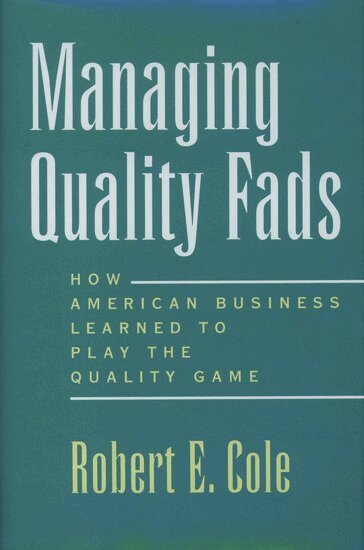
US managers tend to look at the quality challenge posed by Japanese industry in the early 1980s as a challenge slowly yet successfully met. Academics see the emergent quality movement as just another fad. This book is about reconciling these images. Can managers learn from fads? Robert Cole explores the reasons behind American industry's slow response to the challenge of high quality Japanese goods, then proceeds to explain the factors which eventually enabled management to address the quality gap effectively. He argues that a variety of institutional factors slowed management's response in the US, and describes the reshaping of institutional forces that lead to sustained quality improvements in the 1990s. Ultimately, this book is about factors inhibiting and supporting organizational learning and provides lessons for all those interested in the issue of organizational transformation.
1 837 kr
Skickas inom 7-10 vardagar
How did Japan fall from challenger to US hegemonic leadership in the high tech industries in the 1980s, to stumbling giant by the turn of the century? This work examines the challenges faced by Japanese companies through emulation by foreign competitors, and the emergence of new competitive models.
1 025 kr
Skickas inom 5-8 vardagar
How did Japan fall from challenger to US hegemonic leadership in the high tech industries in the 1980s, to stumbling giant by the turn of the century? What is it doing about it? This book examines the challenges faced by Japan's high tech companies through successful emulation of some of their key practices by foreign competitors and the emergence of new competitive models linked to open innovation and modular production. High tech companies were slow to respond, relying at first on formulae which had worked in the past, but in a new environment, some of these traditional strengths had now become sources of weakness. Stability and success, moreover, had decreased their appetite for risk. Early in the new century, however, there were signs of a more concerted response, which opened up past practices to scrutiny, and modification through selective learning and adaptation of the new models. The 'MOT' (management of technology) movement provided a vehicle for this change. It was linked, in turn, to efforts to change the national innovation system, giving universities a more central role, and encouraging spin-offs and startups.The book features contributions from Japanese and Western scholars and practitioners who have distinctive insights into the nature of these challenges and responses, with substantial introductory and concluding chapters. The result is a highly accessible account of innovation, technology, and change management in the world's second largest economy.
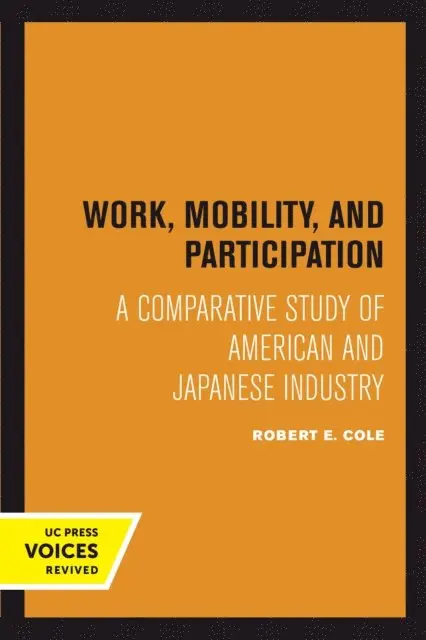
Work, Mobility, and Participation
A Comparative Study of American and Japanese Industry
Häftad, Engelska, 2018
327 kr
Skickas inom 7-10 vardagar
At a minimum our goal is to develop a better understanding of Japanese labor market practices and work organization and in so doing develop a more enlightened vision of American practices. We will greatly enhance our ability to achieve both these goals by arriving at a better understanding of the comparative experience of the two nations over time. We can no longer afford the delusion that what exists in the United States reflects the characteristics of industrial society in its most advanced form. Yet to follow current fashion in simply denying that the United States is the very model of a modern society, while advocating that we imitate the Japanese, is to take a course filled with its own pitfalls. Perhaps it is time we accepted the fact that the social scientist’s intense commitment to generalization cannot be allowed to obscure the fundamental observation that nations develop along their own paths, based on their own political, cultural, economic and social histories. As nations industrialize there is undoubtedly convergence in important institutional spheres, such as the expansion of education, the adoption of common technologies and determinants of labor mobility. Certainly nations can learn from one another, and indeed some nations impose their will on other nations. Yet there are also unique solutions to common problems. —From the Introduction This title is part of UC Press's Voices Revived program, which commemorates University of California Press’s mission to seek out and cultivate the brightest minds and give them voice, reach, and impact. Drawing on a backlist dating to 1893, Voices Revived makes high-quality, peer-reviewed scholarship accessible once again using print-on-demand technology. This title was originally published in 1979.
811 kr
Skickas inom 3-6 vardagar
Japanese Blue Collar: The Changing Tradition is an insightful exploration of the evolving dynamics of Japan's blue-collar workforce amidst rapid industrialization and social transformation. This book delves deep into the lives and experiences of Japanese factory workers, offering a rare, empirical perspective that moves beyond common stereotypes and anecdotal accounts. Drawing on detailed case studies from two Japanese firms—a diecast company and an auto parts manufacturer—this work sheds light on how industrialization has reshaped not only the economic landscape but also the social structures and cultural norms governing worker-employer relationships.Central to this study is the tension between tradition and modernity. While Japan's industrial success is often attributed to its unique blend of cultural heritage and economic ingenuity, this book critically examines the persistence of pre-industrial values within the contemporary industrial workplace. It challenges simplistic narratives, such as viewing the Japanese firm as an idyllic family unit, and instead proposes a nuanced understanding of the corporate group as a semi-closed, loyalty-based social structure. Through an analysis of housing conditions, wage systems, and evolving worker aspirations, the book reveals the complexities of Japanese labor relations and the interplay between traditional practices and the demands of modern industrial society.This meticulously researched work not only contributes to a deeper understanding of Japanese blue-collar workers but also engages broader debates on industrialization, cultural uniqueness, and convergence theory. It is an essential read for anyone interested in labor studies, industrial sociology, or the socio-economic history of Japan, offering a rich empirical foundation for evaluating the role of tradition in shaping industrial societies worldwide.This title is part of UC Press's Voices Revived program, which commemorates University of California Press’s mission to seek out and cultivate the brightest minds and give them voice, reach, and impact. Drawing on a backlist dating to 1893, Voices Revived makes high-quality, peer-reviewed scholarship accessible once again using print-on-demand technology. This title was originally published in 1971.
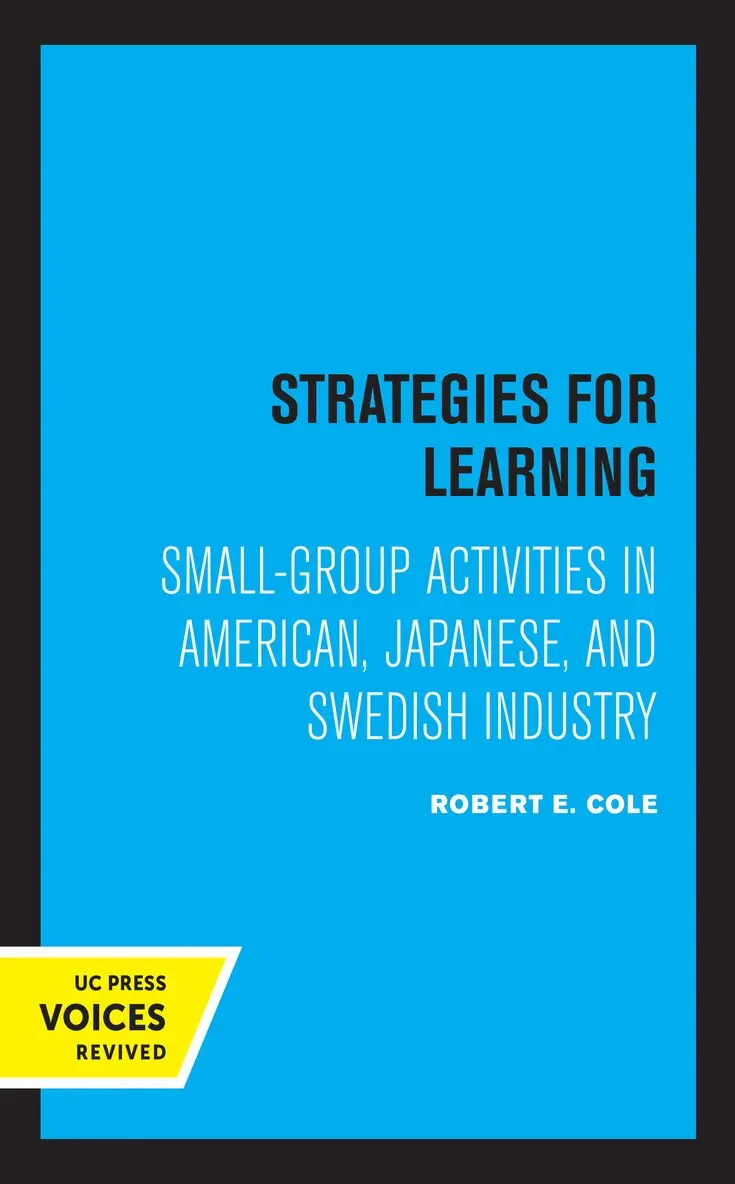
Strategies for Learning
Small-Group Activities in American, Japanese, and Swedish Industry
Häftad, Engelska, 2021
835 kr
Skickas inom 3-6 vardagar
Strategies for Learning: Small-Group Activities in American, Japanese, and Swedish Industry by Robert E. Cole offers a sweeping comparative analysis of how three advanced economies have sought to harness small-group activities—quality circles, autonomous teams, and participatory work practices—as tools for organizational innovation and competitiveness. Cole investigates why American firms were slower and less effective adopters than their Japanese and Swedish counterparts, tracing the interplay of culture, labor relations, managerial strategy, and national infrastructure in shaping both successes and failures. By situating small-group practices in the larger contexts of industrial democracy, organizational design, and global market pressures, the book demonstrates how work-group innovations are never merely technical fixes, but culturally mediated strategies for managing people and production.Rich in empirical detail, the study draws on field research, company surveys, and policy documents to show how quality circles in Japan became institutionalized mass movements, how Sweden’s democratic workplace agenda produced ambitious but uneven experiments in self-managing teams, and why U.S. firms often treated participation as a fad rather than a long-term system. Cole frames these developments within theories of innovation, diffusion, and political economy, underscoring how national infrastructures and managerial coalitions enable—or hinder—the institutionalization of change. For scholars and practitioners alike, Strategies for Learning provides a nuanced, comparative account of workplace participation that illuminates enduring debates about culture, productivity, and the democratization of work.This title is part of UC Press's Voices Revived program, which commemorates University of California Press’s mission to seek out and cultivate the brightest minds and give them voice, reach, and impact. Drawing on a backlist dating to 1893, Voices Revived makes high-quality, peer-reviewed scholarship accessible once again using print-on-demand technology. This title was originally published in 1989.
1 469 kr
Skickas inom 3-6 vardagar
Japanese Blue Collar: The Changing Tradition is an insightful exploration of the evolving dynamics of Japan's blue-collar workforce amidst rapid industrialization and social transformation. This book delves deep into the lives and experiences of Japanese factory workers, offering a rare, empirical perspective that moves beyond common stereotypes and anecdotal accounts. Drawing on detailed case studies from two Japanese firms—a diecast company and an auto parts manufacturer—this work sheds light on how industrialization has reshaped not only the economic landscape but also the social structures and cultural norms governing worker-employer relationships.Central to this study is the tension between tradition and modernity. While Japan's industrial success is often attributed to its unique blend of cultural heritage and economic ingenuity, this book critically examines the persistence of pre-industrial values within the contemporary industrial workplace. It challenges simplistic narratives, such as viewing the Japanese firm as an idyllic family unit, and instead proposes a nuanced understanding of the corporate group as a semi-closed, loyalty-based social structure. Through an analysis of housing conditions, wage systems, and evolving worker aspirations, the book reveals the complexities of Japanese labor relations and the interplay between traditional practices and the demands of modern industrial society.This meticulously researched work not only contributes to a deeper understanding of Japanese blue-collar workers but also engages broader debates on industrialization, cultural uniqueness, and convergence theory. It is an essential read for anyone interested in labor studies, industrial sociology, or the socio-economic history of Japan, offering a rich empirical foundation for evaluating the role of tradition in shaping industrial societies worldwide.This title is part of UC Press's Voices Revived program, which commemorates University of California Press’s mission to seek out and cultivate the brightest minds and give them voice, reach, and impact. Drawing on a backlist dating to 1893, Voices Revived makes high-quality, peer-reviewed scholarship accessible once again using print-on-demand technology. This title was originally published in 1971.
Strategies for Learning
Small-Group Activities in American, Japanese, and Swedish Industry
Inbunden, Engelska, 2021
1 513 kr
Skickas inom 3-6 vardagar
Strategies for Learning: Small-Group Activities in American, Japanese, and Swedish Industry by Robert E. Cole offers a sweeping comparative analysis of how three advanced economies have sought to harness small-group activities—quality circles, autonomous teams, and participatory work practices—as tools for organizational innovation and competitiveness. Cole investigates why American firms were slower and less effective adopters than their Japanese and Swedish counterparts, tracing the interplay of culture, labor relations, managerial strategy, and national infrastructure in shaping both successes and failures. By situating small-group practices in the larger contexts of industrial democracy, organizational design, and global market pressures, the book demonstrates how work-group innovations are never merely technical fixes, but culturally mediated strategies for managing people and production.Rich in empirical detail, the study draws on field research, company surveys, and policy documents to show how quality circles in Japan became institutionalized mass movements, how Sweden’s democratic workplace agenda produced ambitious but uneven experiments in self-managing teams, and why U.S. firms often treated participation as a fad rather than a long-term system. Cole frames these developments within theories of innovation, diffusion, and political economy, underscoring how national infrastructures and managerial coalitions enable—or hinder—the institutionalization of change. For scholars and practitioners alike, Strategies for Learning provides a nuanced, comparative account of workplace participation that illuminates enduring debates about culture, productivity, and the democratization of work.This title is part of UC Press's Voices Revived program, which commemorates University of California Press’s mission to seek out and cultivate the brightest minds and give them voice, reach, and impact. Drawing on a backlist dating to 1893, Voices Revived makes high-quality, peer-reviewed scholarship accessible once again using print-on-demand technology. This title was originally published in 1989.
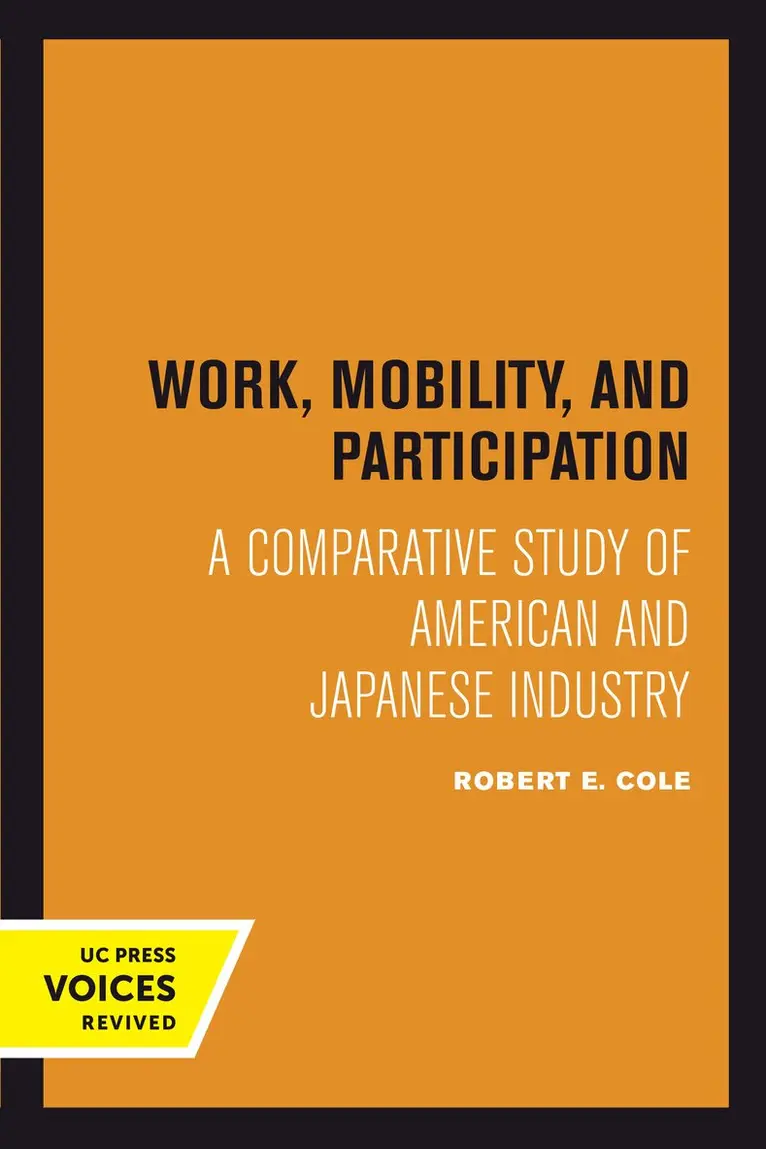
Work, Mobility, and Participation
A Comparative Study of American and Japanese Industry
Inbunden, Engelska, 2024
767 kr
Skickas inom 7-10 vardagar
At a minimum our goal is to develop a better understanding of Japanese labor market practices and work organization and in so doing develop a more enlightened vision of American practices. We will greatly enhance our ability to achieve both these goals by arriving at a better understanding of the comparative experience of the two nations over time. We can no longer afford the delusion that what exists in the United States reflects the characteristics of industrial society in its most advanced form. Yet to follow current fashion in simply denying that the United States is the very model of a modern society, while advocating that we imitate the Japanese, is to take a course filled with its own pitfalls. Perhaps it is time we accepted the fact that the social scientist’s intense commitment to generalization cannot be allowed to obscure the fundamental observation that nations develop along their own paths, based on their own political, cultural, economic and social histories. As nations industrialize there is undoubtedly convergence in important institutional spheres, such as the expansion of education, the adoption of common technologies and determinants of labor mobility. Certainly nations can learn from one another, and indeed some nations impose their will on other nations. Yet there are also unique solutions to common problems. —From the Introduction This title is part of UC Press's Voices Revived program, which commemorates University of California Press’s mission to seek out and cultivate the brightest minds and give them voice, reach, and impact. Drawing on a backlist dating to 1893, Voices Revived makes high-quality, peer-reviewed scholarship accessible once again using print-on-demand technology. This title was originally published in 1979.
3 959 kr
Skickas inom 3-6 vardagar
The Quality Movement and Organizational Theory provides a framework within which organization theorists may learn from, reflect upon, and contribute to the development of new approaches to organizational change and improvement. The book includes contributions by researchers who have been at the forefront of assessing new quality approaches, how they work, and the conditions under which they are effective. It also draws upon other organizational scholars who reflect on current efforts and findings in an effort to better link them to existing knowledge. The book bridges the world of theory and practice, making academics aware of recent developments to improve organizational performance and exploring ways in which these efforts both contribute to and challenge current theories. Practitioners will profit from the concerns and insights of organizational scholars.
2 780 kr
Skickas inom 3-6 vardagar
The Quality Movement and Organizational Theory provides a framework within which organization theorists may learn from, reflect upon, and contribute to the development of new approaches to organizational change and improvement. The book includes contributions by researchers who have been at the forefront of assessing new quality approaches, how they work, and the conditions under which they are effective. It also draws upon other organizational scholars who reflect on current efforts and findings in an effort to better link them to existing knowledge. The book bridges the world of theory and practice, making academics aware of recent developments to improve organizational performance and exploring ways in which these efforts both contribute to and challenge current theories. Practitioners will profit from the concerns and insights of organizational scholars.
2 026 kr
Skickas inom 10-15 vardagar
Because chronic disorder is becoming an ordinary feature of family life and development, understanding its impact has become critical. This volume, and the conference proceedings it reports, represents a major effort to examine the family's response to chronic physical or psychopathological illness in one or more of its members. Recent data are revising our notions of chronic illness. Evidence is mounting that chronic psychiatric disorders reflect, in part, abnormalities of brain structure and function. In this sense, they are, in part, medical disorders. On the other hand, a number of traditionally labeled medical disorders produce a broad range of psychological symptoms and are exquisitely sensitive to psychosocial influences. Families undergo a complex process of adaptation during which their response to stress and their fundamental beliefs about learning and parenting change. These beliefs endure and are difficult to alter. By examining the processes in a wide range of chronic conditions, this volume helps to identify the common, underlying processes of adaptation. The first three chapters concern the families' responses to disorders that are distinctly medical; the next three focus on families' responses to "grey zone" disorders or anomalies that appear early in life, minor physical anomalies, and communication handicaps; and one chapter focuses exclusively on schizophrenia. The last chapter reflects an effort to develop a model based on the experience of researchers with both psychiatric and medical illness.
738 kr
Skickas inom 10-15 vardagar
Because chronic disorder is becoming an ordinary feature of family life and development, understanding its impact has become critical. This volume, and the conference proceedings it reports, represents a major effort to examine the family's response to chronic physical or psychopathological illness in one or more of its members. Recent data are revising our notions of chronic illness. Evidence is mounting that chronic psychiatric disorders reflect, in part, abnormalities of brain structure and function. In this sense, they are, in part, medical disorders. On the other hand, a number of traditionally labeled medical disorders produce a broad range of psychological symptoms and are exquisitely sensitive to psychosocial influences. Families undergo a complex process of adaptation during which their response to stress and their fundamental beliefs about learning and parenting change. These beliefs endure and are difficult to alter. By examining the processes in a wide range of chronic conditions, this volume helps to identify the common, underlying processes of adaptation. The first three chapters concern the families' responses to disorders that are distinctly medical; the next three focus on families' responses to "grey zone" disorders or anomalies that appear early in life, minor physical anomalies, and communication handicaps; and one chapter focuses exclusively on schizophrenia. The last chapter reflects an effort to develop a model based on the experience of researchers with both psychiatric and medical illness.