Robert Giles - Böcker
Visar alla böcker från författaren Robert Giles. Handla med fri frakt och snabb leverans.
7 produkter
7 produkter
618 kr
Skickas inom 10-15 vardagar
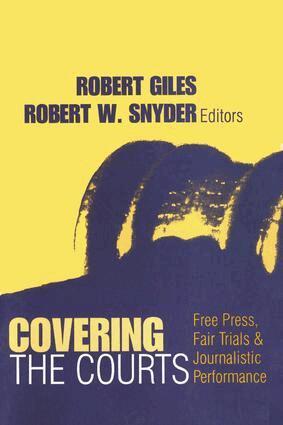
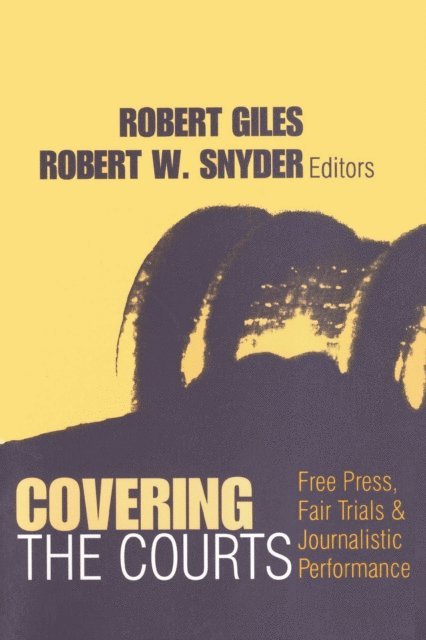
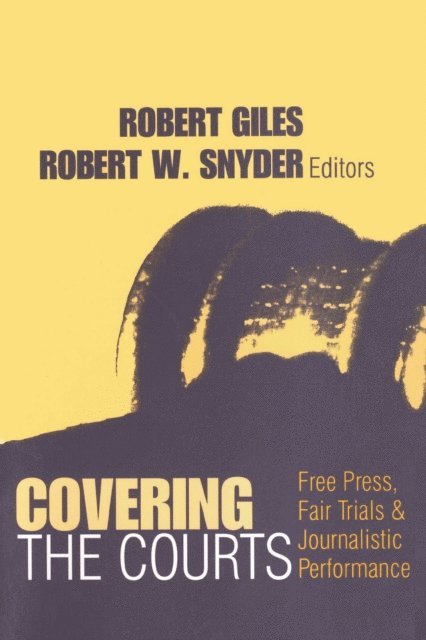
Covering the Courts shows how writers and journalists deal with present-day major trials, such as those involving Timothy McVeigh and O.J. Simpson. The volume features such outstanding contributors as Linda Deutsch and Fred Graham, and provides an in-depth look at the performance of the court in an age of heightened participation by reporters, camera operators, social scientists, major moguls of network radio and television, and advocates of special causes.The volume does far more than discuss specific cases. Indeed, it is a major tool in the study of the new relationships between a free press and a fair trial. Interestingly, a consensus is described in which the parties involved in efforts to balance freedom of the press and the right to a fair trial are moving in tandem. In this regard, sensitive issues ranging from the universality of law to the particularity of racial, religious, and gender claims, are explored with great candor.The volume also turns the intellectual discourse to its major players: the members of the press, the lawyers, and the judiciary. Has there been a shift from reporting functions to entertainment values? Does television and live presentation shift the burden from the contents of a case to the photogenic and star quality of players? What excites and intrigues the public: serious disturbances to the peace and mass mayhem, such as the Oklahoma bombings or sexual adventures of entertainment and sports figures? The findings are sometimes disturbing, but the reading is never dull. This book will be of interest to journalists, lawyers, and the interested general public.This volume is the latest in the Transaction Media Studies Series edited by Everette E. Dennis, dean of the school of communication at Fordham University. The volume itself is edited by Robert Giles, the editor, and Robert W. Snyder, the managing editor, of Media Studies Journal. The original contributions were initially presented at The Freedom Forum and its Media Studies Center.
468 kr
Skickas inom 10-15 vardagar
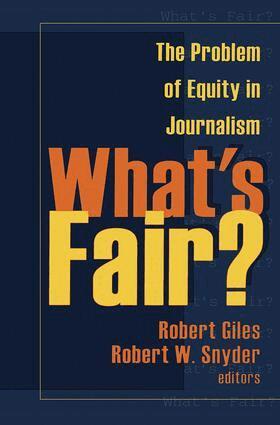
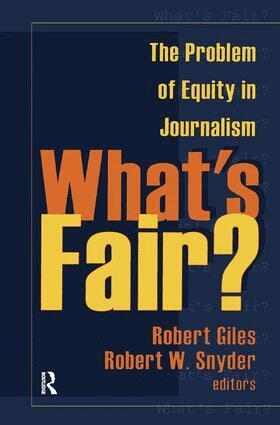
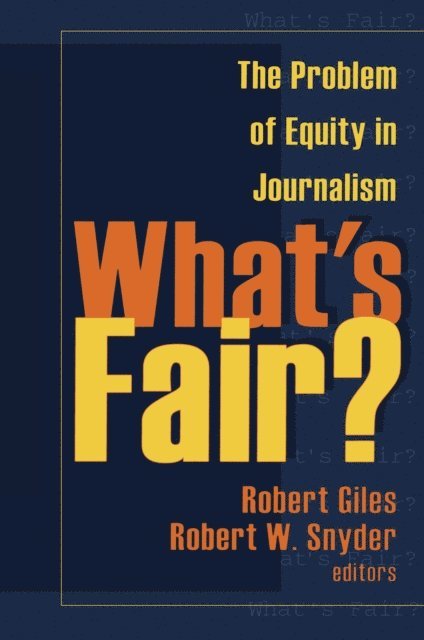
What's fair? It is an old question in journalism. In 1999, it seems more difficult to answer than ever. The cycle of story, spin, and counterspin that surrounds the White House is only the most obvious part of the problem. In the past 25 years, the practice of journalism has changed enormously--particularly in the United States. The demarcation of public and private life that once ruled certain kinds of stories out-of-bounds has eroded, leaving reporters with the unenviable challenge of having to cover events whose seaminess inevitably taints all who touch them. Commercial pressures, and a tidal wave of information and entertainment media, have engulfed the news business--leaving the definitions of journalism and journalistic standards vague and uncertain. And the technology of news reporting is speeding up news cycles in ways that leave little time for sober and measured judgments.What's Fair? is a collection of essays from experts in the field that are sure to spark compelling questions and ideas about journalism and its place in our time. In "Fairness--A Struggle," journalists explore a subject that they normally share only with close friends and colleagues--their own struggles with fairness that occurred in places as different as South Africa, Washington, and the South Bronx. In "Fairness--A History," nine contributors examine the history of the fairness question, specifically the establishment of the Hutchins Commission report of 1947, which is evaluated here by a historian, a journalist and a First Amendment authority. In a comparative vein, two authorities on international communications law examine British regulations for fairness in broadcasting at the end of the 20th century. In "Fairness--A Goal," contributors explore what struggles for fairness mean in a variety of contexts, from American newsrooms to post-Communist Poland to Northern Ireland.Many discussions of fairness are either numbingly abstract or impossibly righteous. To avoid those hazards, Robert Giles and Robert Snyder have grounded this volume in stories--the kind of stories journalists tell each other and the kind of stories people tell about journalism. This volume is a testament to journalism that is free yet fair, probing yet credible and authoritative in content yet open to many voices.Robert Giles is editor-in-chief of Media Studies Journal, senior vice president of the Freedom Forum and executive director of Media Studies Center. Formerly the editor and publisher of The Detroit News, he is the author of Newsroom Management: A Guide to Theory and Practice.Robert W. Snyder is editor of the Media Studies Journal, a historian, and most recently author of Transit Talk: New York's Bus and Subway Workers Tell Their Stories. He has taught at Princeton University and New York University, from which he holds a doctorate in history.
671 kr
Skickas inom 10-15 vardagar
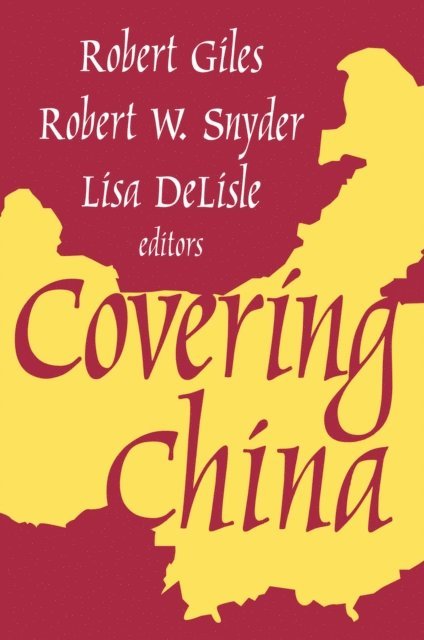
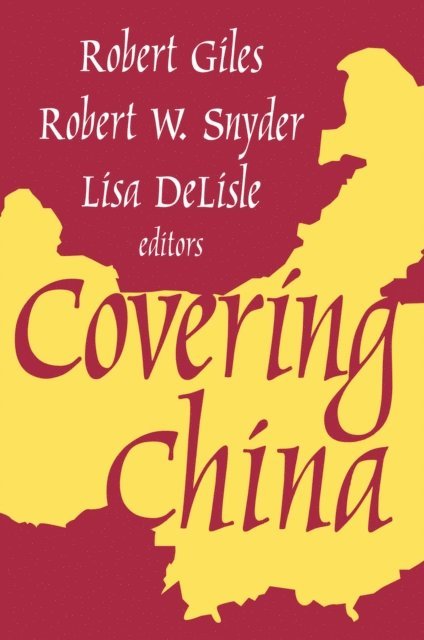
The relationship between China and the United States has been marked by a lack of mutual comprehension that stretches from America's missionary paternalism in the early twentieth century to the fears and fascinations of the present. Throughout the twentieth century China has attracted the attention of American journalists, from the first China hands who covered an ancient country lurching into the modern world, to the chroniclers of World War II and the Chinese civil war, to the reporters who today explore the contradictions of China's economy. Covering China looks at the questions, concerns, and conceptions of all the generations of American reporters against the backdrop of Chinese history and China's own media.Covering China is divided into three sections. "Histories" takes up the events, anniversaries, and processes that have shaped Chinese and American media coverage over the century. Included here are chapters focusing on the civil war and analyzing American reporting in the 1930s and 1940s in their many viewpoints, as well as in the decades when China was closed to American journalists. Other chapters consider the influence on journalism of various political movements from the anti-Western May 4th movement of 1918 to the Tiananmen Square protests of 1989. "Communicating" explores the challenges of explaining China to Americans and America to the Chinese. Among the topics covered here are the Chinese media reaction to the Clinton scandal, the status of Hong Kong as a window between China and the West, Communist efforts to control public opinion in the media, and the pioneering role of Pearl S. Buck in interpreting China for American readers. The concluding section, "Issues," examines important stories now emerging in China that will matter to both journalists and China watchers, including the changing roles of Chinese women, little-covered instances of ethnic unrest, and the complexities of economic and environmental stories.The variety of points of view expressed in Covering China is a testament to the vigor of contemporary writing on China. As one contributor notes, American media coverage of China needs to challenge existing assumptions and be ready for the unexpected. By doing so, journalists can minimize the sense of shock that erupts in America at each swing of Chinese history. Covering China will be of interest to China area specialists, journalists, and cultural historians.Robert W. Snyder is managing editor of the Media Studies Journal, a historian, and author of Transit Talk: New York's Bus and Subway Workers Tell Their Stories. He has taught at Princeton University and New York University.
2 088 kr
Skickas inom 10-15 vardagar
The relationship between China and the United States has been marked by a lack of mutual comprehension that stretches from America's missionary paternalism in the early twentieth century to the fears and fascinations of the present. Throughout the twentieth century China has attracted the attention of American journalists, from the first China hands who covered an ancient country lurching into the modern world, to the chroniclers of World War II and the Chinese civil war, to the reporters who today explore the contradictions of China's economy. Covering China looks at the questions, concerns, and conceptions of all the generations of American reporters against the backdrop of Chinese history and China's own media.Covering China is divided into three sections. "Histories" takes up the events, anniversaries, and processes that have shaped Chinese and American media coverage over the century. Included here are chapters focusing on the civil war and analyzing American reporting in the 1930s and 1940s in their many viewpoints, as well as in the decades when China was closed to American journalists. Other chapters consider the influence on journalism of various political movements from the anti-Western May 4th movement of 1918 to the Tiananmen Square protests of 1989. "Communicating" explores the challenges of explaining China to Americans and America to the Chinese. Among the topics covered here are the Chinese media reaction to the Clinton scandal, the status of Hong Kong as a window between China and the West, Communist efforts to control public opinion in the media, and the pioneering role of Pearl S. Buck in interpreting China for American readers. The concluding section, "Issues," examines important stories now emerging in China that will matter to both journalists and China watchers, including the changing roles of Chinese women, little-covered instances of ethnic unrest, and the complexities of economic and environmental stories.The variety of points of view expressed in Covering China is a testament to the vigor of contemporary writing on China. As one contributor notes, American media coverage of China needs to challenge existing assumptions and be ready for the unexpected. By doing so, journalists can minimize the sense of shock that erupts in America at each swing of Chinese history. Covering China will be of interest to China area specialists, journalists, and cultural historians.Robert W. Snyder is managing editor of the Media Studies Journal, a historian, and author of Transit Talk: New York's Bus and Subway Workers Tell Their Stories. He has taught at Princeton University and New York University.
2 402 kr
Skickas inom 10-15 vardagar
Covering the Courts shows how writers and journalists deal with present-day major trials, such as those involving Timothy McVeigh and O.J. Simpson. The volume features such outstanding contributors as Linda Deutsch and Fred Graham, and provides an in-depth look at the performance of the court in an age of heightened participation by reporters, camera operators, social scientists, major moguls of network radio and television, and advocates of special causes.The volume does far more than discuss specific cases. Indeed, it is a major tool in the study of the new relationships between a free press and a fair trial. Interestingly, a consensus is described in which the parties involved in efforts to balance freedom of the press and the right to a fair trial are moving in tandem. In this regard, sensitive issues ranging from the universality of law to the particularity of racial, religious, and gender claims, are explored with great candor.The volume also turns the intellectual discourse to its major players: the members of the press, the lawyers, and the judiciary. Has there been a shift from reporting functions to entertainment values? Does television and live presentation shift the burden from the contents of a case to the photogenic and star quality of players? What excites and intrigues the public: serious disturbances to the peace and mass mayhem, such as the Oklahoma bombings or sexual adventures of entertainment and sports figures? The findings are sometimes disturbing, but the reading is never dull. This book will be of interest to journalists, lawyers, and the interested general public.This volume is the latest in the Transaction Media Studies Series edited by Everette E. Dennis, dean of the school of communication at Fordham University. The volume itself is edited by Robert Giles, the editor, and Robert W. Snyder, the managing editor, of Media Studies Journal. The original contributions were initially presented at The Freedom Forum and its Media Studies Center.
1 331 kr
Skickas inom 10-15 vardagar
What's fair? It is an old question in journalism. In 1999, it seems more difficult to answer than ever. The cycle of story, spin, and counterspin that surrounds the White House is only the most obvious part of the problem. In the past 25 years, the practice of journalism has changed enormously--particularly in the United States. The demarcation of public and private life that once ruled certain kinds of stories out-of-bounds has eroded, leaving reporters with the unenviable challenge of having to cover events whose seaminess inevitably taints all who touch them. Commercial pressures, and a tidal wave of information and entertainment media, have engulfed the news business--leaving the definitions of journalism and journalistic standards vague and uncertain. And the technology of news reporting is speeding up news cycles in ways that leave little time for sober and measured judgments.What's Fair? is a collection of essays from experts in the field that are sure to spark compelling questions and ideas about journalism and its place in our time. In "Fairness--A Struggle," journalists explore a subject that they normally share only with close friends and colleagues--their own struggles with fairness that occurred in places as different as South Africa, Washington, and the South Bronx. In "Fairness--A History," nine contributors examine the history of the fairness question, specifically the establishment of the Hutchins Commission report of 1947, which is evaluated here by a historian, a journalist and a First Amendment authority. In a comparative vein, two authorities on international communications law examine British regulations for fairness in broadcasting at the end of the 20th century. In "Fairness--A Goal," contributors explore what struggles for fairness mean in a variety of contexts, from American newsrooms to post-Communist Poland to Northern Ireland.Many discussions of fairness are either numbingly abstract or impossibly righteous. To avoid those hazards, Robert Giles and Robert Snyder have grounded this volume in stories--the kind of stories journalists tell each other and the kind of stories people tell about journalism. This volume is a testament to journalism that is free yet fair, probing yet credible and authoritative in content yet open to many voices.Robert Giles is editor-in-chief of Media Studies Journal, senior vice president of the Freedom Forum and executive director of Media Studies Center. Formerly the editor and publisher of The Detroit News, he is the author of Newsroom Management: A Guide to Theory and Practice.Robert W. Snyder is editor of the Media Studies Journal, a historian, and most recently author of Transit Talk: New York's Bus and Subway Workers Tell Their Stories. He has taught at Princeton University and New York University, from which he holds a doctorate in history.
141 kr
Skickas
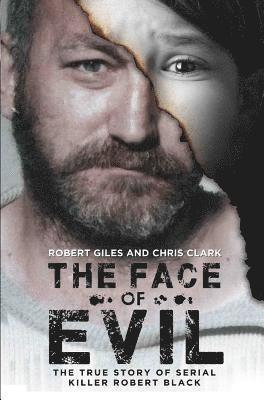
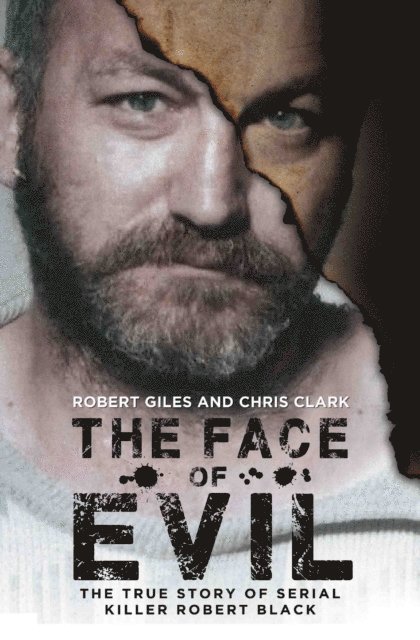
In 1994, Robert Black was convicted of the kidnapping, sexual assault and murder of three young girls, and sentenced to life imprisonment with a minimum tariff of thirty-five years; in 2011 he was convicted of a fourth such killing. He died in HMP Maghaberry, Northern Ireland, in January 2016, aged sixty-eight, unmourned, and entirely unrepentant of his repellent crimes.These bald facts, horrific as they are, do not begin to scratch the surface of the truth about Robert Black, a Scottish-born serial killer who undoubtedly committed further murders for which he was never tried, both in this country and on the Continent. In this ground-breaking account, Robert Giles, who has spent years tracing the killer's movements and sifting through all the evidence, including transcripts of the trials, convincingly argues that Black was an habitual serial killer over many years, and quite certainly responsible for more than the four child murders for which he was convicted.Co-written with Chris Clark, a former police intelligence officer whose tireless work into the Yorkshire Ripper produced convincing new evidence of other murders that went unnoticed or unrecorded, The Face of Evil shows once and for all that Robert Black was a serial killer whose crimes went far beyond what is generally believed. In doing so, it paints a portrait of human cruelty at its worst.