Robert Grosse – författare
Visar alla böcker från författaren Robert Grosse. Handla med fri frakt och snabb leverans.
20 produkter
The Oxford Handbook of Management in Emerging Markets
Av Robert Grosse, Klaus E. Meyer
Inbunden, 2019
3272 kr
Lägg i varukorg
For nearly two decades, emerging markets have been a primary source of growth in the world economy. They have become more international and compete more extensively with companies in developed countries. For these reasons, an understanding of managing businesses in emerging markets is a fundamental …
Can Latin American Firms Compete?
Av Luiz F. Mesquita, Robert Grosse
E-bok, 2007
1775 kr
Lägg i varukorg
In many discussions of globalization and growth, attention focuses on Asia, notably China, South Korea, and India. In contrast, ''Can Latin American Firms Compete?'' looks at business developments in another key emerging market region, Latin America. It examines the success and failure that Latin …
Can Latin American Firms Compete?
Av Luiz F. Mesquita, Robert Grosse
E-bok, 2007
1775 kr
Lägg i varukorg
In many discussions of globalization and growth, attention focuses on Asia, notably China, South Korea, and India. In contrast, ''Can Latin American Firms Compete?'' looks at business developments in another key emerging market region, Latin America. It examines the success and failure that Latin …
Can Latin American Firms Compete?
Av Robert Grosse, Luiz F. Mesquita
Inbunden, 2007
3130 kr
Lägg i varukorg
In many discussions of globalization and growth, attention focuses on Asia, notably China, South Korea, and India. In contrast, 'Can Latin American Firms Compete?' looks at business developments in another key emerging market region, Latin America. It examines the success and failure that Latin …
Multinationals in Latin America
Inbunden, 1989
2200 kr
Lägg i varukorg
Multinational enterprises are particularly strong in Latin America and sensitive to political and economic changes there - the currently emerging debt crisis is likely to have far-ranging effects. This book considers multinationals in Latin America, both those from inside and those from outside the …
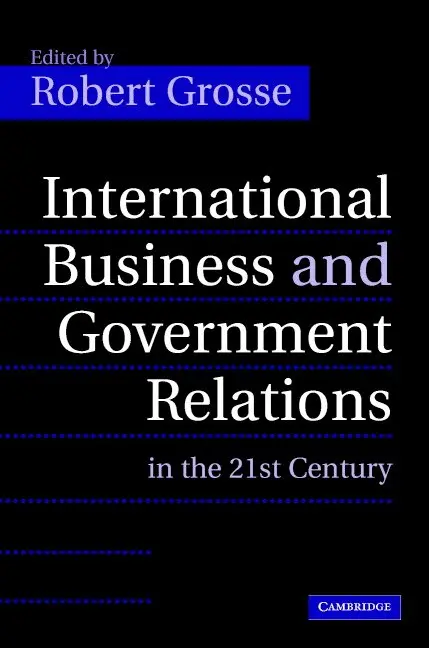
International Business and Government Relations in the 21st Century
Inbunden, 2005
1296 kr
Lägg i varukorg
Originally published in 2005, this book offers an outlook on relations between national governments and multinational companies that provides broad coverage of the key issues likely to determine that relationship during the twenty-first century. From the perspective of the company decision maker …
Emerging Markets
Strategies for Competing in the Global Value Chain
Häftad, 2015
647 kr
Lägg i varukorg
The traditional dominance of international markets by companies from the US, Western Europe and Japan can no longer be taken for granted. Emerging market economies, from the powerhouse Chinese economy (set to pass the US in national income by 2020) to dynamic players such as Mexico, South Africa …
Emerging Markets
Strategies for Competing in the Global Value Chain
E-bok, 2015
755 kr
Lägg i varukorg
The traditional dominance of international markets by companies from the US, Western Europe and Japan can no longer be taken for granted. Emerging market economies, from the powerhouse Chinese economy (set to pass the US in national income by 2020) to dynamic players such as Mexico, South Africa …
New Approach to Cross-Cultural People Management
People are People
E-bok, 2023
660 kr
Lägg i varukorg
When managing cross-culturally in a polarized world, recognizing similarities between people and establishing common ground can be key to success. This book argues that despite differences in language, political systems, income levels, and other factors, people are people. There is no doubt that …
New Approach to Cross-Cultural People Management
People are People
Häftad, 2023
531 kr
Lägg i varukorg
When managing cross-culturally in a polarized world, recognizing similarities between people and establishing common ground can be key to success. This book argues that despite differences in language, political systems, income levels, and other factors, people are people. There is no doubt that …
New Approach to Cross-Cultural People Management
People are People
Inbunden, 2023
2076 kr
Lägg i varukorg
When managing cross-culturally in a polarized world, recognizing similarities between people and establishing common ground can be key to success. This book argues that despite differences in language, political systems, income levels, and other factors, people are people. There is no doubt that …
International Business and Government Relations in the 21st Century
Häftad, 2011
902 kr
Lägg i varukorg
Originally published in 2005, this book offers an outlook on relations between national governments and multinational companies that provides broad coverage of the key issues likely to determine that relationship during the twenty-first century. From the perspective of the company decision maker …
Multinationals in Latin America
E-bok, 2013
856 kr
Lägg i varukorg
Multinational enterprises are particularly strong in Latin America and sensitive to political and economic changes there - the currently emerging debt crisis is likely to have far-ranging effects. This book considers multinationals in Latin America, both those from inside and those from outside the …
Multinationals in Latin America
E-bok, 2013
856 kr
Lägg i varukorg
Multinational enterprises are particularly strong in Latin America and sensitive to political and economic changes there - the currently emerging debt crisis is likely to have far-ranging effects. This book considers multinationals in Latin America, both those from inside and those from outside the …
Four-Day Workweek
Inbunden, 2018
2590 kr
Lägg i varukorg
This provocative book makes a compelling case for reducing the number of workdays in a week to four. Globalization has brought with it fiercer competition and greater worker mobility, and as organizations compete for top talent, they are becoming more open to unconventional worker arrangements, …
Four-Day Workweek
Häftad, 2018
773 kr
Lägg i varukorg
This provocative book makes a compelling case for reducing the number of workdays in a week to four. Globalization has brought with it fiercer competition and greater worker mobility, and as organizations compete for top talent, they are becoming more open to unconventional worker arrangements, …
Four-Day Workweek
E-bok, 2018
883 kr
Lägg i varukorg
This provocative book makes a compelling case for reducing the number of workdays in a week to four. Globalization has brought with it fiercer competition and greater worker mobility, and as organizations compete for top talent, they are becoming more open to unconventional worker arrangements, …
Four-Day Workweek
E-bok, 2018
883 kr
Lägg i varukorg
This provocative book makes a compelling case for reducing the number of workdays in a week to four. Globalization has brought with it fiercer competition and greater worker mobility, and as organizations compete for top talent, they are becoming more open to unconventional worker arrangements, …
Emerging Markets
Strategies for Competing in the Global Value Chain
Inbunden, 2021
1840 kr
Lägg i varukorg
The traditional dominance of international markets by companies from the US, Western Europe and Japan can no longer be taken for granted. Emerging market economies, from the powerhouse Chinese economy (set to pass the US in national income by 2020) to dynamic players such as Mexico, South Africa …