Robert Nau - Böcker
Visar alla böcker från författaren Robert Nau. Handla med fri frakt och snabb leverans.
3 produkter
3 produkter
1 064 kr
Skickas inom 10-15 vardagar
The 1980s and 1990s have been a period of major developments in the modelling of decision-making under risk and uncertainty. Extensions of the theory of expected utility and alternative theories of "non-expected utility" have been devised to explain many puzzles and paradoxes of individual and collective choice behaviour. This volume presents some recent work on the modelling of risk and uncertainty, with applications to problems in environmental policy, public health, economics and finance. Eighteen papers by economists, management scientists, and statisticians aims to shed new light on phenomena such as the Allais and St Petersburg paradoxes, the equity premium puzzle, the demand for insurance, the valuation of public health and safety, and environmental goods. This work should be of interest to economists, management scientists, risk and policy analysts, and others who study risky decision-making in economic and environmental contexts.
1 294 kr
Skickas inom 10-15 vardagar
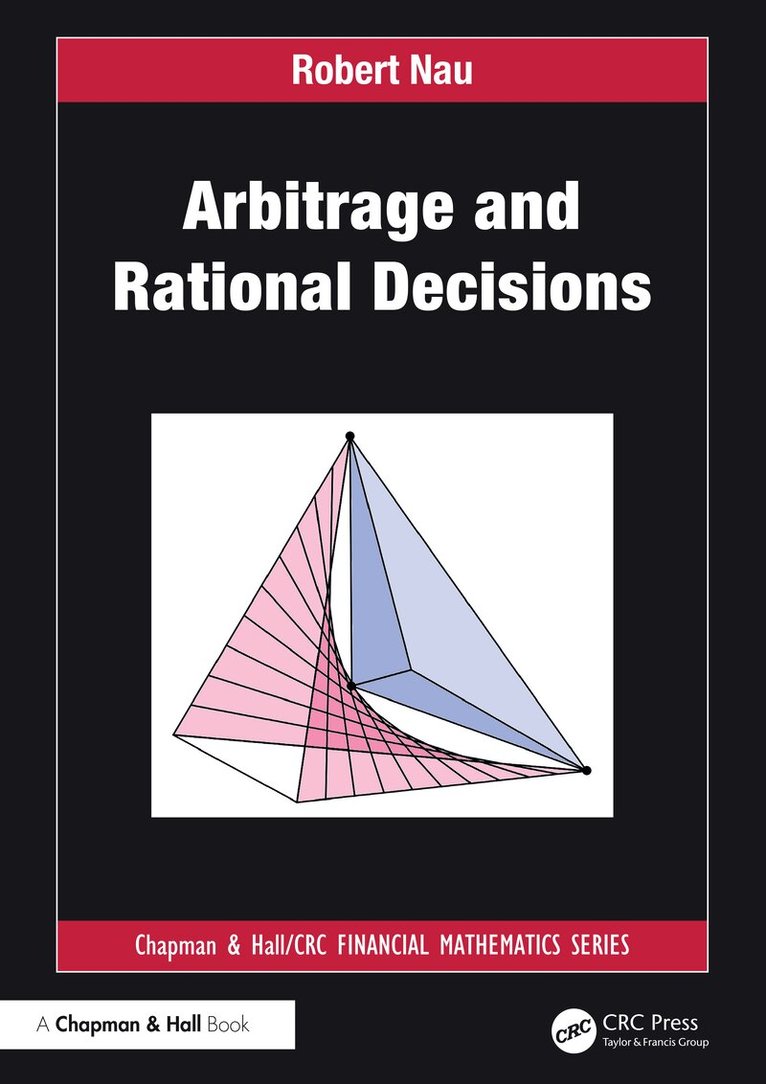
This unique book offers a unified approach to the modeling of rational decision-making under conditions of uncertainty and strategic and competitive interactions among agents. Its most elementary axiom of rationality is the principle of no-arbitrage, namely that neither an individual decision maker nor a small group of strategic competitors nor a large group of market participants should behave in such a way as to provide a riskless profit opportunity to an outside observer.Both those who work in the finance area and those who work in decision theory more broadly will be interested to find that basic tools from finance (arbitrage pricing and risk-neutral probabilities) have broader applications, including the modeling of uncertainty aversion, inseparable beliefs and tastes, nonexpected utility, ambiguity, and noncooperative games.The book emphasizes the use of money (rather than varieties of utility) in the quantification of rational economic thought. It provides not only a medium of exchange and an objective to maximize but also a language for cognition, interpersonal expression of preferences, aggregation of beliefs, and construction of common knowledge in terms of precise numbers. At the same time it provides an obvious standard of economic rationality that applies equally to individuals and groups: don’t throw it away or allow your pocket to be picked. The modeling issues that arise here provide some perspective on issues that arise in quantitative modeling of decisions in which objects of choice are less concrete or higher-dimensional or more personal in nature.One of the book’s key contributions is to show how noncooperative game theory can be directly unified with Bayesian decision theory and financial market theory without introducing separate assumptions about strategic rationality. The no-arbitrage standard of rationality leads straight to the conclusion that correlated equilibrium rather than Nash equilibrium is the fundamental solution concept, and risk-neutral probabilities come into play when agents are uncertainty-averse.The book also provides some history of developments in the field over the last century, emphasizing universal themes as well as controversies and paradigm shifts. It is written to be accessible to advanced undergraduates, graduate students, researchers in the field, and professionals.
1 096 kr
Skickas inom 10-15 vardagar
The 1980s and 1990s have been a period of exciting new developments in the modelling of decision-making under risk and uncertainty. Extensions of the theory of expected utility and alternative theories of `non-expected utility' have been devised to explain many puzzles and paradoxes of individual and collective choice behaviour. This volume presents some of the best recent work on the modelling of risk and uncertainty, with applications to problems in environmental policy, public health, economics and finance. Eighteen papers by distinguished economists, management scientists, and statisticians shed new light on phenomena such as the Allais and St. Petersburg paradoxes, the equity premium puzzle, the demand for insurance, the valuation of public health and safety, and environmental goods. Audience: This work will be of interest to economists, management scientists, risk and policy analysts, and others who study risky decision-making in economic and environmental contexts.