Robert Stainton – författare
Visar alla böcker från författaren Robert Stainton. Handla med fri frakt och snabb leverans.
7 produkter
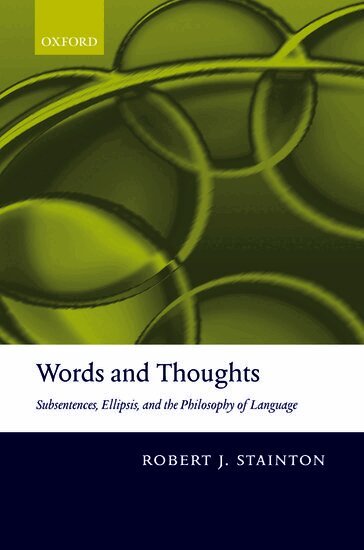
Words and Thoughts
Subsentences, Ellipsis, and the Philosophy of Language
Inbunden, 2006
998 kr
Lägg i varukorg
It is a near truism of philosophy of language that sentences are prior to words. Sentences, it is said, are what we believe, assert, and argue for; uses of them constitute our evidence in semantics; only they stand in inferential relations, and are true or false. Sentences are, indeed, the only …
Words and Thoughts
Subsentences, Ellipsis, and the Philosophy of Language
Häftad, 2009
844 kr
Lägg i varukorg
It is a near truism of philosophy of language that sentences are prior to words. Sentences, it is said, are what we believe, assert, and argue for; uses of them constitute our evidence in semantics; only they stand in inferential relations, and are true or false. Sentences are, indeed, the only …
Philosophy And Linguistics
Av Kumiko Murasugi, Robert Stainton
Inbunden, 2019
3461 kr
Lägg i varukorg
In the 1960s and 1970s questions about the semantics of natural languages were of central concern to the vast majority of analytic philosophers. The work of Chomsky, Davidson, Grice, Donnellan, Kaplan, Kripke and Putnam was widely read by non-specialists. The three main branches of linguistics that …
Philosophy And Linguistics
Av Kumiko Murasugi, Robert Stainton
Häftad, 2020
794 kr
Lägg i varukorg
In the 1960s and 1970s questions about the semantics of natural languages were of central concern to the vast majority of analytic philosophers. The work of Chomsky, Davidson, Grice, Donnellan, Kaplan, Kripke and Putnam was widely read by non-specialists. The three main branches of linguistics that …
Philosophy And Linguistics
Av Robert Stainton, Kumiko Murasugi
E-bok, 2019
915 kr
Lägg i varukorg
In the 1960s and 1970s questions about the semantics of natural languages were of central concern to the vast majority of analytic philosophers. The work of Chomsky, Davidson, Grice, Donnellan, Kaplan, Kripke and Putnam was widely read by non-specialists. The three main branches of linguistics that …
Philosophy And Linguistics
Av Robert Stainton, Kumiko Murasugi
E-bok, 2019
915 kr
Lägg i varukorg
In the 1960s and 1970s questions about the semantics of natural languages were of central concern to the vast majority of analytic philosophers. The work of Chomsky, Davidson, Grice, Donnellan, Kaplan, Kripke and Putnam was widely read by non-specialists. The three main branches of linguistics that …
Proper Names and Reference
Metasemantic Challenges and Epistemological Constraints
Av Stefano Pugnaghi, Lenny Clapp m. fl.
Inbunden, 2026
1340 kr
Kommande
What mechanisms determine the meaning of proper names? Drawing from semantic and metasemantic perspectives, this book offers a novel theory.Names raise controversial issues in philosophy of language, epistemology, philosophy of mind and metaphysics. Stefano Pugnaghi explores The first part of the …