• Fri frakt över 249 kr
  • •
  • Snabba leveranser
  • •
  • Billiga böcker
Kundservice

Du är på sajten för privatpersoner.

Företag, bibliotek eller offentlig verksamhet?

Du handlar på classic.bokus.com, där alla dina funktioner finns intakta.
Till classic.bokus.com
Bokus logotyp. Gå till startsidan.
  • Erbjudanden
  • Student
  • Topplistor
  • Barn & ungdom
  • Bokus Play
  • E-böcker
  • Ljudböcker
  • Pocketböcker
  • Spel och pussel

Pocketfynda! Hundratals böcker för 49 kr/st →

Sidfot

Mina sidor

    Hjälp

    • Kundservice
    • Vanliga frågor och svar
    • Frakt och leverans
    • Retur vid ångerrätt
    • Reklamera vara
    • Betalning
    • Köpvillkor
    • Allmänna villkor
    • Information om webbplatsens tillgänglighet

    Om Bokus

    • Om oss
    • Pressrum
    • För studenter
    • För företag
    • För bibliotek och offentlig verksamhet
    • För leverantörer
    • Hållbarhet

    Populärt

    • Aktuella erbjudanden
    • Presentkort
    • Studentlitteratur
    • Nya böcker
    • Topplistor
    • Signerade böcker
    • Engelska böcker

    Inspiration

    • Boktips
    • BookTok
    • Barnbokskaraktärer
    • Populära författare
    Logotyp för Bokus
    Följ oss på Facebook (extern länk)Följ oss på Instagram (extern länk)Följ oss på YouTube (extern länk)Följ oss på TikTok (extern länk)
    bokus @ CookiesAnpassa cookiesIntegritetspolicyKöpvillkor
    Till Citymail hemsida (extern länk)Till Budbee hemsida (extern länk)Till Postnord hemsida (extern länk)Till Schenker hemsida (extern länk)Till Early Bird hemsida (extern länk)Till Walleys hemsida (extern länk)
    1. Språk och ordböcker
    2. Språkvetenskap och lingvistik

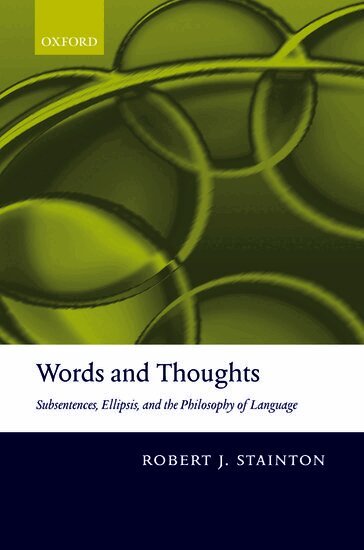
    Words and Thoughts

    Subsentences, Ellipsis, and the Philosophy of Language

    AvRobert Stainton

    Inbunden, Engelska, 2006

    960 kr

    Beställningsvara. Skickas inom 3-6 vardagar. Fri frakt över 249 kr.

    Fler format och utgåvor

    Häftad

    835 kr

    Beskrivning

    It is a near truism of philosophy of language that sentences are prior to words. Sentences, it is said, are what we believe, assert, and argue for; uses of them constitute our evidence in semantics; only they stand in inferential relations, and are true or false. Sentences are, indeed, the only things that fundamentally have meaning.Does this near truism really hold of human languages? Robert Stainton, drawing on a wide body of evidence, argues forcefully that speakers can and do use mere words, not sentences, to communicate complete thoughts. He then considers the implications of this empirical result for language-thought relations, various doctrines of sentence primacy, and the semantics-pragmatics boundary.The book is important both for its philosophical and empirical claims, and for the methodology employed. Stainton illustrates how the methods and detailed results of the various cognitive sciences can bear on central issues in philosophy of language. At the same time, he applies philosophical distinctions with subtlety and care, to show that arguments which seemingly support the primacy of sentences do not really do so. The result is a paradigm example of The New Philosophy of Language: a rich melding of empirical work with traditional philosophy of language.

    Produktinformation

    • Utgivningsdatum:2006-08-03
    • Mått:164 x 240 x 21 mm
    • Vikt:445 g
    • Format:Inbunden
    • Språk:Engelska
    • Antal sidor:262
    • Förlag:OUP OXFORD
    • ISBN:9780199250387

    Utforska kategorier

    • Språkvetenskap och lingvistik inom Språk och ordböcker
    • Filosofiska discipliner inom Filosofi och religion
    • Kognitiv psykologi inom Psykologi och pedagogik

    Recensioner i media

    clearly written, meticulously organized, well argued, and highly informative book...Words and Thoughts is an interesting and often fascinating book. There is much to learn from it, thanks to the rich and varied linguistic ideas and psychological findings that Stainton brings into the discussion.

    Innehållsförteckning

    • PART ONE: THE APPEARANCES AND SOME BACKGROUND ; PART TWO: THE GENUINENESS ISSUE ; PART THREE: IMPLICATIONS