Robert W. Dutton - Böcker
Visar alla böcker från författaren Robert W. Dutton. Handla med fri frakt och snabb leverans.
3 produkter
3 produkter
Del 243 - Springer International Series in Engineering and Computer Science
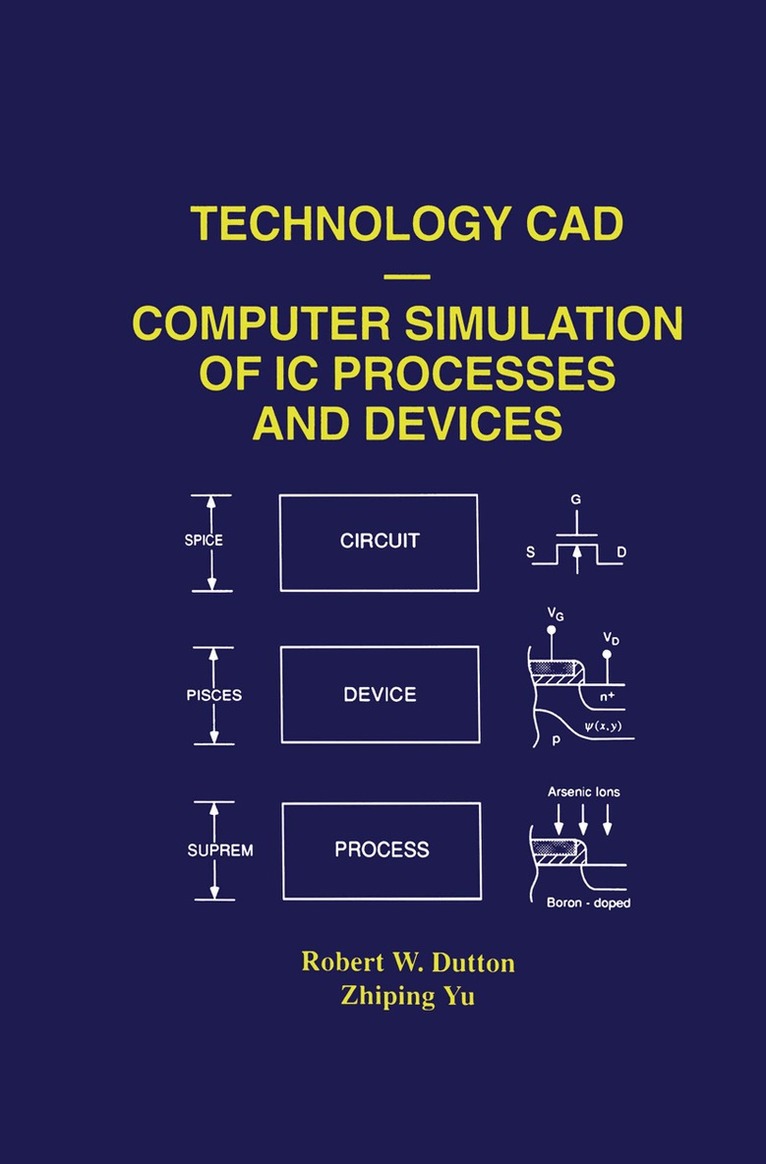
Technology CAD — Computer Simulation of IC Processes and Devices
Inbunden, Engelska, 1993
2 321 kr
Skickas inom 10-15 vardagar
The rapid evolution and explosive growth of integrated circuit technology have had a profound effect on society. Integrated circuits (ICs) are used universally and the expanding use of IC technology requires more accurate circuit analysis methods and tools, prompting the introduction of computers into the design process. The goal of this book is to build a firm foundation in the use of computer-assisted techniques for IC device and process design. Both practical and analytical viewpoints are stressed to give the reader the background necessary to appreciate CAD tools and to feel comfortable with their use. This work presents a discourse on process and device CAD as interrelated subjects, building on a wide range of experiences and applications of the SUPREM program. Chapter 1 focuses on the motivation for coupled process and device CAD. In Chapter 2 SUPREM III is introduced, and process CAD is discussed in terms of ion-implantation, impurity diffusion, and oxidation models. Chapter 3 introduces the Stanford device analysis program SEDAN III (SEmiconductor Device ANalysis).The next three chapters move into greater detail concerning device operating principles and analysis techniques. Chapter 4 reviews the classical formulation of pn junction theory and uses device analysis (SEDAN) both to evaluate some of the classical assumptions and to investigate the difficult problem of high level injection. Chapter 5 returns to MOS devices, reviews the first-order MOS theory, and introduces some important second-order effects. Chapter 6 considers the bipolar transistor. Chapter 7 considers the application of process simulation and device analysis to technology design. The BiCMOS process is selected as a useful design vehicle for two reasons. Firstly, it allows the reader to pull together concepts from the entire book and secondly, the inherent nature of BiCMOS technology offers real constraints and hence trade-offs which must be understood and accounted for.
Del 243 - Springer International Series in Engineering and Computer Science
Technology CAD — Computer Simulation of IC Processes and Devices
Häftad, Engelska, 2012
2 321 kr
Skickas inom 10-15 vardagar
129 3.6 Exercises 130 3.7 References. 131 4 PN Junctions 131 4.1 Introduction. 132 4.2 Carrier Densities: Equilibrium Case 4.3 Non-Equilibrium .......... . 139 4.4 Carrier Transport and Conservation 144 4.5 The pn Junction - Equilibrium Conditions. 147 155 4.6 The pn Junction - Non-equilibrium. 4.7 SEDAN Analysis . . . . . . . . . . . . . 166 4.7.1 Heavy Doping Effects ..... . 176 4.7.2 Analysis of High-Level Injection 181 190 4.7.3 Technology-Dependent Device Effects 4.8 Summary 193 4.9 Exercises 193 194 4.10 References. 5 MOS Structures 197 5.1 Introduction ............. . 197 5.2 The MOS Capacitor ........ . 198 5.3 Basic MOSFET I-V Characteristics. 208 5.4 Threshold Voltage in Nonuniform Substrate 217 5.5 MOS Device Design by Simulation . . . . . 224 5.5.1 Body-bias Sensitivity of Threshold Voltage 225 5.5.2 Two-region Model . . . . . . . . 231 5.5.3 MOSFET Design by Simulation. 234 5.6 Summary 240 5.7 Exercises 240 5.8 References. 242 6 Bipolar Transistors 243 6.1 Introduction ... 243 6.2 Lateral pnp Transistor Operation 245 6.3 Transport Current Analysis ... 252 6.4 Generalized Charge Storage Model 260 6.,1) Transistor Equivalent Circuits. 267 6.5.1 Charge Control Model ...
533 kr
Skickas inom 10-15 vardagar
P. Antognetti University of Genova, Italy Director of the NATO ASI The key importance of VLSI circuits is shown by the national efforts in this field taking place in several countries at differ ent levels (government agencies, private industries, defense de partments). As a result of the evolution of IC technology over the past two decades, component complexi ty has increased from one single to over 400,000 transistor functions per chip. Low cost of such single chip systems is only possible by reducing design cost per function and avoiding cost penalties for design errors. Therefore, computer simulation tools, at all levels of the design process, have become an absolute necessity and a cornerstone in the VLSI era, particularly as experimental investigations are very time-consuming, often too expensive and sometimes not at all feasible. As minimum device dimensions shrink, the need to understand the fabrication process in a quanti tati ve way becomes critical. Fine patterns, thin oxide layers, polycristalline silicon interco~ nections, shallow junctions and threshold implants, each become more sensitive to process variations. Each of these technologies changes toward finer structures requires increased understanding of the process physics. In addition, the tighter requirements for process control make it imperative that sensitivities be unde~ stood and that optimation be used to minimize the effect of sta tistical fluctuations.