Robert W. Greene – författare
Visar alla böcker från författaren Robert W. Greene. Handla med fri frakt och snabb leverans.
5 produkter
5 produkter
314 kr
Skickas inom 3-6 vardagar
657 kr
Skickas inom 5-8 vardagar
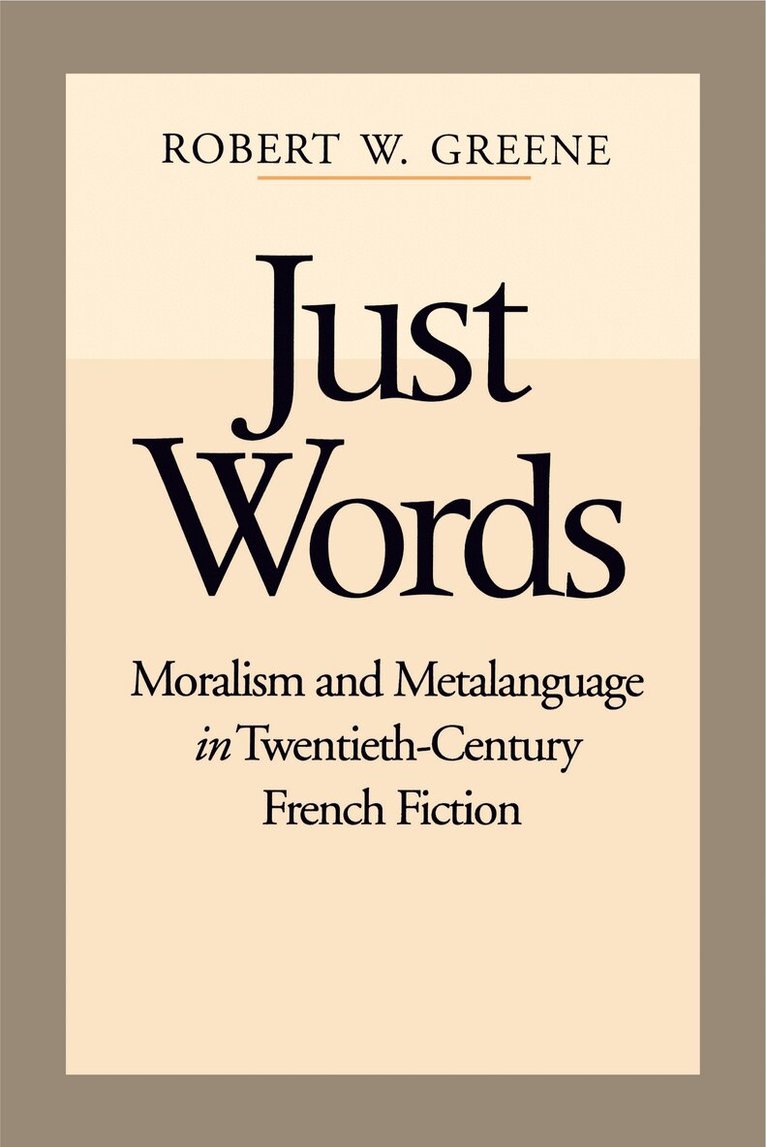
Are the words that a novelist uses adequate to his or her elusive subject—the human condition? Are they pertinent, accurate, invariably fair, unflinchingly honest? Or do the novelist's words execute essentially formal maneuvers, engaging our interest through their patterns rather than their reach? And what about a possible third, synthesizing option? Robert W. Greene discovers that the two apparently divergent intentions in question (metalinguistic vs. moralistic) often paradoxically coexist in French fiction. Also, no doubt because it is more consistently self-conscious than that of any previous era, the fiction of twentieth-century France seems to illustrate this convergence with special brillance.From L'lmmoralist (1902) to L'Usage de la parole (1980) Greene explores combinations and permutations of moralistic analysis and metalinguistic commentary in a particular sequence of prose narrative. Along the way, he observes Gide, Proust, Malraux, Camus, Duras, and Sarraute, each in his or her own fashion, moving ceaselessly back and forth between soundings of the heart and diagnoses of the tongue.
715 kr
Skickas inom 3-6 vardagar
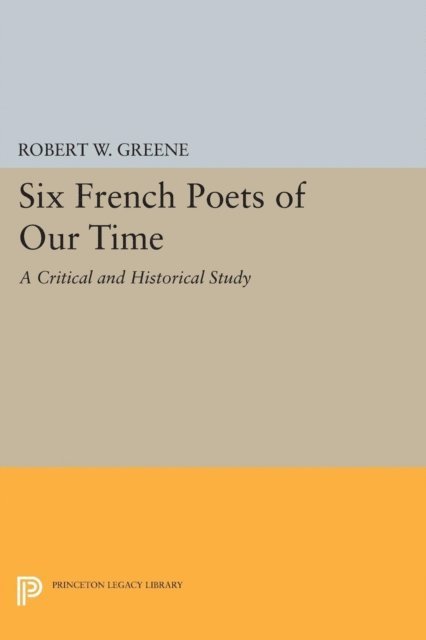
During the last sixty to seventy years avant-garde poetry in France has evolved in two directions: one toward poetry conceived as a means to an end, the other toward poetry as an end in itself. Focusing on Pierre Reverdy, Francis Ponge, Rene Char, Andre du Bouchet, Jacques Dupin, and Marcelin Pleynet as the modern French poets who most faithfully reflect these directions, Robert Greene's chronological study allows us to follow the two-pronged evolution of French poetry since 1910. Situating his argument in a detailed historical context and basing it on comparisons with artistic movements and the poets' own writings on art, and on extended analyses of selected representative poems, the author is able to establish a new intellectual-historical perspective on contemporary poetry. Professor Greene finds that whereas Reverdy, Char, du Bouchet, and Dupin all embrace a conception of poetry as quest, as a search for the absolute, as the Way of beauty or truth, Ponge and Pleynet hold to a view of poetry as jete, as a celebration of the relative, as the play and display of language in action.What knits them together, he concludes, is the way in which each poet sums up his era as a stage in the development of twentieth-century French poetry. Originally published in 1979. The Princeton Legacy Library uses the latest print-on-demand technology to again make available previously out-of-print books from the distinguished backlist of Princeton University Press. These editions preserve the original texts of these important books while presenting them in durable paperback and hardcover editions. The goal of the Princeton Legacy Library is to vastly increase access to the rich scholarly heritage found in the thousands of books published by Princeton University Press since its founding in 1905.
1 626 kr
Skickas inom 3-6 vardagar
During the last sixty to seventy years avant-garde poetry in France has evolved in two directions: one toward poetry conceived as a means to an end, the other toward poetry as an end in itself. Focusing on Pierre Reverdy, Francis Ponge, Rene Char, Andre du Bouchet, Jacques Dupin, and Marcelin Pleynet as the modern French poets who most faithfully reflect these directions, Robert Greene's chronological study allows us to follow the two-pronged evolution of French poetry since 1910. Situating his argument in a detailed historical context and basing it on comparisons with artistic movements and the poets' own writings on art, and on extended analyses of selected representative poems, the author is able to establish a new intellectual-historical perspective on contemporary poetry. Professor Greene finds that whereas Reverdy, Char, du Bouchet, and Dupin all embrace a conception of poetry as quest, as a search for the absolute, as the Way of beauty or truth, Ponge and Pleynet hold to a view of poetry as jete, as a celebration of the relative, as the play and display of language in action.What knits them together, he concludes, is the way in which each poet sums up his era as a stage in the development of twentieth-century French poetry. Originally published in 1979. The Princeton Legacy Library uses the latest print-on-demand technology to again make available previously out-of-print books from the distinguished backlist of Princeton University Press. These editions preserve the original texts of these important books while presenting them in durable paperback and hardcover editions. The goal of the Princeton Legacy Library is to vastly increase access to the rich scholarly heritage found in the thousands of books published by Princeton University Press since its founding in 1905.
1 020 kr
Skickas inom 5-8 vardagar
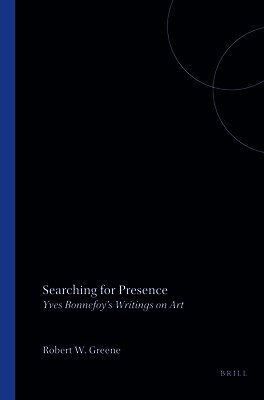
Yves Bonnefoy’s writings have won him praise not only from readers and critics of French poetry, but also, thanks to translations into many other languages, from readers and critics of poetry far beyond the francophone world. Indeed, Bonnefoy may be the most admired poet to have emerged in France since World War II. Yet his art criticism, dazzling in its scope, possibly as original as his poetry, is yet to receive the attention it deserves. Searching for Presence: Yves Bonnefoy’s Writings on Art undertakes to fill that lacuna.Elusive, skirting the ineffable, the notion of presence has haunted Bonnefoy for decades. Central to the notion for the poet is the fleeting experience of mutuality between self and other, of lightning transaction in a transient world, of a shared mortal destiny, hence a plenitude within finitude. In an age when so many of his contemporaries seem to view any form of art as wallpaper spanning a void, Bonnefoy’s faith in presence is all the more welcome. Focusing on his art criticism, the aspect of the poet’s oeuvre in which the notion of presence is the most salient, this study tries to do justice to that fidelity.