Robert Z. Lawrence - Böcker
Visar alla böcker från författaren Robert Z. Lawrence. Handla med fri frakt och snabb leverans.
8 produkter
8 produkter
274 kr
Skickas inom 10-15 vardagar
The world trading envionment changed dramatically in the 1980s. America's trade balance declined sharply, while Japan, Germany, and the newly industrialized countries of Asia built up large, continuing surpluses. Such developments led many people to question whether the traditional postwar strategy of reliance on multilateral free trade agreements is still the best course for the United States, or even a viable one.The challenges to the multilateral system are both practical and theoretical. Various nations are already forming ""free trade"" blocs-- notably the Europe 1992 and the Canadian-American trade arrangements. The United States has increasingly bypassed the GATT and bargained bilaterally in trade disputes, especially with Japan. Several prominent economists have developed new theories that support a more active role for the government to help shape technological change and improve the competitive position of the United States in world markets. Others strongly defend the current arrangements and caution that greater reliance on bilateral bargaining and trading blocs will lead to fragmented world trade and cartel-like arrangements among a few major producers. They are even more skeptical of an interventionist government successfully ""managing"" trade.An American Trade Strategy assesses options for the decade ahead, examining the case for mulitlateral free trade, aggressive bilateralism, and managed trade, as well as their shortcomings. The editors and contributors evaluate the alternative strategies and reflect on their implications for the future direction of American trade policy.
269 kr
Skickas inom 10-15 vardagar
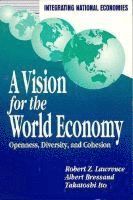
In this capstone volume in the INE series, the authors review the growing pressure for deeper international integration, explore the strengths and weaknesses of alternative approaches to dealing with these pressures, and present concrete proposals to help achieve a global community that will balance openness, diversity, and cohesion. A volume of Brookings' Integrating National Economies Series
282 kr
Skickas inom 10-15 vardagar
The world economy has undergone miraculous changes in the last decade, particularly in developing and former communist countries. Privatization and trade liberalization have replaced the protectionist and statist policies that were deeply entrenched in these areas just ten years ago. Today, these dynamic emerging markets offer attractive opportunities. According to Robert Lawrence, liberal international trade and investment should provide significant opportunities for gains in developing and developed nations alike.But will the developed countries be allowed to keep their markets open and absorb exports from developing countries? Many in the U.S. and Europe blame international trade for unemployment and wage inequality. But what is the real relationship? Lawrence contends that while trade has played some role in reducing the wages of poorly educated workers in the U.S. and in raising the unemployment of unskilled workers in Europe, its impact has been small compared with other causes of these changes.Lawrence examines the role of trade in developed and developing countries and its impact on labor markets and wage inequality, and discusses what he considers the more important effects of technological and organizational change. He begins by focusing on U.S. wage behavior, then moves to wage behavior in the OECD countries.Lawrence concludes that the impact of globalization on OECD labor markets has been far less damaging than many have argued and, indeed, that international trade enhances national welfare. He presents considerable evidence that the sources of poor labor market performance are essentially domesticthey reflect ongoing technological and organizational shocks that would be present even if the economy was closed. This evidence suggests that international differences in wage rates and labor standards are not major factors in OECD labor market behavior. He explains that the major challenges to policy are educating the public on the nature of these changes, emphasizing the need for worker training and education to take advantage of new technologies and new organizational structures, and developing measures to reduce earnings inequality while preserving and increasing wage flexibility.Robert Z. Lawrence is professor of international trade and investment at the John F. Kennedy School of Government at Harvard University. His previous books include A Vision for the World Economy: Openness, Diversity, and Cohesion (Brookings, 1996), the capstone volume to the Integrating National Economies series.Copublished with the OECD Development Centre
282 kr
Skickas inom 10-15 vardagar
American Living Standards contends that the central problem of the U.S. economy has been for some years now, and for the foreseeable future will continue to be, the slowdown in the growth of living standards. This decline began in the early 1970s, was masked by a resort to overseas borrowing in the early 1980s, and now threatens to get worse in the years immediately ahead as the foreign debt bills come due. The editors and contributes to this volume seek to advance our understanding of the causes and consequences of this potential slowdown in the growth of living standards. Equally important, the book examines what policy measure holds out the best hope for presenting, or at the very least, minimizing this slowdown. Various chapters explore the changes in the level and distribution of incomes that have occurred in recent years; changes in the quality and distribution of jobs among industries and regions; what economists do and do not know about recent trends in productivity growth and in the quality of education; and what events could trigger a recession.
282 kr
Skickas inom 10-15 vardagar
The proposed North American Free Trade Agreement (NAFTA) represents a historic change in relations among Canada, Mexico, and the United States. The effect of the agreement on the three economies has generated controversy and some degree of alarm within each country.In this book, noted trade and development experts review the available literature on the effects of NAFTA on the three member countries and the world trading system. They evaluate how NAFTA will affect areas such as economic growth, employment, income distribution, industry, and agriculture in Canada, Mexico, and the United States; and consider the significance the trade agreement holds for the rest of the world.Drusill K. Brown begins the discussion by providing an overview and comparison of the general results from recent studies. Raúl Hinojosa-Ojeda and Sherman Robinson explore in greater detail the potential effects of NAFTA on wages and employment in Mexico and the United States. Sidney Wintrab reviews industry-specific effects of NAFTA, in particular, the environment, the social agenda, and human rights and democracy. Finally, Carlos Alberto Primo Braga considers the implications of NAFTA on the rest of the world.Following each of these chapters, international scholars assess the alternatives and provide recommendations for future research.
282 kr
Skickas inom 10-15 vardagar
The unprecedented shifts in the U.S. dollar's exhange rate that started during the late 1970s and continued through the 1980s provide an ideal opportunity to explore how the global economy works and the role that multinational enterprises (MNEs) play in the phenomenon of globalization. In this book, Subramanian Rangan and Robert Z. Lawrence examine the international pricing, sourcing, and trade responses of MNEs to shifts in the dollar. Based upon the micro patterns they observe in MNE behavior, the authors suggest explanations for some puzzling macro patterns evident in our international economy. They conclude that the global integration of markets remains incomplete due to informational and other important discontinuities, and they refute stereotypes which portray multinational firms as either footloose or inflexible. Policy implications for exchange rates, trade, and foreign direct investment are also discussed.
146 kr
Skickas inom 5-8 vardagar
307 kr
Skickas
This essay addresses the "new-new" issues on the emerging agenda for the global trade negotiations to follow the recently concluded Uruguay Round. The authors first examine the extent to which international rules in new trade areas are needed and then consider the three highest profile issues: competition policy, labor standards, and linking trade and environment. Robert Lawrence argues that if an international agreement on competition policy was possible, developing countries would derive considerable benefits. Dani Rodrik examines the evidence and concludes that labor standards-or lack thereof-have consequences for trade and foreign investment patterns. He then considers whether a social-safeguards approach can be made to work for labor standards and suggests that the risks of not negotiating such a clause outweigh the dangers of an inappropriately designed process. Finally, John Whalley argues that the central issue for trade and the environment is whether developing countries should be compensated for policies encouraging environmental restraint.