Roberto E. Villarreal - Böcker
Visar alla böcker från författaren Roberto E. Villarreal. Handla med fri frakt och snabb leverans.
4 produkter
4 produkter
474 kr
Skickas inom 10-15 vardagar
Coalition formation is mounting among Latinos as they acquire greater strength in U.S. politics. This collection of essays is the first complete study of Latino political coalitions. It elaborates on Latino Empowerment: Progress, Problems, and Prospects (Greenwood Press, 1988), an earlier collection by the same editors that studied Latino empowerment in general. The contributors to Latinos and Political Coalitions detail how coalitional politics have become a major avenue of empowerment for the Latino community.The contributors illuminate the historical and cyclical changes in the political life of the Latino community by exploring coalitional politics at all levels and stages: from new coalitions attempting to broaden their power base to established organizational coalitions working to support or defeat legislation. The media, community response, language policy, immigration reform, the labor movement, municipal politics, and voter mobilization are among the topics covered. This collection concludes with theoretical insights about minority group coalitions and offers a comprehensive bibliography. It will be valuable for courses and research in political science, sociology, Chicano studies, and history.
809 kr
Skickas inom 10-15 vardagar
This exemplary contribution to the literature on ethnic studies examines the issues surrounding Mexican-American political empowerment in the United States. The chapters, originally contributions to a symposium at the University of Texas in El Paso, are uniformly engaging, rigorous in their analysis, and richly suggestive in their conclusions. This exceptionally fine collection discusses the political history of Mexican-Americans, the role of their interest groups, educational models, local bureaucracies, and electoral strategies. Noteworthy are the barriers to Chicano authority found in Los Angeles and Texas. Strongly recommended. Library JournalThis timely book is among the first to be published that directly addresses the political empowerment of Hispanics. The contributors concern themselves not only with the progress and problems of political empowerment, but also with the prospects of future empowerment--the political strategies and agendas for the next decade. Conducted by a group of scholars well known for their research on Chicano politics, the studies suggest that while substantial progress has been made in opening political doors to Mexican Americans, most of their political potential has yet to be realized.The volume begins with an overview of the history of Mexican-American political empowerment from 1850 to the present. Institutional, procedural, and ideological barriers to success in American politics for Mexican- Americans are reviewed. An examination of two major politics for paradigms for educational achievement reflect different views on educational success and failure. The bureaucracy of local government and its sensitivity in increasing political representation in Los Angeles, the development of political organization and leadership, and future legal issues are covered. In the conclusion, the various perspectives of the contributors are synthesized to point the way to the next level of Mexican-American empowerment, and ultimately, to a general theory of political integration.
1 009 kr
Skickas inom 10-15 vardagar
Coalition formation is mounting among Latinos as they acquire greater strength in U.S. politics. This collection of essays is the first complete study of Latino political coalitions. It elaborates on Latino Empowerment: Progress, Problems, and Prospects (Greenwood Press, 1988), an earlier collection by the same editors that studied Latino empowerment in general. The contributors to Latinos and Political Coalitions detail how coalitional politics have become a major avenue of empowerment for the Latino community.The contributors illuminate the historical and cyclical changes in the political life of the Latino community by exploring coalitional politics at all levels and stages: from new coalitions attempting to broaden their power base to established organizational coalitions working to support or defeat legislation. The media, community response, language policy, immigration reform, the labor movement, municipal politics, and voter mobilization are among the topics covered. This collection concludes with theoretical insights about minority group coalitions and offers a comprehensive bibliography. It will be valuable for courses and research in political science, sociology, Chicano studies, and history.
398 kr
Skickas inom 7-10 vardagar
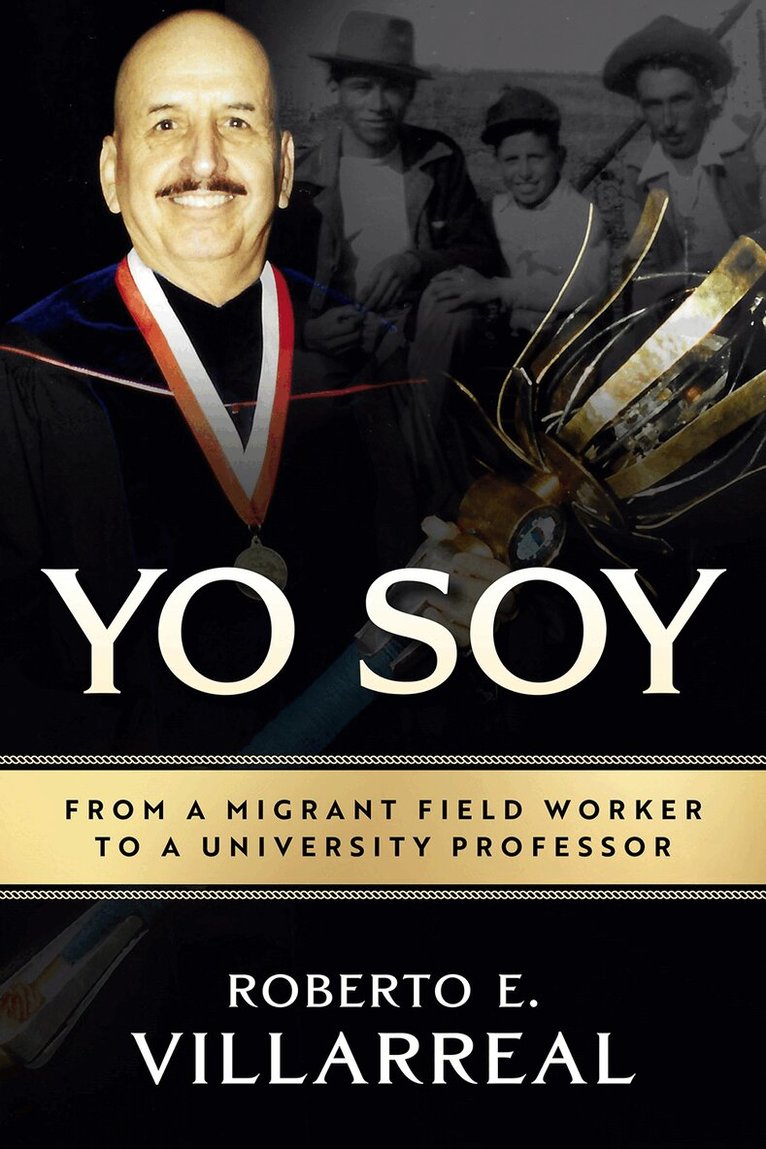
Yo Soy is a memoir of Roberto E. Villarreal’s life struggle for social justice and equality and a reclamation of his ancestry, language, and culture, forbidden by the Texas state school policies during his childhood in the 1930s. Racism, bigotry, violence, and subordination formed a shell difficult to overcome. The “Mexican problem,” as it was known, was deeply ingrained in the life of the Anglo community, creating a perpetual labor class. As a result, Mexican Americans were poverty-stricken sharecroppers and migrants, with a complete disconnect between families and the school system.This was the setting in South Texas where Villarreal grew up in the 1930s to 1950s. His desire to learn English and the American culture were blocked by various obstacles, such as school attendance in the spring semester only and migrant work in lieu of a fall semester. The best route for success was a formal education, but many Hispanic students dropped out of school at the fourth or fifth grade. Villarreal, however, fought to surmount the odds and an internal lack of confidence in order to achieve the highest level of education possible.Despite numerous struggles, frustrations, and animosities with others in education, Villarreal first graduated from elementary school at the age of 18 and high school at 22. He soon became an unprepared university student but proceeded to acquire a bachelor’s degree in four years, followed by two master’s degrees and a PhD. In the process he taught migrants and elementary, high school, community college, and university-level students. While at the University of Texas at El Paso, Villarreal became highly productive as a teacher, author, administrator, president of the University Graduate Council, Fulbright Scholar, and community activist. Ultimately, the efforts of his generation’s entry into higher education brought greater integration between Anglos and Mexican Americans, better access to universities, greater graduation rates, and larger recognition and importance to the Mexican American community.