Roger Caillois - Böcker
Visar alla böcker från författaren Roger Caillois. Handla med fri frakt och snabb leverans.
10 produkter
10 produkter
252 kr
Skickas
According to Roger Caillois, play is "an occasion of pure waste: waste of time, energy, ingenuity, skill, and often of money." In spite of this--or because of it--play constitutes an essential element of human social and spiritual development. In this classic study, Caillois defines play as a free and voluntary activity that occurs in a pure space, isolated and protected from the rest of life. Play is uncertain, since the outcome may not be foreseen, and it is governed by rules that provide a level playing field for all participants. In its most basic form, play consists of finding a response to the opponent's action--or to the play situation--that is free within the limits set by the rules. Caillois qualifies types of games-- according to whether competition, chance, simulation, or vertigo (being physically out of control) is dominant--and ways of playing, ranging from the unrestricted improvisation characteristic of children's play to the disciplined pursuit of solutions to gratuitously difficult puzzles. Caillois also examines the means by which games become part of daily life and ultimately contribute to various cultures their most characteristic customs and institutions. Presented here in Meyer Barash's superb English translation, Man, Play and Games is a companion volume to Caillois's Man and the Sacred.
230 kr
Skickas inom 7-10 vardagar
Throughout the world, people believe that much of what they do is accidental, ordinary, and inconsequential, while other acts can bring on divine retribution or earn eternal grace. In Man and the Sacred, Caillois demonstrates how humanity's ambiguous attitude toward the sacred influences behavior and culture. Drawing on a diverse array of ethnographic contexts, including the sexual rituals of the Ba-Thong of South Africa and evidence drawn from aboriginal Australian, Eskimo, and traditional Chinese social systems, Caillois analyzes the role of the forbidden in the social cohesion of the group. He examines the character of the sacred in the light of specific instances of taboos and transgressions, exploring wide differences in attitudes toward diet and sex and extreme behaviors associated with the sacred, such as rapture and paroxysm. He also discusses the festival--an exuberant explosion following a period of strict repression--and compares its functions with those of modern war. A classic study of one of the most fundamental aspects of human social and spiritual life, Man and the Sacred--presented here in Meyer Barash's superb English translation--is a companion volume to Caillois's Man, Play and Games.
389 kr
Skickas inom 7-10 vardagar
The study of dreams and their role in human societies, particularly within classical Islam, provides a fascinating lens through which to understand both individual and collective psychology. In medieval Islamic culture, dreams were seen not only as personal experiences but as profound communications from the divine or supernatural. This belief system imbued the dream with cognitive power, often interpreting dreams as forms of prophecy or divine messages, a view that transcended the individual's inner psyche and extended into the realm of objective truth. Dreams were considered a bridge to understanding the future, the Hereafter, and the will of God, with scholars like ‘Abdalghani an-Nâbulusî developing elaborate systems for interpreting their meanings. These interpretations drew heavily from religious texts, such as the Koran and Hadith, and offered guidance on a variety of matters ranging from personal conduct to political affairs.The significance of dreams within classical Islam is also evident in their societal and political implications. Dreams were not only seen as personal revelations but also as instruments of prophecy, often used to predict the death of rulers, the success of military campaigns, or the outcomes of political struggles. They were deeply intertwined with religious doctrines, with the Prophet Muhammad and various saints appearing in dreams to guide or advise key figures in Islamic history. These dream visions were viewed as essential tools for navigating both the personal and political spheres, reinforcing the belief that the dream world was closely linked with the divine order. The widespread acceptance of dreams as a form of truth is a striking contrast to contemporary Western thought, where dreams are more commonly seen as reflections of the subconscious mind. In this sense, the historical and cultural context of classical Islam elevated the dream to a status that intertwined it with both personal and societal identity, suggesting a powerful intersection of religion, politics, and individual experience.This title is part of UC Press's Voices Revived program, which commemorates University of California Press’s mission to seek out and cultivate the brightest minds and give them voice, reach, and impact. Drawing on a backlist dating to 1893, Voices Revived makes high-quality, peer-reviewed scholarship accessible once again using print-on-demand technology. This title was originally published in 1966.
733 kr
Skickas inom 7-10 vardagar
The study of dreams and their role in human societies, particularly within classical Islam, provides a fascinating lens through which to understand both individual and collective psychology. In medieval Islamic culture, dreams were seen not only as personal experiences but as profound communications from the divine or supernatural. This belief system imbued the dream with cognitive power, often interpreting dreams as forms of prophecy or divine messages, a view that transcended the individual's inner psyche and extended into the realm of objective truth. Dreams were considered a bridge to understanding the future, the Hereafter, and the will of God, with scholars like ‘Abdalghani an-Nâbulusî developing elaborate systems for interpreting their meanings. These interpretations drew heavily from religious texts, such as the Koran and Hadith, and offered guidance on a variety of matters ranging from personal conduct to political affairs.The significance of dreams within classical Islam is also evident in their societal and political implications. Dreams were not only seen as personal revelations but also as instruments of prophecy, often used to predict the death of rulers, the success of military campaigns, or the outcomes of political struggles. They were deeply intertwined with religious doctrines, with the Prophet Muhammad and various saints appearing in dreams to guide or advise key figures in Islamic history. These dream visions were viewed as essential tools for navigating both the personal and political spheres, reinforcing the belief that the dream world was closely linked with the divine order. The widespread acceptance of dreams as a form of truth is a striking contrast to contemporary Western thought, where dreams are more commonly seen as reflections of the subconscious mind. In this sense, the historical and cultural context of classical Islam elevated the dream to a status that intertwined it with both personal and societal identity, suggesting a powerful intersection of religion, politics, and individual experience.This title is part of UC Press's Voices Revived program, which commemorates University of California Press’s mission to seek out and cultivate the brightest minds and give them voice, reach, and impact. Drawing on a backlist dating to 1893, Voices Revived makes high-quality, peer-reviewed scholarship accessible once again using print-on-demand technology. This title was originally published in 1966.
356 kr
Skickas inom 7-10 vardagar
If you thought you knew all there is to know about Pontius Pilate and Jesus, this little book has some surprises for you. In this ""greatest story never told,"" Pontius Pilate finally gets a chance to tell his side of the story, filling in what the Bible left out. For someone who made one of the most momentous decisions of all time, we know almost nothing about him. Who was this man who sentenced Jesus to death? What went through his mind as he weighed the alternatives? Was he a villain or a victim of circumstance? If we can imagine Pilate as our contemporary, what would we have done in his place? Written by one of France's great men of letters of the twentieth century, ""Pontius Pilate"" is a highly provocative and psychologically gripping novel that reconstructs Pilate's state of mind in deciding to convict Jesus. Taking his place alongside the authors of other such ""sacred fantasies"" as Nikos Kazantzakis (""The Last Temptation of Christ"") and Dan Brown (""The Da Vinci Code""), the surrealist Roger Caillois conjures countless plausible dramas of the ""what ifs"" that might have played out inside Pilate's mind during the final twenty-four hours before he decided Jesus's fate. Transgressive, disconcerting, and original, ""Pontius Pilate"" provides a fascinating opportunity to contemplate the mind of a man who, with one decision, arguably changed the course of human history. It explores the interplay of politics and conscience, fundamentalism and cosmopolitanism, and fanaticism and pragmatism - themes even more compelling today than they were forty-some years ago when the book was originally published. With an introduction by the religion scholar Ivan Strenski, this new American edition of Charles Lam Markmann's original English translation (published in 1963 and long since out of print) makes available once again for the English-language reading public a remarkable work of intelligence, wit, and imagination. ""Pontius Pilate"" offers an engaging and climactic read for anyone interested in the interplay of religion and culture and in the mysteries of this pinnacle moment in the biblical narrative.
1 674 kr
Skickas inom 7-10 vardagar
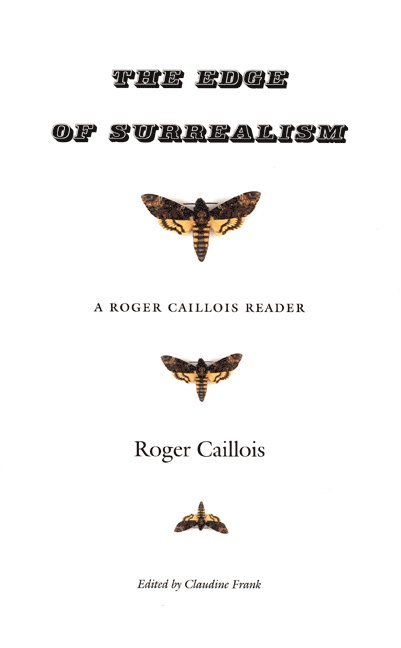
The Edge of Surrealism is an essential introduction to the writing of French social theorist Roger Caillois. Caillois was part of the Surrealist avant-garde and in the 1930s founded the College of Sociology with Georges Bataille and Michel Leiris. He spent his life exploring issues raised by this famous group and by Surrealism itself. Though his subjects were diverse, Caillois focused on concerns crucial to modern intellectual life, and his essays offer a unique perspective on many of twentieth-century France’s most significant intellectual movements and figures. Including a masterful introductory essay by Claudine Frank situating his work in the context of his life and intellectual milieu, this anthology is the first comprehensive introduction to Caillois’s work to appear in any language. These thirty-two essays with commentaries strike a balance between Caillois’s political and theoretical writings and between his better known works, such as the popular essays on the praying mantis, myth, and mimicry, and his lesser-known pieces. Presenting several new pieces and drawing on interviews and unpublished correspondence, this book reveals Caillois’s consistent effort to reconcile intellectual rigor and imaginative adventure. Perhaps most importantly, The Edge of Surrealism provides an overdue look at how Caillois’s intellectual project intersected with the work of Georges Bataille and others including Breton, Bachelard, Benjamin, Lacan, and LÉvi-Strauss.
606 kr
Skickas inom 3-6 vardagar
The Edge of Surrealism is an essential introduction to the writing of French social theorist Roger Caillois. Caillois was part of the Surrealist avant-garde and in the 1930s founded the College of Sociology with Georges Bataille and Michel Leiris. He spent his life exploring issues raised by this famous group and by Surrealism itself. Though his subjects were diverse, Caillois focused on concerns crucial to modern intellectual life, and his essays offer a unique perspective on many of twentieth-century France’s most significant intellectual movements and figures. Including a masterful introductory essay by Claudine Frank situating his work in the context of his life and intellectual milieu, this anthology is the first comprehensive introduction to Caillois’s work to appear in any language. These thirty-two essays with commentaries strike a balance between Caillois’s political and theoretical writings and between his better known works, such as the popular essays on the praying mantis, myth, and mimicry, and his lesser-known pieces. Presenting several new pieces and drawing on interviews and unpublished correspondence, this book reveals Caillois’s consistent effort to reconcile intellectual rigor and imaginative adventure. Perhaps most importantly, The Edge of Surrealism provides an overdue look at how Caillois’s intellectual project intersected with the work of Georges Bataille and others including Breton, Bachelard, Benjamin, Lacan, and LÉvi-Strauss.
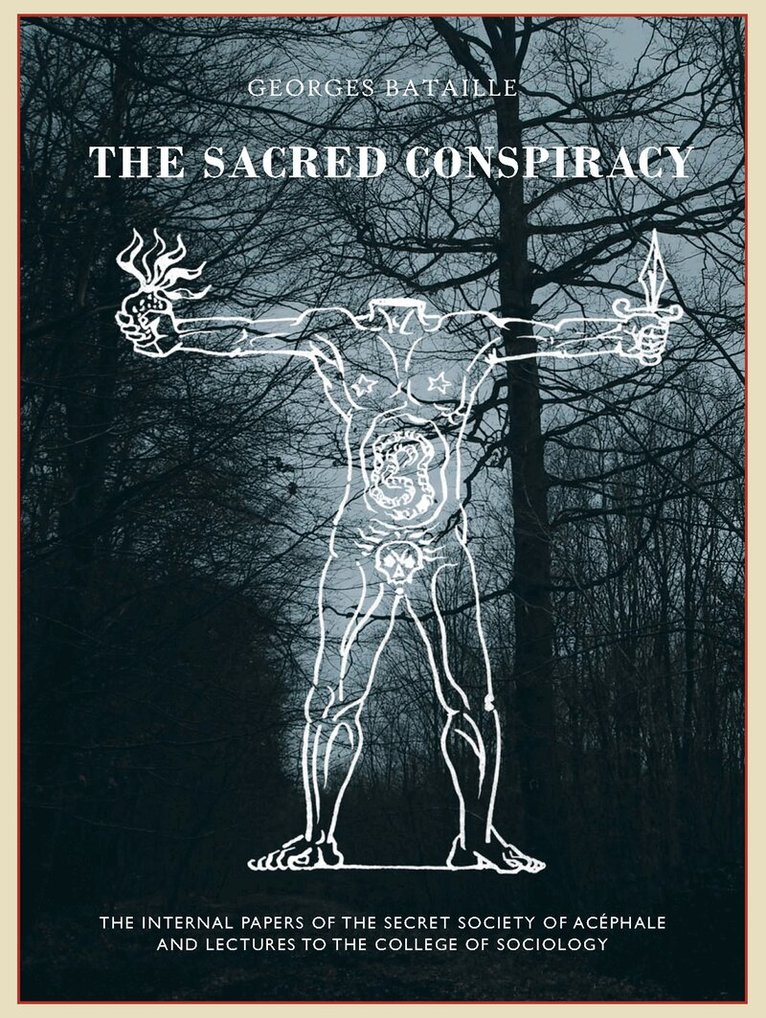
The Sacred Conspiracy
The Internal Papers of the Secret Society of Acéphale and Lectures to the College of Sociology
Inbunden, Engelska, 2018
370 kr
Skickas
256 kr
Skickas inom 3-6 vardagar
256 kr
Skickas inom 3-6 vardagar