Ronald Aronson - Böcker
Visar alla böcker från författaren Ronald Aronson. Handla med fri frakt och snabb leverans.
5 produkter
5 produkter
199 kr
Skickas inom 7-10 vardagar
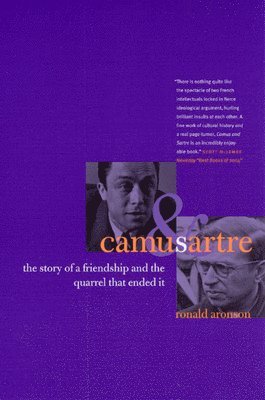
Albert Camus and Jean-Paul Sartre first met in 1943, during the German occupation of France. Intellectual as well as political allies, they grew famous overnight after Paris was liberated. But East West tensions began to strain their friendship as they evolved in opposing directions, disagreeing over philosophy, the responsibilities of intellectuals, and what sorts of political changes were necessary or possible. And while Sartre embraced violence as a path to change, Camus sharply opposed it, leading to a bitter and very public falling out in 1952, after which they never spoke again. Ronald Aronson chronicles this riveting story while demonstrating how Camus and Sartre developed first in connection with and then against each other, each keeping the other in his sights long after their break. Combining biography and intellectual history, philosophical and political passion, Camus and Sartre will fascinate anyone interested in these great writers or the world-historical issues that tore them apart.
763 kr
Tillfälligt slut
As a lifelong radical and political activist, Ronald Aronson accepted an invitation to lecture in South Africa only after two years of deliberation. "Stay Out of Politics," which begins with the moral questions that Aronson confronted in his decision to go, is a reaffirmation of the necessity for majority rule and the abolition of apartheid. Amidst the pressure of widespread talk of an academic boycott of South Africa, Aronson decided to lecture there as a contribution to the struggle for majority rule. He decided to become mobilized as a philosopher and activist by engaging in the effort close at hand rather than settling for a distant and comfortable protest by avoidance. Along with his visa, Aronson was given the following warning by a consular officer: "Stay out of politics!" Believing that philosophy not only has a role to play but that it can, and must, involve itself in the vital social and political issues of our time, Aronson equally discovered that in South Africa politics is everywhere and inescapable. The lectures Aronson delivered focused on the meaning of progress and hope, on the threat—and experience—of disaster today, and on our responsibility to join the struggle for a humane and rational world. Two of the most provocative lectures are included here, the first a discussion of the Holocaust that has direct and intentional applications to the current situation in South Africa. The second lecture, in memory of the assassinated political philosopher Richard Turner, is a sketch of Aronson's philosophy of hope as seen from within the South African context. Despite the limitations of teaching under possible surveillance in a revolutionary situation, Aronson witnessed the social reality of apartheid and heard the voices of its victims. Aronson's love for the South African people motivated him to write this powerful account. He presents a lecturer's tour of South Africa: the experiences that both confirmed his belief in the urgent need for majority rule but also revealed the complexities of the society that seeks to continue apartheid through all reforms; and his philosopher's reflections upon returning to the United States on the irrationality of apartheid and the ambiguities of the struggle to end it. "Stay Out of Politics" is not only a powerful encounter with South Africa today, it is a provocative statement about philosophy—its nature, its tasks, its duty to understand and change the world in which we live.
219 kr
Skickas inom 7-10 vardagar
What was it about Barack Obama's campaign of hope that resonated so much not just with Americans, but people the world over? Have we really become so despairing in the face of collapsed economies and the threat of violence around every corner that a simple rallying cry to remember hope can have such a powerful effect? In this moving and thoughtful book, Ronald Aronson explores our relationship to hope at a time some have called the end of history, others the end of politics, in order to formulate a more active stance, one in which hope is far more than a mood or feeling it is the very basis of social will and political action. Aronson examines our own heartbreaking story: a century of violence, upheaval, and the undelivered promises of progress all of which have contributed to the evaporation of social hope. As he shows, we are now in an era when hope has been privatized, when despite all the ways we are connected to each other we are desperately alone, struggling to weather the maelstrom around us, demoralized by the cynicism that permeates our culture and politics, and burdened with finding personal solutions to social problems. Yet social hope, Aronson argues, still persists.Carefully exploring what we mean when we say we "hope" and teasing hope apart from its dangerously misconstrued sibling, progress, he locates real seeds of change. He argues that always underlying our experience even if we completely ignore it is a sense of social belonging, and that this can be reactivated into a powerful collective force, an active we. He looks to various political movements, from the massive collective force of environmentalists to the stunning rise of movement-centered politicians such as Bernie Sanders and Jeremy Corbyn, as powerful examples of socially energized, politically determined, and actionably engaged forms of hope. The result is an illuminating and inspiring call that anyone can clearly hear: we can still create a better future for ourselves, but only if we do it together.
156 kr
Skickas inom 7-10 vardagar
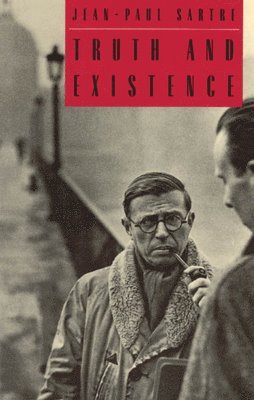
Truth and Existence, written in response to Martin Heidegger's Essence of Truth, is a product of the years when Sartre was reaching full stature as a philosopher, novelist, playwright, essayist, and political activist. This concise and engaging text not only presents Sartre's ontology of truth but also addresses the key moral questions of freedom, action, and bad faith. Truth and Existence is introduced by an extended biographical, historical, and analytical essay by Ronald Aronson. "Truth and Existence is another important element in the recently published links between Sartre's existentialist ontology and his later ethical, political, and literary concerns...The excellent introduction by Aronson will help readers not experienced in reading Sartre."--Choice "Accompanied by an excellent introduction, this dense, lucidly translated treatise reveals Sartre as a characteristically 20th-century figure."--Publishers Weekly
Living Without God: New Directions for Atheists, Agnostics, Secularists, and the Undecided
Häftad, Engelska, 2009
239 kr
Skickas inom 3-6 vardagar