Ronald G. Knapp - Böcker
Visar alla böcker från författaren Ronald G. Knapp. Handla med fri frakt och snabb leverans.
10 produkter
10 produkter
566 kr
Skickas inom 11-20 vardagar
The Hermit’s Hut offers an original insight into the profound relationship between architecture and asceticism. Although architecture continually responds to ascetic compulsions, as in its frequent encounter with the question of excess and less, it is typically considered separate from asceticism. In contrast, this innovative book explores the rich and mutual ways in which asceticism and architecture are played out in each other’s practices. The question of asceticism is also considered—as neither a religious discourse nor a specific cultural tradition but as a perennial issue in the practice of culture. The work convincingly traces the influences from early Indian asceticism to Zen Buddhism to the Japanese teahouse—the latter opening the door to modern minimalism. As the book’s title suggests, the protagonist of the narrative is the nondescript hermit’s hut. Relying primarily on Buddhist materials, the author provides a complex narrative that stems from this simple structure, showing how the significance of the hut resonates widely and how the question of dwelling is central to ascetic imagination. In exploring the conjunctions of architecture and asceticism, he breaks new ground by presenting ascetic practice as fundamentally an architectural project, namely the fabrication of a “last” hut. Through the conception of the last hut, he looks at the ascetic challenge of arriving at the edge of civilization and its echoes in the architectural quest for minimalism. The most vivid example comes from a well-known Buddhist text where the Buddha describes the ultimate ascetic moment, or nirvana, in cataclysmic terms using architectural metaphors: “The roof-rafters will be shattered”, the Buddha declares, and the architect will “no longer build the house again”. As the book compellingly shows, the physiological and spiritual transformation of the body is deeply intertwined with the art of building. The Hermit’s Hut weaves together the fields of architecture, anthropology, religion, and philosophy to offer multidisciplinary and historical insights. Written in an engaging and accessible manner, it will appeal to readers with diverse interests and in a variety of disciplines—whether one is interested in the history of ascetic architecture in India, the concept of “home” in ancient India, or the theme of the body as building.
305 kr
Skickas inom 11-20 vardagar
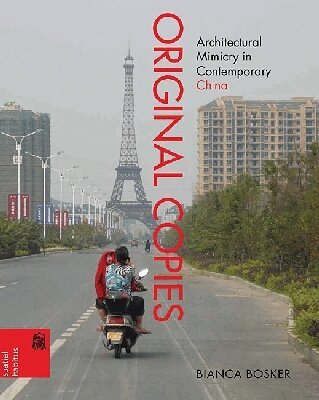
A 108-meter high Eiffel Tower rises above Champs Elysées Square in Hangzhou. A Chengdu residential complex for 200,000 recreates Dorchester, England. An ersatz Queen’s Guard patrols Shanghai’s Thames Town, where pubs and statues of Winston Churchill abound. Gleaming replicas of the White House dot Chinese cities from Fuyang to Shenzhen. These examples are but a sampling of China’s most popular and startling architectural movement: the construction of monumental themed communities that replicate towns and cities in the West.Original Copies presents the first definitive chronicle of this remarkable phenomenon in which entire townships appear to have been airlifted from their historic and geographic foundations in Europe and the Americas, and spot-welded to Chinese cities. These copycat constructions are not theme parks but thriving communities where Chinese families raise children, cook dinners, and simulate the experiences of a pseudo-Orange County or Oxford.In recounting the untold and evolving story of China’s predilection for replicating the greatest architectural hits of the West, Bianca Bosker explores what this unprecedented experiment in “duplitecture” implies for the social, political, architectural, and commercial landscape of contemporary China. With her lively, authoritative narrative, the author shows us how, in subtle but important ways, these homes and public spaces shape the behavior of their residents, as they reflect the achievements, dreams, and anxieties of those who inhabit them, as well as those of their developers and designers.From Chinese philosophical perspectives on copying to twenty-first century market forces, Bosker details the factors giving rise to China’s new breed of building. Her analysis draws on insights from the world’s leading architects, critics and city planners, and on interviews with the residents of these developments.
752 kr
Skickas inom 7-10 vardagar
Between the fall of the Han dynasty in 220 CE and the year 600, more than thirty dynasties, kingdoms, and states rose and fell on the eastern side of the Asian continent. The founders and rulers of those polities represented the spectrum of peoples in North, East, and Central Asia. Nearly all of them built palaces, altars, temples, tombs, and cities, and almost without exception, the architecture was grounded in the building tradition of China.Illustrated with colour and black-and-white photographs, maps, and drawings, Chinese Architecture in an Age of Turmoil uses all available evidence—Chinese texts, secondary literature in six languages, excavation reports, and most important, physical remains—to present the architectural history of this tumultuous period in China’s history. Its author, Nancy Shatzman Steinhardt, arguably North America’s leading scholar of pre-modern Chinese architecture, has done field research at nearly every site mentioned, many of which were unknown twenty years ago and have never been described in a Western language.The physical remains are a handful of pagodas, dozens of cave-temples, thousands of tombs, small-scale evidence of architecture such as sarcophaguses, and countless representations of buildings in paint and relief sculpture. Together they narrate an expansive architectural history that offers the first in-depth study of the development, century-by-century, of Chinese architecture of third through the sixth centuries, plus a view of important buildings from the two hundred years before the third century and the resolution of architecture of this period in later construction. The subtext of this history is an examination of Chinese architecture that answers fundamental questions such as: What was achieved by a building system of standardized components? Why has this building tradition of perishable materials endured so long in China? Why did it have so much appeal to non-Chinese empire builders? Does contemporary architecture of Korea and Japan enhance our understanding of Chinese construction? How much of a role did Buddhism play in construction during the period under study? In answering these questions, the book focuses on the relation between cities and monuments and their heroic or powerful patrons, among them Cao Cao, Shi Hu, Empress Dowager Hu, Gao Huan, and lesser-known individuals. Specific and uniquely Chinese aspects of architecture are explained. The relevance of sweeping—and sometimes uncomfortable—concepts relevant to the Chinese architectural tradition such as colonialism, diffusionism, and the role of historical memory also resonate though the book.Published in association with Hong Kong University Press, China.
331 kr
Skickas inom 11-20 vardagar
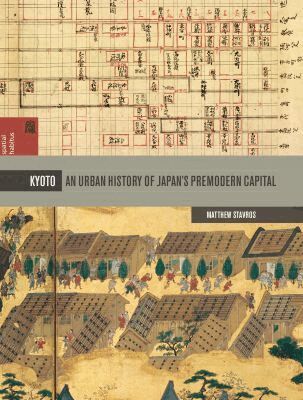
Kyoto was Japan’s political and cultural capital for more than a millennium before the dawn of the modern era. Until about the fifteenth century, it was also among the world’s largest cities and, as the eastern terminus of the Silk Road, it was a place where the political, artistic, and religious currents of Asia coalesced and flourished. Despite these and many other traits that make Kyoto a place of both Japanese and world historical significance, the physical appearance of the premodern city remains largely unknown. Through a synthesis of textual, pictorial, and archeological sources, this work attempts to shed light on Kyoto’s premodern urban landscape with the aim of opening up new ways of thinking about key aspects of premodern Japanese history.The book begins with an examination of Kyoto’s highly idealized urban plan (adapted from Chinese models in the eighth century) and the reasons behind its eventual failure. The formation of the suburbs of Kamigy? and Shimogy? is compared to the creation of large exurban temple-palace complexes by retired emperors from the late eleventh century. Each, it is argued, was a material manifestation of the advancement of privatized power that inspired a medieval discourse aimed at excluding “outsiders.” By examining this discourse, a case is made that medieval power holders, despite growing autonomy, continued to see the emperor and classical state system as the ultimate sources of political legitimacy. This sentiment was shared by the leaders of the Ashikaga shogunate, who established their headquarters in Kyoto in 1336. The narrative examines how these warrior leaders interacted with the capital’s urban landscape, revealing a surprising degree of deference to classical building protocols and urban codes. Remaining chapters look at the dramatic changes that took place during the Age of Warring States (1467–1580s) and Kyoto’s postwar revitalization under the leadership of Oda Nobunaga and Toyotomi Hideyoshi. Nobunaga’s construction of Nij? Castle in 1569 transformed Kyoto’s fundamental character and, as Japan’s first castle town, it set an example soon replicated throughout the archipelago. In closing, the book explores how Hideyoshi—like so many before him, yet with much greater zeal—used monumentalism to co-opt and leverage the authority of Kyoto’s traditional institutions.Richly illustrated with original maps and diagrams, Kyoto is a panoramic examination of space and architecture spanning eight centuries. It narrates a history of Japan’s premodern capital relevant to the fields of institutional history, material culture, art and architectural history, religion, and urban planning. Students and scholars of Japan will be introduced to new ways of thinking about old historical problems while readers interested in the cities and architecture of East Asia and beyond will benefit from a novel approach that synthesizes a wide variety of sources.
793 kr
Skickas inom 7-10 vardagar
Timber-framed architecture has long been viewed as an embodiment of Chinese civilization, a hierarchic society ruled by Confucian orthodoxy. Throughout its history, Chinese architectural design was closely regulated by court-enforced building codes, which created a highly standardized and modularized system. In Diversity in the Great Unity - the first in-depth English-language work to present regional traditions of Chinese architecture based on a detailed study of the timber construction system - Lala Zuo maintains that during the nearly century-long Yuan dynasty (1271–1368), the tradition of “Han-Chinese” architecture as coded, uniform, and controlled by the central government did not take hold. She presents case studies of twenty buildings along the Yangtze River built during the Yuan, often considered a transitional phase in Chinese architectural history. Most of the structures have firm dates, and all are analyzed according to patronage, chronology, and function. Their representativeness is determined by their broad geographic distribution as well as by their scarcity. Numerous photographs and line-drawings accompany the analyses. Referencing Yuan architecture in north China along the Yellow River, Zuo outlines its characteristics in three regions and connects the regional traditions to periods before and after the Yuan, allowing her to contextualize architecture in Yuan social and political history. She explains how the division of regional traditions, especially those in the south, contributed to the transformation of dynastic styles from the Song (960–1279) to the Ming (1368–1644) and how the Song-Yuan migration may have affected architectural design.An appendix presents an extensive glossary of Chinese architectural terms in Song terminology to enable a better understanding of the subject. Although the primary focus of this book is the technical evolution of surviving Yuan architecture, its interdisciplinary approach goes beyond architecture by offering a re-evaluation of Chinese society in light of cultural and religious diversity under Mongol rule.
820 kr
Skickas inom 7-10 vardagar
Utopia" is a word not often associated with the city of Bangkok, which is better known for its disorderly sprawl, overburdened roads, and stifling levels of pollution. Yet as early as 1782, when the city was officially founded on the banks of the Chao Phraya river as the home of the Chakri dynasty, its orientation was based on material and rhetorical considerations that alluded to ideal times and spaces. The construction of palaces, monastic complexes, walls, forts, and canals created a defensive network while symbolically locating the terrestrial realm of the king within the Theravada Buddhist cosmos. Into the twentieth century, pictorial, narrative, and built representations of utopia were critical to Bangkok's transformation into a national capital and commercial entrepôt. But as older representations of the universe encountered modern architecture, building technologies, and urban planning, new images of an ideal society attempted to reconcile urban-based understandings of Buddhist liberation and felicitous states like nirvana with worldly models of political community like the nation-state.Bangkok Utopia outlines an alternative genealogy of both utopia and modernism in a part of the world that has often been overlooked by researchers of both. It examines representations of utopia that developed in the city-as expressed in built forms as well as architectural drawings, building manuals, novels, poetry, and ecclesiastical murals-from its first general strike of migrant laborers in 1910 to the overthrow of the military dictatorship in 1973. Using Thai- and Chinese-language archival sources, the book demonstrates how the new spaces of the city became arenas for modern subject formation, utopian desires, political hegemony, and social unrest, arguing that the modern city was a space of antinomy-one able not only to sustain heterogeneous temporalities, but also to support conflicting world views within the urban landscape. By underscoring the paradoxical character of utopias and their formal narrative expressions of both hope and hegemony, Bangkok Utopia provides an innovative way to conceptualize the uneven economic development and fractured political conditions of contemporary global cities.
1 059 kr
Skickas inom 3-6 vardagar
This is the first English-language study devoted to dougong, the block-bracket cluster widely regarded as the epitome of traditional Chinese architecture. For almost two millennia, dougong have been central to the multipartite frame structure of wooden buildings, connecting columns with beams, supporting projecting eaves, and providing resistance to earthquake damage. They have enabled and required builders to ensure both the functionality and the moral dimension of their designs through the thoughtful use of appropriately graded timbers and corresponding methods of modular design that determine the size and quality of a building in keeping with the social standing of its owner.Richly illustrated with original high-quality photographs and drawings, this book explores the engaging story of dougong as technical artifacts that embody Chinese culture. Alexandra Harrer delves into the previously unresolved relationship between standard dougong and their regional and local variations in the rhetoric of Chinese construction, offering an alternative to sociopolitical caste as a means of interpreting these differences. She untangles the lengthy selection process and trial-and-error development of the block-bracket cluster before codification to reveal how design idiosyncrasies derived from an unlikely combination of legal codes and ethical imperatives. For example, dougong with arms projecting at a 45- or 60-degree angle from the wall plane—long dismissed as unorthodox—are shown to be a subtle design expression that yields to authority while it seeks to exploit archi-cultural standards. Harrer argues that the ethical dimensions of graphic shapes and the culturally charged space that dougong occupy are key to understanding this creative process.
Theodore Burr and the Bridging of Early America
The Man, Fellow Bridge Builders, and Their Forgotten Timber Spans
Häftad, Engelska, 2023
765 kr
Skickas inom 5-8 vardagar
Theodore Burr and the Bridging of Early America
The Man, Fellow Bridge Builders, and Their Forgotten Timber Spans
Inbunden, Engelska, 2023
797 kr
Skickas inom 5-8 vardagar
711 kr
Skickas inom 7-10 vardagar
China’s Covered Bridges: Architecture over Water is the first book in English to examine comprehensively one of the three great covered bridge traditions in the world. Based on decades of observation and ten years of intensive field research throughout China, this book illuminates countless covered bridges that have never been presented in a Western language.Terry E. Miller, Ronald G. Knapp, and A. Chester Ong, whose America’s Covered Bridges: Practical Crossings, Nostalgic Icons, broke new ground, have joined here with Liu Jie, China’s leading timber covered bridge scholar. This team has traveled in areas rarely visited by others to document a living tradition whose roots go deep into Chinese history.Long before professional engineers analyzed bridge structure mechanically, early builders in China, as in North America and Europe, solved the daunting problem of spanning deep ravines and wild rivers to facilitate the flow of pedestrians, animals, and vehicles. Their collective, yet independent, efforts represent the triumph of ingenuity and common sense. Although there has been no census of covered bridges, and it is impossible to calculate how many existed in the past in China, some 3,000 remain, far more than found elsewhere in the world. Wooden trusses as understood in the West were not a component of China’s bridge-building traditions. Instead, covered corridors were situated atop either a masonry base or, more significantly, supported by an ingenious assemblage of timbers. China’s Covered Bridges highlights covered bridges with a timber sub-structure, including both a variety of cantilevered forms and extraordinary "woven arch/woven arch-beam" types that until the until the last quarter of the 20th century were believed to have died out more than a millennium earlier. The story of China’s covered bridges is fascinating not only in terms of technological achievement, social functioning, and aesthetic identity. Each covered bridge in China, whether still standing or long gone, has a story to tell about the nature of rural and urban life.Thoroughly researched with a text of over 70,000 words and profusely illustrated with more than 600 historic and contemporary photographs, this book features the work of master photographer A. Chester Ong and is supplemented by photographs by the authors.Like America’s Covered Bridges, China’s Covered Bridges is written in an accessible style that will satisfy not only those with general interests but also those with more specialized knowledge.