Ronald Redmer – författare
Visar alla böcker från författaren Ronald Redmer. Handla med fri frakt och snabb leverans.
4 produkter
4 produkter
Del 96 - Lecture Notes in Computational Science and Engineering
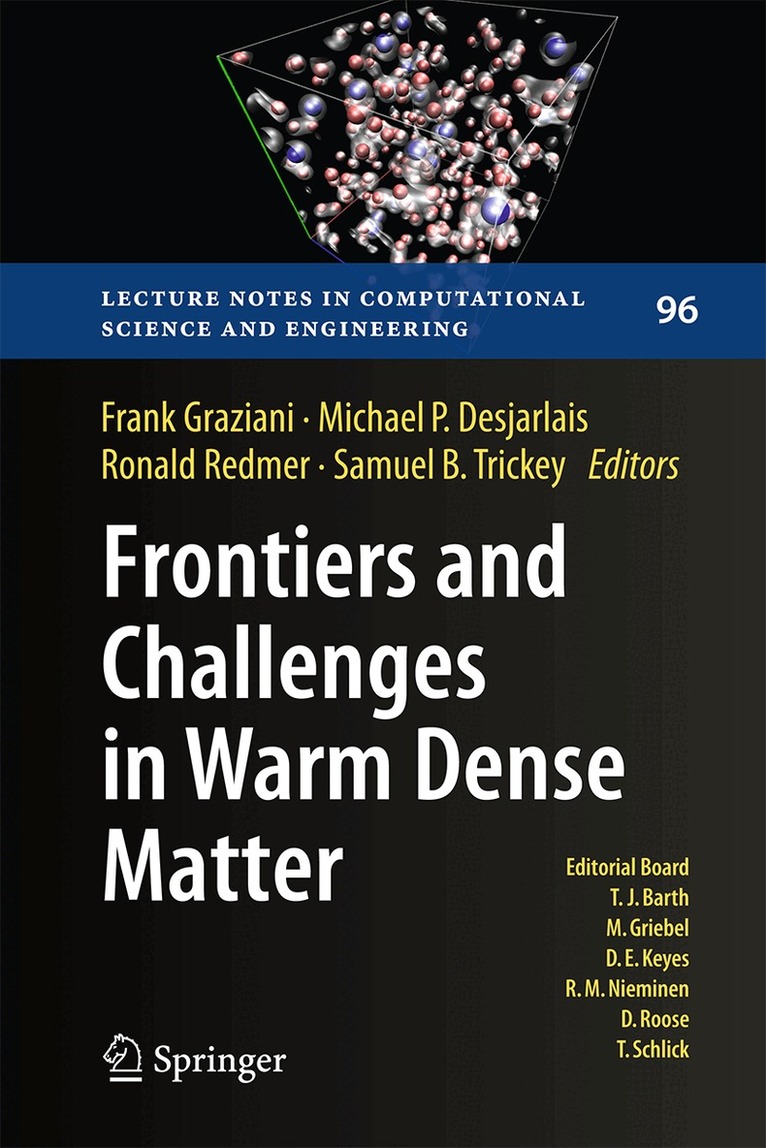
Frontiers and Challenges in Warm Dense Matter
Inbunden, Engelska, 2014
1 589 kr
Skickas inom 10-15 vardagar
Warm Dense Matter (WDM) occupies a loosely defined region of phase space intermediate between solid, liquid, gas, and plasma, and typically shares characteristics of two or more of these phases. WDM is generally associated with the combination of strongly coupled ions and moderately degenerate electrons, and careful attention to quantum physics and electronic structure is essential. The lack of a small perturbation parameter greatly limits approximate attempts at its accurate description. Since WDM resides at the intersection of solid state and high energy density physics, many high energy density physics (HEDP) experiments pass through this difficult region of phase space. Thus, understanding and modeling WDM is key to the success of experiments on diverse facilities. These include the National Ignition Campaign centered on the National Ignition Facility (NIF), pulsed-power driven experiments on the Z machine, ion-beam-driven WDM experiments on the NDCX-II, and fundamental WDM research at the Linear Coherent Light Source (LCLS). Warm Dense Matter is also ubiquitous in planetary science and astrophysics, particularly with respect to unresolved questions concerning the structure and age of the gas giants, the nature of exosolar planets, and the cosmochronology of white dwarf stars. In this book we explore established and promising approaches to the modeling of WDM, foundational issues concerning the correct theoretical description of WDM, and the challenging practical issues of numerically modeling strongly coupled systems with many degrees of freedom.
Del 96 - Lecture Notes in Computational Science and Engineering
Frontiers and Challenges in Warm Dense Matter
Häftad, Engelska, 2016
1 589 kr
Skickas inom 10-15 vardagar
Warm Dense Matter (WDM) occupies a loosely defined region of phase space intermediate between solid, liquid, gas, and plasma, and typically shares characteristics of two or more of these phases. WDM is generally associated with the combination of strongly coupled ions and moderately degenerate electrons, and careful attention to quantum physics and electronic structure is essential. The lack of a small perturbation parameter greatly limits approximate attempts at its accurate description. Since WDM resides at the intersection of solid state and high energy density physics, many high energy density physics (HEDP) experiments pass through this difficult region of phase space. Thus, understanding and modeling WDM is key to the success of experiments on diverse facilities. These include the National Ignition Campaign centered on the National Ignition Facility (NIF), pulsed-power driven experiments on the Z machine, ion-beam-driven WDM experiments on the NDCX-II, and fundamental WDM research at the Linear Coherent Light Source (LCLS). Warm Dense Matter is also ubiquitous in planetary science and astrophysics, particularly with respect to unresolved questions concerning the structure and age of the gas giants, the nature of exosolar planets, and the cosmochronology of white dwarf stars. In this book we explore established and promising approaches to the modeling of WDM, foundational issues concerning the correct theoretical description of WDM, and the challenging practical issues of numerically modeling strongly coupled systems with many degrees of freedom.
1 062 kr
Skickas inom 10-15 vardagar
Materialscanbedividedintometalsandnonmetals.Thecharacteristicfeature ofmetalslikecopperandaluminumisahighelectricalandthermalconduct- ity, while nonmetals such as phosphor and sulfur are insulators. The electrical 6 ?1 ?1 conductivity varies over many orders of magnitude, from 10 ? m for ?20 ?1 ?1 typical metals down to 10 ? m for almost ideal insulators. However, a sharp separation between metals and insulators is in general not possible. For instance, semiconducting materials such as silicon and germanium ?ll the conductivity domain between metals and insulators. Their electrical cond- tivity is dependent on temperature and,in addition, canbe variedstronglyby doping the material with donor or acceptor atoms. A famous example is the sharp insulator-to-metal transition measured in Si:P at temperatures below 18 ?3 0.1K and donor concentrations of about 3.8x10 cm phosphor atoms [1]. Furthermore, materials may exist in both states: carbon is metallic as graphite and insulating as diamond. A fascinating quantum e?ect is observed at low temperatures: some materials even loose their electrical resistivity and becomesuperconductors.Therefore,thequestionsWhatisametal?andWhen does a metal transform into a nonmetal?are of fundamental interest and - lated to many aspects of modern physics and chemistry. We refer the int- ested reader to the very nice introduction into this diverse topic given by Edwards [2].
1 062 kr
Skickas inom 10-15 vardagar
Materialscanbedividedintometalsandnonmetals.Thecharacteristicfeature ofmetalslikecopperandaluminumisahighelectricalandthermalconduct- ity, while nonmetals such as phosphor and sulfur are insulators. The electrical 6 ?1 ?1 conductivity varies over many orders of magnitude, from 10 ? m for ?20 ?1 ?1 typical metals down to 10 ? m for almost ideal insulators. However, a sharp separation between metals and insulators is in general not possible. For instance, semiconducting materials such as silicon and germanium ?ll the conductivity domain between metals and insulators. Their electrical cond- tivity is dependent on temperature and,in addition, canbe variedstronglyby doping the material with donor or acceptor atoms. A famous example is the sharp insulator-to-metal transition measured in Si:P at temperatures below 18 ?3 0.1K and donor concentrations of about 3.8x10 cm phosphor atoms [1]. Furthermore, materials may exist in both states: carbon is metallic as graphite and insulating as diamond. A fascinating quantum e?ect is observed at low temperatures: some materials even loose their electrical resistivity and becomesuperconductors.Therefore,thequestionsWhatisametal?andWhen does a metal transform into a nonmetal?are of fundamental interest and - lated to many aspects of modern physics and chemistry. We refer the int- ested reader to the very nice introduction into this diverse topic given by Edwards [2].