RoSusan D. Bartee - Böcker
Visar alla böcker från författaren RoSusan D. Bartee. Handla med fri frakt och snabb leverans.
7 produkter
7 produkter
Del 312 - Counterpoints
School Matters
Why African American Students Need Multiple Forms of Capital
Inbunden, Engelska, 2007
822 kr
Tillfälligt slut
Broken Cisterns of African American Education
Academic Performance and Achievement in the Post-Brown Era
Häftad, Engelska, 2008
520 kr
Skickas inom 7-10 vardagar
The failure of American education to achieve racial diversity has resulted from the inability of educational researchers, policy makers and judicial officials to disentangle the complex definitions that have emerged in a post-segregated society. More specifically, the capricious aim of post-segregated educational settings leads to the confusing and often conflicting interchangeable usage of terms desegregated, integrated and diversity. This ambituity is further confounded by the imprecise definitions of equity, equality and opportunity. The proposed book will examine the role of language post-Brown v. Board of Education and the effects of that language on educational policy and practice. He also examines how the fundamental implications of language within post-Brown court cases, in pre- through post-secondary education, demonstrate the unspecified outcomes for desegregation and integration while concomitantly demand an educational continuum of equitable distribution. The arguments will further interrogate how education policy and practices implicitly contain a scholarly roadmap to forge equal opportunity and access, fifty years after Brown.
Broken Cisterns of African American Education
Academic Performance and Achievement in the Post-Brown Era
Inbunden, Engelska, 2008
958 kr
Skickas inom 7-10 vardagar
The failure of American education to achieve racial diversity has resulted from the inability of educational researchers, policy makers and judicial officials to disentangle the complex definitions that have emerged in a post-segregated society. More specifically, the capricious aim of post-segregated educational settings leads to the confusing and often conflicting interchangeable usage of terms desegregated, integrated and diversity. This ambituity is further confounded by the imprecise definitions of equity, equality and opportunity. The proposed book will examine the role of language post-Brown v. Board of Education and the effects of that language on educational policy and practice. He also examines how the fundamental implications of language within post-Brown court cases, in pre- through post-secondary education, demonstrate the unspecified outcomes for desegregation and integration while concomitantly demand an educational continuum of equitable distribution. The arguments will further interrogate how education policy and practices implicitly contain a scholarly roadmap to forge equal opportunity and access, fifty years after Brown.
520 kr
Skickas inom 7-10 vardagar
The edited volume, Contemporary Perspectives on Capital in Educational Contexts, is timely in its unique and appropriate analyses of the prevailing internal and external dynamics of capital as indicative of the type of currency within institutional structures or the currency among individual stakeholders of education. The intersection of capital and currency emerges similarly and differently within the American compulsory-based system of K-12 and the choice-based system of higher education. More specifically, Contemporary Perspectives on Capital in Educational Contexts disentangles the broader challenges and opportunities of the institution of education and the individuals who comprise. Emerging insights from the analyses provide an informed basis for ascertaining the rules of engagement and means of negotiation for the respective constituencies. With that said, this volume essentially responds to three important questions: 1) What are the tenets of capital and currency in public schools and higher education?; 2 ) How do institutions and individuals navigate those tenets?; and 3) What general and specific implications do capital hold for the educational pipeline and beyond? These questions provide a useful framework for engaging critical conversations about the dynamics of capital while offering perspectives about how to improve the quality of currency in K-12 or colleges and universities. These questions further serve as a basis for eliciting more questions toward the consideration capital as both a conceptual construct and applicable model.Contemporary Perspectives on Capital in Educational Contexts, too, is an expansion of the work of School matters: Why African American students need multiple forms of capital, where Bartee & Brown (2006) examines how the acquisition and possession of capital equips African American students in a highperforming, high-achieving magnet school in Chicago for competitiveness in school-generated and non-school generated activities. Success experienced by the students and the school become associated with the academic rigor and reputation while any shortcomings reflect an inadequate capacity of the school or the student to appropriately engage the other. School matters: Why African American students need multiple forms of capital (2006) further introduces an initial exploration of different forms of capital as producer (improve the status quo through inputs), consumer (participant based upon outputs), and regulator (maintain the status quo through the process) within the educational system. The multifaceted role of capital demonstrates its span of influence for institutional and individual capacities.
958 kr
Skickas inom 7-10 vardagar
The edited volume, Contemporary Perspectives on Capital in Educational Contexts, is timely in its unique and appropriate analyses of the prevailing internal and external dynamics of capital as indicative of the type of currency within institutional structures or the currency among individual stakeholders of education. The intersection of capital and currency emerges similarly and differently within the American compulsory-based system of K-12 and the choice-based system of higher education. More specifically, Contemporary Perspectives on Capital in Educational Contexts disentangles the broader challenges and opportunities of the institution of education and the individuals who comprise. Emerging insights from the analyses provide an informed basis for ascertaining the rules of engagement and means of negotiation for the respective constituencies. With that said, this volume essentially responds to three important questions: 1) What are the tenets of capital and currency in public schools and higher education?; 2 ) How do institutions and individuals navigate those tenets?; and 3) What general and specific implications do capital hold for the educational pipeline and beyond? These questions provide a useful framework for engaging critical conversations about the dynamics of capital while offering perspectives about how to improve the quality of currency in K-12 or colleges and universities. These questions further serve as a basis for eliciting more questions toward the consideration capital as both a conceptual construct and applicable model.Contemporary Perspectives on Capital in Educational Contexts, too, is an expansion of the work of School matters: Why African American students need multiple forms of capital, where Bartee & Brown (2006) examines how the acquisition and possession of capital equips African American students in a highperforming, high-achieving magnet school in Chicago for competitiveness in school-generated and non-school generated activities. Success experienced by the students and the school become associated with the academic rigor and reputation while any shortcomings reflect an inadequate capacity of the school or the student to appropriately engage the other. School matters: Why African American students need multiple forms of capital (2006) further introduces an initial exploration of different forms of capital as producer (improve the status quo through inputs), consumer (participant based upon outputs), and regulator (maintain the status quo through the process) within the educational system. The multifaceted role of capital demonstrates its span of influence for institutional and individual capacities.
585 kr
Skickas inom 7-10 vardagar
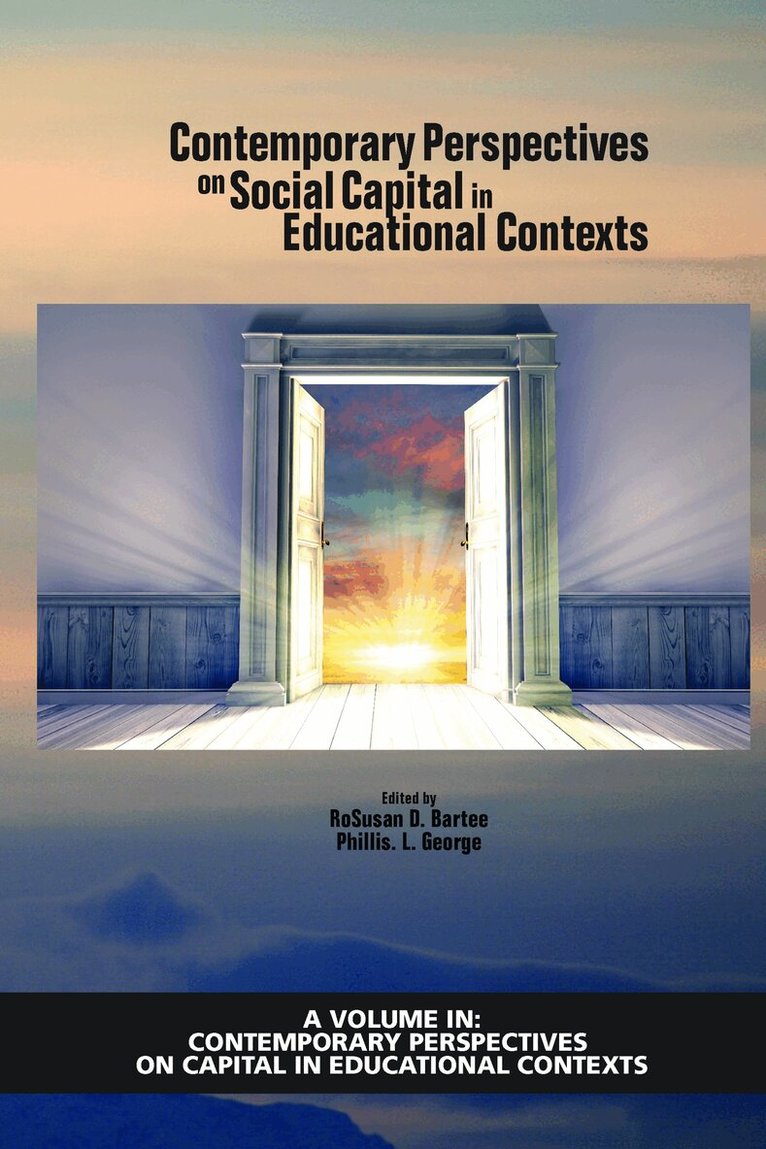
The currency of social capital serves as an important function given the capacity to generate external access (getting to) and internal accountability (getting through) for individuals and institutions alike. Pierre Bourdieu (1986) defines social capital as “the aggregate of the actual or potential resources which are linked to possession of a durable network of more or less institutionalized relationships of mutual acquaintance and recognition or in other words, to membership in a group” (p. 251). Social capital contains embedded resources as a tool for manifesting opportunities and options among individuals and groups. Inevitably, the aforementioned opportunities and options become reflective of the depth and breadth of access and accountability experienced by the individual and institution. As educational stakeholders, we must consistently challenge ourselves with the question, “How do K-12 schools and colleges and universities accomplish shared, egalitarian goals of achieving access and accountability?” Such goals become fundamental toward ensuring students matriculating through K-12 and higher education, irrespective of background, are provided the caliber of education and schooling experience to prepare them for economic mobility and social stability.To that end, the volume, Contemporary Perspectives on Social Capital in Educational Contexts (2019), as part of the book series, Contemporary Perspectives on Capital in Educational Contexts, offers a unique opportunity to explore social capital as a currency conduit for creating external access and internal accountability for K-12 and higher education. The commonalities of social capital emerging within the 12 chapters of the volume include the following: 1) Social Capital as Human Connectedness; 2) Social Capital as Strategic Advocacy; 3) Social Capital as Intentional Engagement; and 4) Social Capital as Culturally-Responsive Leadership. Thus, it becomes important for institutions of education (i.e. secondary, postsecondary, continuing) and individuals to assume efforts with intentionality and deliberateness to promote access and accountability.
1 034 kr
Skickas inom 7-10 vardagar
The currency of social capital serves as an important function given the capacity to generate external access (getting to) and internal accountability (getting through) for individuals and institutions alike. Pierre Bourdieu (1986) defines social capital as “the aggregate of the actual or potential resources which are linked to possession of a durable network of more or less institutionalized relationships of mutual acquaintance and recognition or in other words, to membership in a group” (p. 251). Social capital contains embedded resources as a tool for manifesting opportunities and options among individuals and groups. Inevitably, the aforementioned opportunities and options become reflective of the depth and breadth of access and accountability experienced by the individual and institution. As educational stakeholders, we must consistently challenge ourselves with the question, “How do K-12 schools and colleges and universities accomplish shared, egalitarian goals of achieving access and accountability?” Such goals become fundamental toward ensuring students matriculating through K-12 and higher education, irrespective of background, are provided the caliber of education and schooling experience to prepare them for economic mobility and social stability.To that end, the volume, Contemporary Perspectives on Social Capital in Educational Contexts (2019), as part of the book series, Contemporary Perspectives on Capital in Educational Contexts, offers a unique opportunity to explore social capital as a currency conduit for creating external access and internal accountability for K-12 and higher education. The commonalities of social capital emerging within the 12 chapters of the volume include the following: 1) Social Capital as Human Connectedness; 2) Social Capital as Strategic Advocacy; 3) Social Capital as Intentional Engagement; and 4) Social Capital as Culturally-Responsive Leadership. Thus, it becomes important for institutions of education (i.e. secondary, postsecondary, continuing) and individuals to assume efforts with intentionality and deliberateness to promote access and accountability.