Roundtable on Value and Science-Driven Health Care – författare
Visar alla böcker från författaren Roundtable on Value and Science-Driven Health Care. Handla med fri frakt och snabb leverans.
17 produkter
Clinical Data as the Basic Staple of Health Learning
Creating and Protecting a Public Good: Workshop Summary
Av Roundtable on Value and Science-Driven Health Care, Institute of Medicine m. fl.
E-bok, 2010
1248 kr
Lägg i varukorg
Successful development of clinical data as an engine for knowledge generation has the potential to transform health and health care in America. As part of its Learning Health System Series, the Roundtable on Value & Science-Driven Health Care hosted a workshop to discuss expanding the access to and …
Redesigning the Clinical Effectiveness Research Paradigm
Innovation and Practice-Based Approaches: Workshop Summary
Av Institute of Medicine, Roundtable on Value and Science-Driven Health Care m. fl.
Häftad, 2010
1042 kr
Lägg i varukorg
Recent scientific and technological advances have accelerated our understanding of the causes of disease development and progression, and resulted in innovative treatments and therapies. Ongoing work to elucidate the effects of individual genetic variation on patient outcomes suggests the rapid …
Redesigning the Clinical Effectiveness Research Paradigm
Innovation and Practice-Based Approaches: Workshop Summary
Av Roundtable on Value and Science-Driven Health Care, Institute of Medicine m. fl.
E-bok, 2010
1177 kr
Lägg i varukorg
Recent scientific and technological advances have accelerated our understanding of the causes of disease development and progression, and resulted in innovative treatments and therapies. Ongoing work to elucidate the effects of individual genetic variation on patient outcomes suggests the rapid …
Clinical Data as the Basic Staple of Health Learning
Creating and Protecting a Public Good: Workshop Summary
Av Roundtable on Value and Science-Driven Health Care, Institute of Medicine m. fl.
E-bok, 2010
918 kr
Lägg i varukorg
Successful development of clinical data as an engine for knowledge generation has the potential to transform health and health care in America. As part of its Learning Health System Series, the Roundtable on Value & Science-Driven Health Care hosted a workshop to discuss expanding the access to and …
Patients Charting the Course
Citizen Engagement and the Learning Health System: Workshop Summary
Av Roundtable on Value and Science-Driven Health Care, Institute of Medicine m. fl.
E-bok, 2011
937 kr
Lägg i varukorg
As past, current, or future patients, the public should be the health care system''s unwavering focus and serve as change agents in its care. Taking this into account, the quality of health care should be judged not only by whether clinical decisions are informed by the best available scientific …
Digital Infrastructure for the Learning Health System
The Foundation for Continuous Improvement in Health and Health Care: Workshop Series Summary
Av Roundtable on Value and Science-Driven Health Care, Institute of Medicine m. fl.
E-bok, 2011
928 kr
Lägg i varukorg
Like many other industries, health care is increasingly turning to digital information and the use of electronic resources. The Institute of Medicine''s Roundtable on Value & Science-Driven Health Care hosted three workshops to explore current efforts and opportunities to accelerate progress in …
Redesigning the Clinical Effectiveness Research Paradigm
Innovation and Practice-Based Approaches: Workshop Summary
Av Roundtable on Value and Science-Driven Health Care, Institute of Medicine m. fl.
E-bok, 2010
1212 kr
Lägg i varukorg
Recent scientific and technological advances have accelerated our understanding of the causes of disease development and progression, and resulted in innovative treatments and therapies. Ongoing work to elucidate the effects of individual genetic variation on patient outcomes suggests the rapid …
Patients Charting the Course
Citizen Engagement and the Learning Health System: Workshop Summary
Av Roundtable on Value and Science-Driven Health Care, Institute of Medicine m. fl.
E-bok, 2011
952 kr
Lägg i varukorg
As past, current, or future patients, the public should be the health care system''s unwavering focus and serve as change agents in its care. Taking this into account, the quality of health care should be judged not only by whether clinical decisions are informed by the best available scientific …
Digital Infrastructure for the Learning Health System
The Foundation for Continuous Improvement in Health and Health Care: Workshop Series Summary
Av Roundtable on Value and Science-Driven Health Care, Institute of Medicine m. fl.
E-bok, 2011
981 kr
Lägg i varukorg
Like many other industries, health care is increasingly turning to digital information and the use of electronic resources. The Institute of Medicine''s Roundtable on Value & Science-Driven Health Care hosted three workshops to explore current efforts and opportunities to accelerate progress in …
Digital Data Improvement Priorities for Continuous Learning in Health and Health Care
Workshop Summary
Av Roundtable on Value and Science-Driven Health Care, Institute of Medicine m. fl.
E-bok, 2013
506 kr
Lägg i varukorg
Digital health data are the lifeblood of a continuous learning health system. A steady flow of reliable data is necessary to coordinate and monitor patient care, analyze and improve systems of care, conduct research to develop new products and approaches, assess the effectiveness of medical …
Core Measurement Needs for Better Care, Better Health, and Lower Costs
Counting What Counts: Workshop Summary
Av Institute of Medicine, Roundtable on Value and Science-Driven Health Care m. fl.
Häftad, 2013
694 kr
Lägg i varukorg
Health care quality and its affordability have become very pressing issues in the United States. All sectors of the country are attempting to push forward initiatives that will improve the health care system as well as the health of the American population in general. Despite the economical …
Core Measurement Needs for Better Care, Better Health, and Lower Costs
Counting What Counts: Workshop Summary
Av Roundtable on Value and Science-Driven Health Care, Institute of Medicine m. fl.
E-bok, 2013
624 kr
Lägg i varukorg
Health care quality and its affordability have become very pressing issues in the United States. All sectors of the country are attempting to push forward initiatives that will improve the health care system as well as the health of the American population in general. Despite the economical …
Partnering with Patients to Drive Shared Decisions, Better Value, and Care Improvement
Workshop Proceedings
Av Institute of Medicine, Roundtable on Value and Science-Driven Health Care
Häftad, 2014
793 kr
Lägg i varukorg
The Institute of Medicine\'s Roundtable on Value & Science-Driven Health Care held a workshop, titled Partnering with Patients to Drive Shared Decisions, Better Value, and Care Improvement, on February 25 and 26, 2013. The workshop, supported by the Gordon and Betty Moore Foundation and the Blue …
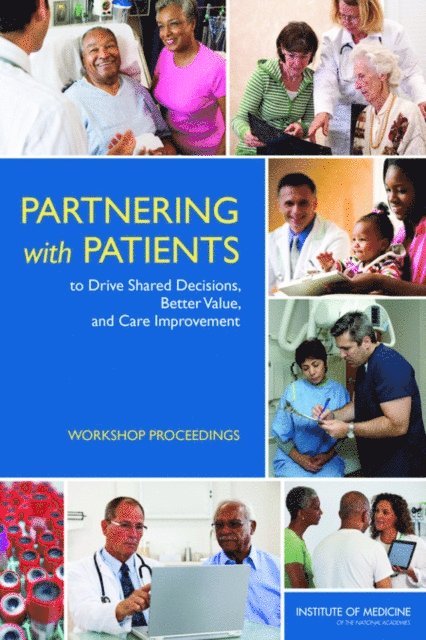
Partnering with Patients to Drive Shared Decisions, Better Value, and Care Improvement
Workshop Proceedings
Av Roundtable on Value and Science-Driven Health Care, Institute of Medicine
E-bok, 2014
716 kr
Lägg i varukorg
The Institute of Medicine\''s Roundtable on Value & Science-Driven Health Care held a workshop, titled Partnering with Patients to Drive Shared Decisions, Better Value, and Care Improvement, on February 25 and 26, 2013. The workshop, supported by the Gordon and Betty Moore Foundation and the Blue …
Large Simple Trials and Knowledge Generation in a Learning Health System
Workshop Summary
Av Roundtable on Value and Science-Driven Health Care, and Translation Forum on Drug Discovery, Development m. fl.
E-bok, 2013
541 kr
Lägg i varukorg
Randomized clinical trials (RCTs) are often referred to as the "gold standard" of clinical research. However, in its current state, the U.S. clinical trials enterprise faces substantial challenges to the efficient and effective conduct of research. Streamlined approaches to RCTs, such as large …
Observational Studies in a Learning Health System
Workshop Summary
Av A Learning Health System Activity, Roundtable on Value and Science-Driven Health Care m. fl.
E-bok, 2013
589 kr
Lägg i varukorg
Clinical research strains to keep up with the rapid and iterative evolution of medical interventions, clinical practice innovation, and the increasing demand for information on the clinical effectiveness of these advancements. In response to the growing availability of archived and real-time …
Integrating Research and Practice
Health System Leaders Working Toward High-Value Care: Workshop Summary
Av Roundtable on Value and Science-Driven Health Care, Institute of Medicine m. fl.
E-bok, 2015
663 kr
Lägg i varukorg
Health care has been called one of the most complex sectors of the U.S. economy. Driven largely by robust innovation in treatments and interventions, this complexity has created an increased need for evidence about what works best for whom in order to inform decisions that lead to safe, efficient, …